Structural Analysis: Möbius Strip

Part 2: Analysis

00:02:51

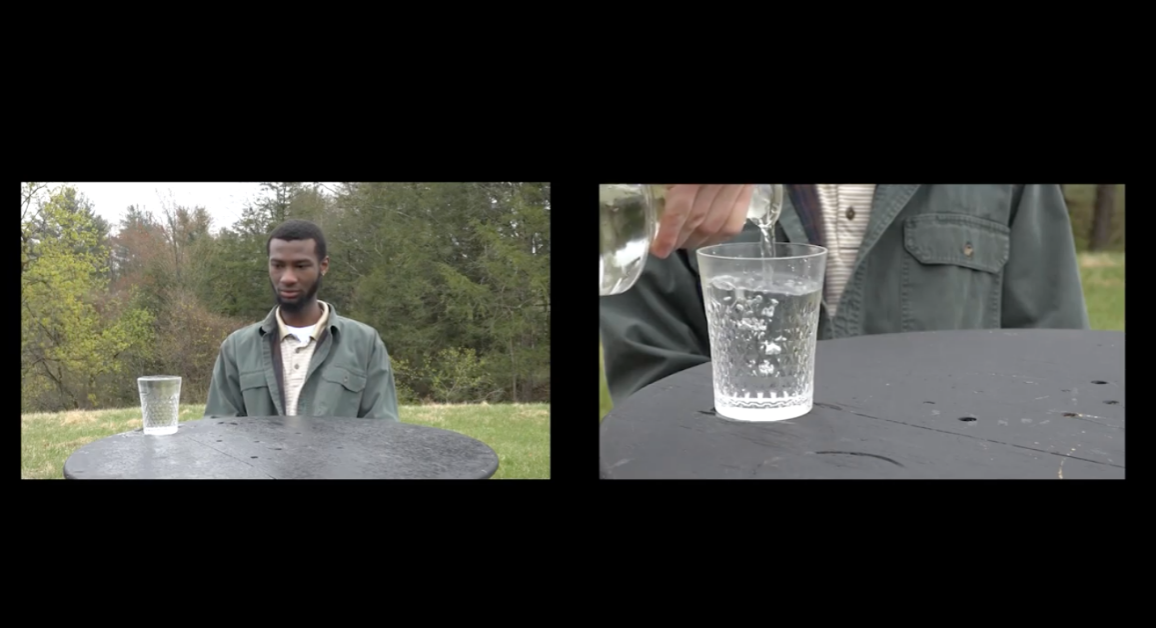
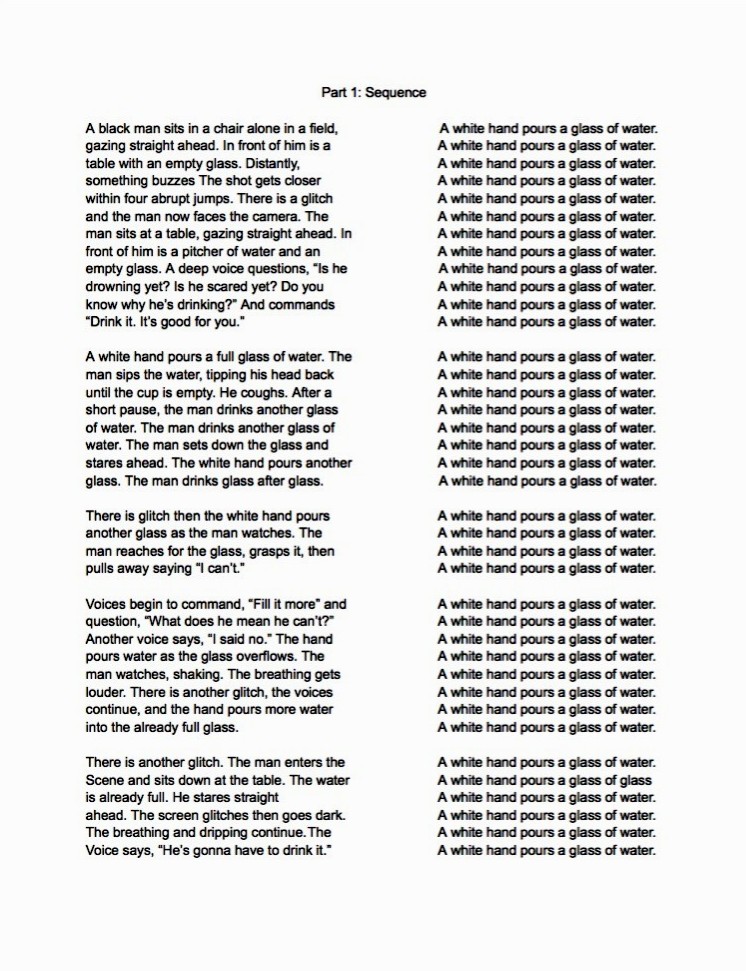
On each side of a split screen, a man sits at a table with a full glass of water. The frame on the left is a medium shot revealing the man’s upper body and face, the majority of the table, and trees in the background. The man is placed at the center of the shot, staring down and to the left at the glass. The green of the man’s jacket flows into the green of the trees and grass. The frame on the right is a close-up shot. A disembodied white hand in the upper left corner pours water into a nearly full glass. The glass sits at the ⅓ line within the frame, further drawing attention with the base’s stark white color. The table takes up nearly half of the frame with the man’s chest in the background.


The stark white color of the base of the glass in contrast to the muted blacks, browns, greens, and grays of the rest of the mise en scène, the position of the glass at the ⅓ line in the frame on the right, and the line of the man’s gaze in the frame on the left all draw focus toward the glasses. In the frame on the right, the whiteness of the base, the bubbles, the reflection off the pitcher, and the hand not only draw the viewer’s attention to the interaction between hand and water but also emphasizes the power of the racially coded whiteness in this scene. Though in the left frame, the cup sits still and full, in the right frame the white hand pours water endlessly. This suggests that, although the man has stated that he can no longer drink, the pattern (under white coercion) cannot be disrupted.


In the frame on the left, the man looks down at the relatively small glass with hesitancy and fear. He does not reach for it and has already refused to drink it, but the emotion suggests he knows that he is not free from this loop of pouring and drinking. Though, in the frame in which the man’s face is visible and his body is centered, the glass appears relatively small, in the continuously pouring frame, the glass’s proximity to the camera and its position communicate its power. This alludes to the lack choice to exist outside of oppressive relationships determined by the White Agenda.

Möbius Strip

This video is the culmination of a semester long course investigating the impacts of race in and around our digital technologies. The group focused on a Möbius strip. A Möbius strip is a continuous surface with only one side and only one boundary; however, blackness can never fit within one. We tweaked it, making our video the representation of our rendition of the multifaceted Möbius strip, one where viewing time after time again provides different abstract and concrete perspectives of the black experience in media and in real life.

This video was made by Negasi, Louisa, Kester, and Haley.

GTA V: Faults in the Idea of Freedom of Play

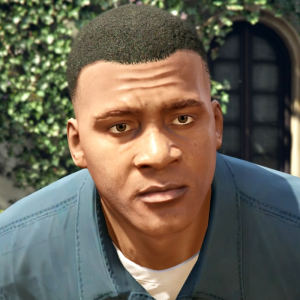
One of the three protagonists of GTA V, Franklin

This is what I learned in my first hour of gameplay: Grand Theft Auto: San Andreas is not a game for beginners. Playing GTA V made me feel out of control, confused, inadequate, and nauseous. While the game is celebrated for the freedom it supposedly provides players, my experience felt extremely limited. GTA may set you loose within a new world but you, the player, have no control over the world. You have no option to change or grow as a character, to radically alter your path, or to develop new relationships (at least that I saw). The game forces you to engage with a world in which you are trapped and over which you have no lasting impact. It also forces you to engage with and embody a set self, one which is ruled by rigidly consistent programming. You may have minimal control over some immediate actions, but nothing you do can change the rules which dictate what is possible.

The free play sections of the game allow you to experiment with possibilities. In this section you are Franklin. Here is a short list of what you (Franklin) can do: you can bump into people on the street, you can follow women, making them scream and run, you can jump off of tall things, and injure yourself, you can get in physical fights, you can drive messily in the wrong direction, over sidewalks, and into houses, you can break streets signs but not fire hydrants, you can smoke weed, you can get a haircut, you can make small talk with strangers. Do anything a few times and you begin to expect the outcome. If you are interested in learning about the relationship of your character to the other characters, you can command them to interact but you don’t have any control over what they say. More constricted even than the character Carrie in Black Museum, whose consciousness is locked within a teddy bear, the GTA player has no agency over how they interact with and are perceived by others. You are stuck in place with a controller in hand, repeatedly pressing , sometimes without response, sometimes with reciprocated anger expressed by other characters.

This lack of control clearly reveals that this world communicates, what Brooker calls, a “mediated truth.” It gives the experience of walking, driving, and shooting within an extremely limited imagination of a black life. It limits choices for action and for self, suggesting that black life lacks agency. It has none of the expansiveness of choice, even in what language players use or what they communicates with others. The language used by the characters clearly marks them racially and by class. In-game speech then serves not as a form of self-expression but as an iterative lesson in who the characters are and can be. This allows for what Leonard calls “sampling the other” which then allows for the development of “good gaming skills” (5). Players are rewarded for learning not only how to control the main character’s body but also what is possible within this imagination of black life. Though I can’t say I derived any pleasure from my gaming experience, I have to admit that there was a satisfaction in learning, after half an hour of failing the prologue sequence, how to aim the on-screen gun. Learning the rules which govern the world of GTA V, including the rules for how raced characters can and will behave and how to manipulate their bodies with the controller, allows for players to engage with the most control available to them: it equips them with a toolbox of possibilities, albeit one that is nearly empty.

Once I reluctantly accepted that interactions with pedestrians were extremely limited, I returned to the mission-focused path of the game. GTA V wore me down. It showed me again and again what was possible until I accepted that I had no power to change the world or my options within the world. I was frustrated as I played and disturbed that female characters ran from me, from CJ. As a small white femme, I have never experienced this kind of response to my presence. I found myself deeply uncomfortable being perceived, even by programmed characters, as predatory. And so I need to admit that, while I know that the lack of options, agency, and control in the game presents a limited, racist imagination of black life, I also know that part of the reason that I felt the wrongness of this so poignantly was due to my own discomfort with being responded to in the ways that the game presents as normative responses to black men. I want options. I want to be in control of my presentation and how others perceive me. That I expect these things in my in-game and out-of-game experiences is clearly a result of my white femmeness, and the privileges which come along with these identities.

Online Dating

If I told you that I changed my name online you would probably call me a catfish. Catfisher? The point is, you would see me as someone unworthy of your trust. But what’s in a name? Who cares if my name online is Isabel or Erin or Erica? It’s all a careful presentation of the self. I might tell you a couple of lies: “Oh I LOVE that band” or “I hate beets” (This is a real lie I have told) but I’ll also sprinkle in some carefully cultivated truths. I love to dance. I used to be a cheerleader. I’ll eat anything. Is this any different than my offline presentation? Part of me thinks that my initial online interactions are more true to myself, or the self I am revealing today (because there are multiple), than my first date self-presentation IRL.

I don’t do online dating through Match.com. I don’t use Bumble or Twitter. You won’t be able to find my profile online. And that’s the way that I want it. At this point, I’m not looking to find a relationship online. And I’m certainly not looking to forever archive the tiny speck of myself that I’m sharing today. People ask me why I don’t have my full name on my social media accounts. The artistic and angsty part of me wants to respond with a careful analysis of the fragments of self presented on each site. That is definitely part of it. Another part is that I read, in a guide to working online, that workers should remove any associations of photos with their full names online. Why? Because if a customer finds your full name, they have access to you forever. They can make unlimited accounts and follow you over and over again. I’ve already seen this happening with strangers. For evidence, go look through the unsolicited photos in my Instagram direct message inbox.

I’m not looking for serious relationships right now. If I was, I might use Tinder. It seems the most game-like, full of swiping, giggling, texting your friends to ask about potential matches. How flattering is it to get SUPER-liked? I have friends who have used Tinder. I know queers who have found THE ONE (for now) on Tinder. But still…does my last name have to be one it? Lately, I’ve been thinking about adding my mom’s last name into my name. Would that save me from my online past? Applying for jobs, resting safe that when they google me they’ll only see me starting at age twenty.

I don’t like the idea of being swiped myself. I don’t like the idea of selecting swipeable photos. I have a queer friend who never gets matched with women. She says her profile looks too heterosexual. Do I post the photos of me on my femme days? Do I try to find an old photo in a dress to show that I’m “date” material? Do I even want to date guys? Or do I go full EnBi-Haley, dressed, as my friends like to say, like a nerd? These questions are important because they hint at the necessity of figuring out how to brand yourself online. Tinder certainly doesn’t provide the opportunity to portray yourself expansively. The photos you post on your profile, do they portray you in your complications and nuanced, does each photo reveal another facet? Or are they instead the bits of blue left by Bower Birds, beautiful selections meant only to attract?

“He Has No Future”: The Futurity of Blackness in 28 Days Later

Part 1: Plot

Sequence 1: Animal activists break into a laboratory and free monkeys that have been infected by “rage.” A monkey attacks a woman, infecting her.

Sequence 2: Jim wakes up alone in a hospital. He walks through the abandoned streets of London, entering a church only to be attacked by an infected priest. Two people, Selena and Mark, rescue him from infected people by blowing up a gas station. In an abandoned store, Selena and Mark tell Jim about the deadly disease.

Sequence 3: The next morning, they chance a trip to Jim’s parents’ house. He finds them dead and a suicide note telling him, “Don’t wake up.” That night, the trio is attacked by an infected person. Mark is infected and Selena kills him, telling Jim she would do the same thing to him.

Sequence 4: They make their way to an apartment with Christmas lights in a window. As they arrive, an infected person chases them and a man in a mask defends them. A young girl, Hannah, lets them into the apartment where they formally meet Frank, her father. Frank shows them a looping radio broadcast advertising “the answer to infection.” He convinces them to go with him and Hannah to find the answer.

Sequence 5: They make their way through the city in Frank’s cab. In a tunnel, they blow a tire and quickly repair it as infected people rapidly approach. They narrowly escape then drive through the countryside, becoming closer and more relaxed. They spend the night in ruins and Selena gives them drugs to sleep. Jim dreams that they have left him.

Sequence 6: They reach the blockade, where they thought they would find help. It is deserted. As Frank looks around for signs of life, a drop of blood falls into his eye, infecting him.  Soldiers arrive and kill Frank.

Sequence 7: The survivors are taken to a militarized mansion. Major West gives Jim a tour of the building, including introducing him to Mailer, an infected black soldier whom West is keeping in order to learn about the disease.

Sequence 8: The soldiers defend the mansion from attack. Afterwards they harass and threaten Selena. West stops them then reveals to Jim that he has lured the trio to the mansion because he “promised them women.”

Sequence 9: Jim, Selena, and Hannah are caught trying to escape. Jim is imprisoned with a dissenting soldier, Farrell, who speculates that the country is being quarantined. Selena temporarily keeps the soldiers from raping her by kissing one.

Sequence 10: Jim and Farrell are taken to a pile of dead bodies in the woods. Farrell is killed and Jim hides among the bodies until the others leave. Jim attacks West and a soldier then releases Mailer. Selena, Jim, and Hannah run to their car where West shoots Jim. Hannah backs up the car, smashing into infected people who take West. To escape, Hannah crashes the car into a locked gate.

Sequence 11: Jim dreams of Selena trying to save him in a hospital. He wakes up in a house in the countryside and finds her sewing. Hannah rushes in, saying she heard something. They go outside and lay out out the word “HELLO.” A plane flies overhead and Selena asks if they think they have been seen.


Part Two: Analysis

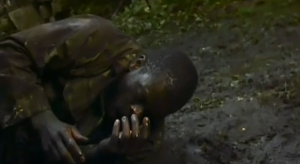
At 1:12:50 the film rests on a shot of Mailer, lying on the ground after a dramatic attempt to reach West and Jim from where he is leashed. This frame is a close up and feels intimate due to Mailer’s closed and protective body language. The frame is not so close as to cut out his arms which characterize the way he is laying as a sort of fetal position, reminiscent of a baby or someone dying. The camera angle is canted and tilted downward giving the audience the point of view of West or Jim, peering down at Mailer from the safety of the doorway.

The mise en scène is almost completely brown. There is a sparse scattering of green grass in the background of the frame which works to emphasize the brownness. Throughout the larger scene, Mailer’s uniform transforms from a muddy green to wholly brown, as he rolls in the mud. He appears to be blending into the mud or returning to the mud, since the part of him which is not brown, his clothing, becomes brown. This suggested transition to mud supports West’s dialogue during this shot which asert’s Mailer’s lack of futurity.

West says, “He’s telling me he’s futureless.” This conclusion is drawn from the preceding statements that, “he’ll never bake bread, farm crops, raise livestock.” Mailer’s loss of the ability to provide labor for the community of soldiers constitutes a loss of futurity. Later in the film, West returns to the requirements for futurity saying, “Women mean a future” (01:21:35). This example clearly demonstrates the necessity of reproduction for futurity. The women, notably Selena whom, unlike Hannah is not treated as a child to be protected, are valued for their ability to provide literal reproductive labor. Mailer is assessed for his ability to support the reproduction of white society through his physical labor. Though Mailer’s usefulness is diminished by the infection, West uses him as a tool to understand the “rage.” The information is collected in order to give the soldiers, and the envisioned future humanity which will come from them, a better chance at survival and reproduction.

This lack of futurity, supplies a missing link between the contemporary period of the movie’s release and the future depicted in many other science fiction films in which black people have disappeared. In 28 Days Later, we see black people, potentially the last black people, still alive but depicted as without futurity, going to starve to death or used for their ability to reproduce white society. The film ends with Jim, Selena, and Hannah forming a sort of family of survivors. Hannah functions as a surrogate daughter to the couple, with the trio’s paternal relationship foreshadowed by Selena’s realization of the importance of motherhood earlier in the film while looking at Hannah and her father (00:55:20). Hannah then is the white child of the future, the product of the graphic mixing of blood depicted in Jim and Selena’s reunion (1:42:35).

I, Robot: Weight Lifting and The Body

PART 1: PLOT

Sequence 1: The Three Laws for robots (protect and obey humans and, secondarily, protect yourself) bubble up and disappear as a man in a car struggles against rising water. A robot climbs through the car window.

Sequence 2: In Chicago, 2035, detective Del Spooner wakes from a dream. Outside, robots do service labor. An ad for a new robot, the NS5, plays on billboards. Spooner chases and tackles a robot that is running with a purse. The robot’s owner chastises him. At the police station, the chief of police questions if Spooner is okay to work.

Sequence 3: Spooner is called to U.S Robotics (USR) to investigate the death of the founder, Alfred Lanning. Spooner tours USR with Susan Calvin, a robopsychologist, utilizing the A.I operating system, VIKI. They examine Lanning’s office, discovering a hiding robot. The robot defies orders then escapes.

Sequence 4: Spooner and Calvin look for the NS5 in a storage shed. Spooner tries to get it to reveal itself by shooting at the other robots. The robot reveals itself accidentally. Outside, the police surround and catch it.

Sequence 5: Spooner interrogates the robot, who calls himself Sonny. Sonny talks about his relationship with Lanning, whom he insists he did not murder and describes as his father. Sonny is taken back to USR.

Sequence 6: Spooner investigates Lanning’s house, watching a video of Lanning speaking about robot’ unexplained behaviors. A demolition robot destroys the house. Spooner barely escapes.

Sequence 7: Huge vehicles distribute NS5’s. The chief tells Spooner to stop focusing on robots. Calvin tells Sonny he will be decommissioned. He says he doesn’t want to die.

Sequence 8: While driving, Spooner is attacked by NS5’s. He crashes his car and fights on foot. His arm is damaged, revealing that it is robotic. The chief confiscates Spooner’s badge.

Sequence 9: Calvin discovers that Sonny can violate the Three Laws. Spooner shows her his robotic arm and explains that Lanning saved his life after a car accident in which a robot saved him instead of a young girl.

Sequence 10: Spooner and Calvin ask Sonny about his dreams. Sonny draws a picture of robots gathering below a bridge, being led by a man. He says the man is Spooner.

Sequence 11: Robertson convinces Calvin not to trust Spooner. Calvin decomissions Sonny. Spooner goes to the robot storage facility from Sonny’s drawing, where robots respond to his flashlight. NS5’s destroy the older robots. Spooner escapes.

Sequence 12: Calvin and Spooner’s grandmother’s robots hold them hostage. Hundreds of NS5’s patrol the streets, announcing a curfew. Robots invade the police station.

Sequence 13: Calvin and Spooner go to USR as humans and robots fight in the streets. Sonny, whom was not actually decommissioned, lets them into the building.

Sequence 14: They discover Robertson is dead. Spooner realizes that VIKI is controlling the other robots. Sonny and Spooner shoot their way through the other NS5’s.

Sequence 15: Spooner, Calvin, and Sonny try to destroy VIKI with nanites as NS5’s attack them. Calvin falls but Sonny pulls her to safety. Spooner injects the nanites into VIKI.

Sequence 16: The NS5’s return to their normal, nonviolent state. They gather for storage. Sonny and Spooner shake hands as a sign of friendship. Sonny reports for storage along with the other robots. The robots come together below him as he stands under the bridge from his dream.


PART 2: FRAME ANALYSIS

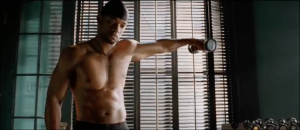
The second scene of the film shows detetive Del Spooner going through his morning routine. Beginning at 00:02:33, the film has a seven second shot of Spooner lifting a weight. The frame at 00:02:36 is a medium shot with the camera tilted up at Spooner from below eye-level. His shoulder is centered horizontally and his extended left arm cuts across the upper-third line of the frame. The camera zooms in subtly on his shoulder, occasionally cutting the top of his head out of the frame.

Spooner is backlit by bright white light from the window. The left side of his body is shadowed, while the lower right side and his shoulder are in bright light. As he lifts the weight, a shadow passes over his body. His face is mostly shadowed, with only his cheek in the light. This shot is quick and, though he is shirtless, the scar on his chest is only visible for a moment. For a split second, light passes through the room, suggesting a car passing outside, and light reflects off of his scar.

In this frame, Will Smith’s body is highly accessible to the audience. He is uncovered and, unlike in the following shot, he is close to the camera. His body is clearly the main focus of the shot since his face is almost completely shadowed and part of his head is periodically cut out of the frame as he moves. The weight lifting clearly communicates strength and self-discipline while his unfocused facial expression appears almost soft and hints at important inner dialogue. He is meant to be read as tough but not scary. Smith’s character, Del Spooner, strengthens his body as a tool to be used against robots but not against the audience.

Interestingly, this shot captures Spooner exercising his robotic arm. He later uses this arm to deflect attacks and to slide down a pole for thirty stories. When the arm is damaged, he repairs it using some kind of spray. Due to the inherent strength of the arm, this weight lifting might not serve a utilitarian purpose but, instead, communicates Spooner’s desire for control over his robotic part. Alternatively, this practice might reflect lingering unfamiliarity with the robotic arm. The exercise seems to require little focus, suggesting that the routine existed before the robotic arm. His performance is then a continuation of a human behavior in spite of a clear hybridization of his body.

This tendency to ignore and reject his robotic parts appears throughout the film and is depicted as tied to his nostalgia for the past. Rather than use advanced voice-activated technology, he uses an old-fashioned record player. Rather than acknowledge his robotic arm, implanted in him without his permission by white scientists, Spooner presents himself as using his black body as a tool, a tool which the audience is meant to read as outdated.


Word Count: 1,012

The Cockroach Scene: Frame Analysis in The Fifth Element


Part One: Plot

Sequence 1: In 1914 in a temple in Egypt, a scientist analyzes symbols on the wall which tell a story about an evil force. A priest tries to poison the scientists to prevent them from discovering more. A spaceship lands and aliens emerge. They open a vault and remove four stones and a statue, the fifth element. One of the scientists shoots at the aliens, causing the vault to close with an alien inside.

Sequence 2: 300 years later, on a spaceship, military officers monitor a growing dark planet. The president approves a plan to destroy it. The planet gets bigger as it is attacked.

Sequence 3: Korben wakes up from a bad dream in his apartment in Brooklyn, New York. He outsmarts a man trying to rob him and leaves for work in his taxi.

Sequence 4: A spaceship carrying the stones is shot down by pig-like aliens called Mangalores. A man named Zorg receives a call from the Mangalores confirming the attack.

Sequence 5: The fifth element, who looks like a human woman, is regenerated from remains from the spaceship crash. She escapes and falls through the roof of Korben’s taxi. He takes her to the priest.

Sequence 6: After Zorg realizes the Mangalores did not retrieve the stones from the spaceship attacked, his henchman spies on the president, and learns the stones will be on a planet called Fhloston Paradise.

Sequence 7: General Munroe asks Korben to retrieve the stones. Korben’s neighbor is kidnapped by Mangalores who believe he is Korben. The priest steals Korben’s passes to Fhloston Paradise.

Sequence 8: David, an associate of the priest, a Mangalore man, and one of Zorg’s henchmen all try to imitate Korben in order to go to Fhloston Paradise but the real Korben gets on board with Leeloo. Korben is pulled aside to meet Ruby Rhod, a talk-show host. Ruby tries to interview Korben but only gets a couple of words out of him. As they take off, Ruby has sex with a flight attendant.

Sequence 9: On Fhloston Paradise, Korben goes to an opera. Ruby tries to interview Korben and receives a one word response. Mangalores break into Plavalaguna’s room but Leeloo bursts in and fights them. As she escapes, Zorg shoots her. Plavalaguna is shot by Mangalores. Zorg sets a bomb.

Sequence 10: Plavalaguna dies and Korben removes the stones from her abdomen. He fights the Mangalores while Ruby protects the stones. Zorg returns and deactivates the bomb. Korben, Leeloo, the priest, and Ruby escape. The Mangalores blow themselves up along with Zorg.

Sequence 11: The president is told that the evil planet is moving quickly towards Earth. Leeloo learns about war on the computer.

Sequence 12: In the temple, Ruby, the priest, David, and Korben open the stones by exposing them to their corresponding elements. To activate Leeloo as the fifth element, Korben tells her he loves her and kisses her. A beam of light explodes from her body and the dark planet is shown, dead.

Sequence 13: The president comes to the science lab to meet Korben and Leeloo. They are having sex inside the reactor in which Leeloo was reconstructed.


Part Two: Frame Analysis

At the moment 00:58:13, we find a frame within a frame within a frame. The outermost frame is foregrounded by the hand of Zorg’s henchman. The hand is out of focus and carefully positioned so as not to block the important aspects of the inner two frames. Beyond the hand, the outermost frame is completely dark, giving the viewer the sense that they are inside of the cockroach shown in the previous shot. In the outermost frame, the camera is stable and positioned at the level of the controller’s hand. Because the camera is not at the controller’s eye level, the viewer is not led to identify with him. Instead, this camera position and its upward tilted angle ascribe to the viewer a cockroach-like position towards the man inside the cockroach.

Due to the camera’s position and angle, the viewer can see the screen examined by the controller. The screen serves as the second frame. This frame is unmoving and is organized into different windows with functions including “exit,” “check,” “timer,” and “method.” It occupies the center of the outermost frame and is bounded by the darkness beyond the screen. The innermost frame is shot from the height of the table with the camera tilted dramatically upward toward the president, shaking as it moves towards him. It provides the point of view of the cockroach. The innermost frame is split between the president and his reflection in the table. Behind the president is an unknown employee who, unlike the president, appears to be facing the camera directly. The president appears to be sitting low at the table, in fact, not very far above the cockroach. The president has his shoe in his hand, foreshadowing the roach’s death.

This frame, in relationship with the frame which immediately precedes it, suggests a similarity between the president and the cockroach. The darkness of the space in which the controller works leads to an understanding of the controller as being inside the cockroach. He can also be read as being the bug himself. The aural aspects of the frame support the man as cockroach portrayal: the clicking of the controller replaces the clicking of the cockroach in the previous shot. The abrupt cut from the cockroach shot to this shot at 00:58:13 also ties together the president reflected in the table and the cockroach crawling across the table in which it is also reflected. Thus, the cockroach is associated with both the controller and the president, the two black men in this scene. The following shot of the president smashing the cockroach may provide conscious or unconscious pleasure to an anti-black racist audience: it is a depiction of a black man, who is characterized throughout the film as a powerless president constantly in need of advice from white advisors, killing another black man through the cinematic enactment of an old racist metaphor: black people as cockroaches.