

Online Dating

If I told you that I changed my name online you would probably call me a catfish. Catfisher? The point is, you would see me as someone unworthy of your trust. But what’s in a name? Who cares if my name online is Isabel or Erin or Erica? It’s all a careful presentation of the self. I might tell you a couple of lies: “Oh I LOVE that band” or “I hate beets” (This is a real lie I have told) but I’ll also sprinkle in some carefully cultivated truths. I love to dance. I used to be a cheerleader. I’ll eat anything. Is this any different than my offline presentation? Part of me thinks that my initial online interactions are more true to myself, or the self I am revealing today (because there are multiple), than my first date self-presentation IRL.

I don’t do online dating through Match.com. I don’t use Bumble or Twitter. You won’t be able to find my profile online. And that’s the way that I want it. At this point, I’m not looking to find a relationship online. And I’m certainly not looking to forever archive the tiny speck of myself that I’m sharing today. People ask me why I don’t have my full name on my social media accounts. The artistic and angsty part of me wants to respond with a careful analysis of the fragments of self presented on each site. That is definitely part of it. Another part is that I read, in a guide to working online, that workers should remove any associations of photos with their full names online. Why? Because if a customer finds your full name, they have access to you forever. They can make unlimited accounts and follow you over and over again. I’ve already seen this happening with strangers. For evidence, go look through the unsolicited photos in my Instagram direct message inbox.

I’m not looking for serious relationships right now. If I was, I might use Tinder. It seems the most game-like, full of swiping, giggling, texting your friends to ask about potential matches. How flattering is it to get SUPER-liked? I have friends who have used Tinder. I know queers who have found THE ONE (for now) on Tinder. But still…does my last name have to be one it? Lately, I’ve been thinking about adding my mom’s last name into my name. Would that save me from my online past? Applying for jobs, resting safe that when they google me they’ll only see me starting at age twenty.

I don’t like the idea of being swiped myself. I don’t like the idea of selecting swipeable photos. I have a queer friend who never gets matched with women. She says her profile looks too heterosexual. Do I post the photos of me on my femme days? Do I try to find an old photo in a dress to show that I’m “date” material? Do I even want to date guys? Or do I go full EnBi-Haley, dressed, as my friends like to say, like a nerd? These questions are important because they hint at the necessity of figuring out how to brand yourself online. Tinder certainly doesn’t provide the opportunity to portray yourself expansively. The photos you post on your profile, do they portray you in your complications and nuanced, does each photo reveal another facet? Or are they instead the bits of blue left by Bower Birds, beautiful selections meant only to attract?
“He Has No Future”: The Futurity of Blackness in 28 Days Later

Part 1: Plot

Sequence 1: Animal activists break into a laboratory and free monkeys that have been infected by “rage.” A monkey attacks a woman, infecting her.

Sequence 2: Jim wakes up alone in a hospital. He walks through the abandoned streets of London, entering a church only to be attacked by an infected priest. Two people, Selena and Mark, rescue him from infected people by blowing up a gas station. In an abandoned store, Selena and Mark tell Jim about the deadly disease.

Sequence 3: The next morning, they chance a trip to Jim’s parents’ house. He finds them dead and a suicide note telling him, “Don’t wake up.” That night, the trio is attacked by an infected person. Mark is infected and Selena kills him, telling Jim she would do the same thing to him.

Sequence 4: They make their way to an apartment with Christmas lights in a window. As they arrive, an infected person chases them and a man in a mask defends them. A young girl, Hannah, lets them into the apartment where they formally meet Frank, her father. Frank shows them a looping radio broadcast advertising “the answer to infection.” He convinces them to go with him and Hannah to find the answer.

Sequence 5: They make their way through the city in Frank’s cab. In a tunnel, they blow a tire and quickly repair it as infected people rapidly approach. They narrowly escape then drive through the countryside, becoming closer and more relaxed. They spend the night in ruins and Selena gives them drugs to sleep. Jim dreams that they have left him.

Sequence 6: They reach the blockade, where they thought they would find help. It is deserted. As Frank looks around for signs of life, a drop of blood falls into his eye, infecting him.  Soldiers arrive and kill Frank.

Sequence 7: The survivors are taken to a militarized mansion. Major West gives Jim a tour of the building, including introducing him to Mailer, an infected black soldier whom West is keeping in order to learn about the disease.

Sequence 8: The soldiers defend the mansion from attack. Afterwards they harass and threaten Selena. West stops them then reveals to Jim that he has lured the trio to the mansion because he “promised them women.”

Sequence 9: Jim, Selena, and Hannah are caught trying to escape. Jim is imprisoned with a dissenting soldier, Farrell, who speculates that the country is being quarantined. Selena temporarily keeps the soldiers from raping her by kissing one.

Sequence 10: Jim and Farrell are taken to a pile of dead bodies in the woods. Farrell is killed and Jim hides among the bodies until the others leave. Jim attacks West and a soldier then releases Mailer. Selena, Jim, and Hannah run to their car where West shoots Jim. Hannah backs up the car, smashing into infected people who take West. To escape, Hannah crashes the car into a locked gate.

Sequence 11: Jim dreams of Selena trying to save him in a hospital. He wakes up in a house in the countryside and finds her sewing. Hannah rushes in, saying she heard something. They go outside and lay out out the word “HELLO.” A plane flies overhead and Selena asks if they think they have been seen.


Part Two: Analysis

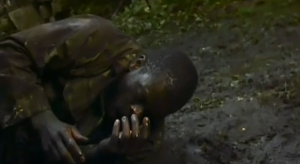
At 1:12:50 the film rests on a shot of Mailer, lying on the ground after a dramatic attempt to reach West and Jim from where he is leashed. This frame is a close up and feels intimate due to Mailer’s closed and protective body language. The frame is not so close as to cut out his arms which characterize the way he is laying as a sort of fetal position, reminiscent of a baby or someone dying. The camera angle is canted and tilted downward giving the audience the point of view of West or Jim, peering down at Mailer from the safety of the doorway.

The mise en scène is almost completely brown. There is a sparse scattering of green grass in the background of the frame which works to emphasize the brownness. Throughout the larger scene, Mailer’s uniform transforms from a muddy green to wholly brown, as he rolls in the mud. He appears to be blending into the mud or returning to the mud, since the part of him which is not brown, his clothing, becomes brown. This suggested transition to mud supports West’s dialogue during this shot which asert’s Mailer’s lack of futurity.

West says, “He’s telling me he’s futureless.” This conclusion is drawn from the preceding statements that, “he’ll never bake bread, farm crops, raise livestock.” Mailer’s loss of the ability to provide labor for the community of soldiers constitutes a loss of futurity. Later in the film, West returns to the requirements for futurity saying, “Women mean a future” (01:21:35). This example clearly demonstrates the necessity of reproduction for futurity. The women, notably Selena whom, unlike Hannah is not treated as a child to be protected, are valued for their ability to provide literal reproductive labor. Mailer is assessed for his ability to support the reproduction of white society through his physical labor. Though Mailer’s usefulness is diminished by the infection, West uses him as a tool to understand the “rage.” The information is collected in order to give the soldiers, and the envisioned future humanity which will come from them, a better chance at survival and reproduction.

This lack of futurity, supplies a missing link between the contemporary period of the movie’s release and the future depicted in many other science fiction films in which black people have disappeared. In 28 Days Later, we see black people, potentially the last black people, still alive but depicted as without futurity, going to starve to death or used for their ability to reproduce white society. The film ends with Jim, Selena, and Hannah forming a sort of family of survivors. Hannah functions as a surrogate daughter to the couple, with the trio’s paternal relationship foreshadowed by Selena’s realization of the importance of motherhood earlier in the film while looking at Hannah and her father (00:55:20). Hannah then is the white child of the future, the product of the graphic mixing of blood depicted in Jim and Selena’s reunion (1:42:35).

I, Robot: Weight Lifting and The Body

PART 1: PLOT

Sequence 1: The Three Laws for robots (protect and obey humans and, secondarily, protect yourself) bubble up and disappear as a man in a car struggles against rising water. A robot climbs through the car window.

Sequence 2: In Chicago, 2035, detective Del Spooner wakes from a dream. Outside, robots do service labor. An ad for a new robot, the NS5, plays on billboards. Spooner chases and tackles a robot that is running with a purse. The robot’s owner chastises him. At the police station, the chief of police questions if Spooner is okay to work.

Sequence 3: Spooner is called to U.S Robotics (USR) to investigate the death of the founder, Alfred Lanning. Spooner tours USR with Susan Calvin, a robopsychologist, utilizing the A.I operating system, VIKI. They examine Lanning’s office, discovering a hiding robot. The robot defies orders then escapes.

Sequence 4: Spooner and Calvin look for the NS5 in a storage shed. Spooner tries to get it to reveal itself by shooting at the other robots. The robot reveals itself accidentally. Outside, the police surround and catch it.

Sequence 5: Spooner interrogates the robot, who calls himself Sonny. Sonny talks about his relationship with Lanning, whom he insists he did not murder and describes as his father. Sonny is taken back to USR.

Sequence 6: Spooner investigates Lanning’s house, watching a video of Lanning speaking about robot’ unexplained behaviors. A demolition robot destroys the house. Spooner barely escapes.

Sequence 7: Huge vehicles distribute NS5’s. The chief tells Spooner to stop focusing on robots. Calvin tells Sonny he will be decommissioned. He says he doesn’t want to die.

Sequence 8: While driving, Spooner is attacked by NS5’s. He crashes his car and fights on foot. His arm is damaged, revealing that it is robotic. The chief confiscates Spooner’s badge.

Sequence 9: Calvin discovers that Sonny can violate the Three Laws. Spooner shows her his robotic arm and explains that Lanning saved his life after a car accident in which a robot saved him instead of a young girl.

Sequence 10: Spooner and Calvin ask Sonny about his dreams. Sonny draws a picture of robots gathering below a bridge, being led by a man. He says the man is Spooner.

Sequence 11: Robertson convinces Calvin not to trust Spooner. Calvin decomissions Sonny. Spooner goes to the robot storage facility from Sonny’s drawing, where robots respond to his flashlight. NS5’s destroy the older robots. Spooner escapes.

Sequence 12: Calvin and Spooner’s grandmother’s robots hold them hostage. Hundreds of NS5’s patrol the streets, announcing a curfew. Robots invade the police station.

Sequence 13: Calvin and Spooner go to USR as humans and robots fight in the streets. Sonny, whom was not actually decommissioned, lets them into the building.

Sequence 14: They discover Robertson is dead. Spooner realizes that VIKI is controlling the other robots. Sonny and Spooner shoot their way through the other NS5’s.

Sequence 15: Spooner, Calvin, and Sonny try to destroy VIKI with nanites as NS5’s attack them. Calvin falls but Sonny pulls her to safety. Spooner injects the nanites into VIKI.

Sequence 16: The NS5’s return to their normal, nonviolent state. They gather for storage. Sonny and Spooner shake hands as a sign of friendship. Sonny reports for storage along with the other robots. The robots come together below him as he stands under the bridge from his dream.


PART 2: FRAME ANALYSIS

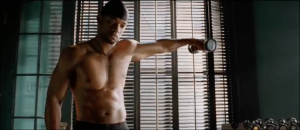
The second scene of the film shows detetive Del Spooner going through his morning routine. Beginning at 00:02:33, the film has a seven second shot of Spooner lifting a weight. The frame at 00:02:36 is a medium shot with the camera tilted up at Spooner from below eye-level. His shoulder is centered horizontally and his extended left arm cuts across the upper-third line of the frame. The camera zooms in subtly on his shoulder, occasionally cutting the top of his head out of the frame.

Spooner is backlit by bright white light from the window. The left side of his body is shadowed, while the lower right side and his shoulder are in bright light. As he lifts the weight, a shadow passes over his body. His face is mostly shadowed, with only his cheek in the light. This shot is quick and, though he is shirtless, the scar on his chest is only visible for a moment. For a split second, light passes through the room, suggesting a car passing outside, and light reflects off of his scar.

In this frame, Will Smith’s body is highly accessible to the audience. He is uncovered and, unlike in the following shot, he is close to the camera. His body is clearly the main focus of the shot since his face is almost completely shadowed and part of his head is periodically cut out of the frame as he moves. The weight lifting clearly communicates strength and self-discipline while his unfocused facial expression appears almost soft and hints at important inner dialogue. He is meant to be read as tough but not scary. Smith’s character, Del Spooner, strengthens his body as a tool to be used against robots but not against the audience.

Interestingly, this shot captures Spooner exercising his robotic arm. He later uses this arm to deflect attacks and to slide down a pole for thirty stories. When the arm is damaged, he repairs it using some kind of spray. Due to the inherent strength of the arm, this weight lifting might not serve a utilitarian purpose but, instead, communicates Spooner’s desire for control over his robotic part. Alternatively, this practice might reflect lingering unfamiliarity with the robotic arm. The exercise seems to require little focus, suggesting that the routine existed before the robotic arm. His performance is then a continuation of a human behavior in spite of a clear hybridization of his body.

This tendency to ignore and reject his robotic parts appears throughout the film and is depicted as tied to his nostalgia for the past. Rather than use advanced voice-activated technology, he uses an old-fashioned record player. Rather than acknowledge his robotic arm, implanted in him without his permission by white scientists, Spooner presents himself as using his black body as a tool, a tool which the audience is meant to read as outdated.


Word Count: 1,012