It’s hard for me to write about Valentine’s Day. It’s not that someone I’d been dating broke up with me on that day. February 14th doesn’t carry, for me, ironic associations with heartbreak. It’s precisely my distance from the significance of this day that leaves me squinting at my screen in an effort to describe my feelings towards it. I mean, I do enjoy chocolates, and cute little notes, and wearing red. But I don’t need capitalism to remind me to love people, I’ve never had a day off on February 14th, and flowers die easily once my cat gets involved. Most times I just don’t get it. Shouldn’t it be a problem that we rely on one day of the year to guarantee the exchange of love? If we prioritize love on that one day aren’t we thereby conceding that we don’t prioritize love on the remaining 364 days? Time is fleeting and should not be the thing that compassion and romance leans on. It’s fine china teetering atop a base of even finer china. It makes me question the notion of love as a whole. Then, enter February the 15th of this year, when I discovered that Frank Ocean had released a new single, his cover of Mancini and Mercer’s “Moon River.”
There I was, sitting in my common room, finishing up homework with my entrymates, when I received a notification on my phone: “New upload from Frank Ocean — ‘Moon River.’” Aw, shit. I saw the red cover art and knew that I was in for it. I tore out my headphones from my pj’s and couldn’t make it past one minute of the song before retreating to my room to listen to it in silence, where no one could catch me in my feels. The thing that struck me the most after repeatedly listening to the tune was the way in which Frank was able to work me up, even though he had dropped his cover the night after Valentine’s Day, and even knowing that the song, from Breakfast at Tiffany’s, had more to do with striving to become a successful artist than with romantic love,. There’s significance in trying to tackle this number as a love ballad, but how so?
It goes back to how Ocean manipulates a song that never uses the word “love,” and it helps to refer to Nietzsche’s thoughts on the autonomy of language to place that significance in context. The late nineteenth-century philosopher postulated that language serves to project meanings into a gap, in that no object, person, or event dictates the way we name or describe it. And if we follow that line of thought, then the fundamental human drive is that of forming metaphors and making the world more dream-like.[1] Love, along with all other concepts, would be the making equal of unequal things; love, with all of its empty heaviness, would be an illusion.[2] And I’m okay with that! At least, in that the circumlocutory use of the word “love” would be the technique to practice in order to make the concept more real. In that sense, Frank Ocean does a fine job of reworking the delivery and production of “Moon River” in order to convey more heartfelt emotion, and perhaps call out all the loners out there, post Valentine’s Day. But why should we care about the ways in which Frank Ocean manages to make love more real?
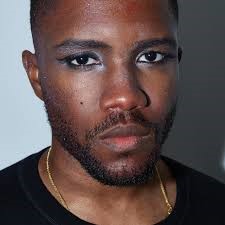 If you’re unfamiliar with Frank Ocean as an artist, it’s hard for me to believe you, but I would encourage you to take a break right here and give him a listen before we move forward (“Solo,” “Ivy,” “Pink + White,” and “Thinkin Bout You” would be my personal favorites, while his feature on “Slide” is bound to make anyone get their groove on). One of my friends on campus cites Frank as “one of the greatest things to have been made in the U.S.,” and I can’t help but nod my head vigorously every time I hear him say that. Rising out of an era in 2010s hip-hop where rap needed to hit hard and make you grit your teeth from the taste of testosterone (looking at you, Kanye), Frank came on the scene willing to strip everything down to its core. Ocean lives in metaphor, writing lyrics that leave most moody adolescents and young adults repeating them for the sake of how they sound rather than their significance as prose. His beats are simple, his raps are melodic, and he’s willing to manipulate his voice, the synthesizer, and electric guitar in low key but successful ways. He’s not afraid to make you feel emotional, kind of like the old Drake? Although that would be insulting to Ocean (as Christian Thorne professed last semester, “It’s the end of hip-hop. You’ve got an aggressively bland Canadian running the game.”), so maybe something closer to Lauryn Hill. Frank is more of that lay-back, smoke-a-joint, call-your-mom kinda vibe. So, once again, how does Ocean manage to make love more real?
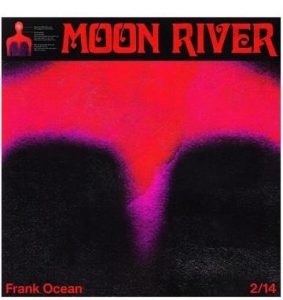
We can start by looking at the cover art for “Moon River.” At first glance, it’s hard to make out what’s being depicted — a red crow? A menacing pair of eyes? The Batman symbol? But if you look closely at the top of the image, the pieces start to come together. The title, “Moon River,” is printed in a bold red, with hearts hanging off of the edges of most of the letters. In the left corner of the cover, there’s a small figure with the labelled anatomy of the human body. After finding a zoomed-in image of the figure online, it’s shown that the label for the brain reads: “Origin of tingling sensation.” It’s a curious description, but given the context, the figure could very well be mapping the bodily responses towards seeing a loved one. For the top of the spine, the “tingling sensation” then becomes “Described as moving downwards, following the line of the spine. May also feel this in the shoulders.” And finally, for the arms, their label reads: “Sensation may spread to other areas with increasing intensity, typically the limbs and lower back.” So there it is, Frank is coming on the scene and getting right down to it — real love can produce a physical response throughout most of the body, but which area is missing a description? The main image on the cover of the single — the heart. So hopefully, on the day after Valentine’s Day, Frank will be able to send a tingling sensation through listener’s hearts with his cover of “Moon River.” Now, let’s move on to the meat of it — the song itself.
 I’m hesitant to declaim my take on the original version of “Moon River,” since I’ve never seen Breakfast at Tiffany’s. But from what I can tell, Audrey Hepburn sang that song in the film with a subtle, whispery voice to express her aspirations towards fame, which makes Frank Ocean’s more sentimental twist on it all the more impressive, to differentiate between love for entertainment and love for a person. With Ocean, “Moon River” begins with him counting his listeners in with a sharp “one, two” before they are greeted by steady bass guitar chord progressions and Frank’s auto tuned falsetto. Ocean then begins to long after “Moon River, wider than a mile / I’m crossing you in style someday.” The sudden shift from a major to a minor key as he sings the two words, “Moon River,” pierces the ears just enough for listeners to feel the reverberating high pitch cling onto their heartstrings and reach their toes. On “wider than a mile,” Frank layers his natural voice over his auto tuned one, allowing listeners to feel the breadth of his sentiments before he switches back to falsetto on “I’m crossing you in style.” Listeners hear his natural voice only at the end of the lyric: “– someday,” emphasizing the solitude and hesitancy with which an Ocean would contemplate crossing a River. Frank chooses to center his listeners on the lament of this ballad, mixing his voice over itself and echoing it in and out so that they can feel him along the shadowy waters of his romantic life. Just the first verse of Ocean’s song asks listeners to take in what is being sung, to question what is not being sung, and to identify which gaps are being filled with the alternating sounds of his voice. Without even knowing who or what Moon River is — it really could be a river illuminated by the light of the moon — Frank sings the opening of a song that is painful, unexpected, and entrancing, a love at first listen.

For the remainder of the ballad, Ocean uses his natural voice, but continues to play around with the layering of his vocals to accentuate the lyrics. The second verse of the song speaks of “two drifters off to see the world,” and Frank ends the verse by omitting the word “rainbow’s” from “We’re all chasing after all the same / Chasing after our rainbow’s end.” Our end is suddenly shifted from critical acclaim and material wealth — a stereotypical pot of gold at the end of the rainbow — to the person with whom we can spend the rest of our lives with. But perhaps the most powerful point in Frank’s cover is his later repetition of the first verse. Just after he sings “Chasing after our end,” his voice begins to swell, with different trills of his voice overlapping over each other before reaching the climax: Ocean cries out “Moon River” again, but with his natural voice at a powerfully high pitch, with a slight vibrato that almost mimics the shakiness of someone sobbing. And all the while, the trills continue, his sound alternating in timbre and pitch, t
he inner voices of his love calling out. It makes my heart well up before the raw emotion escapes through my eyes. Just those three seconds can fill me with the sentiment that no four-letter word could handle. It’s a real weight that is being pressed upon you. A sinking, heavy feeling, something smothering in its beauty. Most is said in what Frank Ocean leaves unsaid, in the words he creates through the pure trills that escape through his throat. What better way to describe the way the heart feels love than to reimagine a piece of music that can enact intense emotion in its listeners? Frank, frankly, knows how to leave language alone and make concepts real through the real sensations that we as humans feel. Isn’t that what love is all about?
[1] Friedrich Nietzsche, On Truth and Lies in a Nonmoral Sense, 1873, 121.
[2] Nietzche, 117.
 So I would sit there, changing the radio station or turning down the volume on my cell phone, knowing that I would never stop enjoying hip-hop music, but also knowing that I would have to keep my interest in it hidden from my parents. Unlike when I would casually contemplate lyrics from Pink Floyd or Stevie Wonder with my dad, blasting their songs from our living room speakers, I only listened to rap through my headphones, while I was commuting to school, when I was alone with similarly interested friends, or when I went to a party and the DJ knew what was up. But I’ve grown tired of the secrecy! It’s too fatally ironic to feel pressured into dismissing an art form that in itself seeks to combat oppressional institutions and the silencing of people of color. I believe that it was the combined instances of being unable to passionately converse about post-90s rap with my family, watching Netflix’s Hip-Hop Evolution, and reading from Jay-Z’s Decoded that has now led me here. The words that particularly struck me from Jay-Z were: “The reason hip-hop is controversial: People don’t bother trying to get it. The problem isn’t in the rap or the rapper or the culture. The problem is that so many people don’t even know how to listen to the music.”
 So let’s take a sample from Jay-Z’s “99 Problems:” “Rap mags try and use my black ass / So advertisers can give ’em more cash for ads, fuckers / I don’t know what you take me as / Or understand the intelligence that Jay-Z has.” Mags, ass, cash, ads, as, has — the words themselves provide familiar imagery of popular rappers living the high life while also trying to avoid being played by the entertainment industry. And the fact that the lyrics all rhyme on top of a booming hip-rock beat, complete with a surprisingly infectious cowbell (that we’ll always need more of), reinforces the recognition of that identity even when the words are missed. As Jay-Z says, even when the story itself isn’t real, it is an artist’s ability to formulate, mix, and remix words along with music that grants them the clout they deserve. With rap, we can say, it is not only the type of language that creates these hard-hitting, hustling, hypermasculine rap personas, but more importantly, the composition of those words on a page and then to a beat — the sound of those words as they are spit in succession.
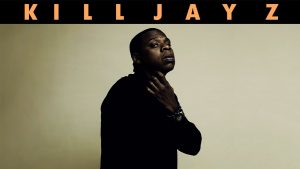 Okay, so the “disappearance” of an author from her writing, or a rapper from her lyrics, or a human entity from her persona, can be contested in some aspects of hip-hop music. But what happens when there is a purposeful self-erasure and redefinition of an author’s persona? Maybe in looking at the first song on Jay-Z’s latest album, “Kill Jay Z,” we can realign ourselves with some aspects of Foucault’s thinking. Michel believes that “the author also constitutes a principle of unity in writing where any unevenness of production is ascribed to changes caused by evolution, maturation, or outside influence,” and we need only take a short look at the lyrics in “Kill Jay Z” to see the ways in which Jay-Z’s content has matured as he has.