I have been guilty of skipping the preface. And the foreword to the preface. And the prologue to the foreword to the preface. It only recently occurred to me that a school of literary theorists, headed by Wimsatt and Beardsley, are ready to formally clear me of blame: The New Critics are not interested in authors’ intentions or their biographical details. They believe that the intentions of authors are elusive, and moreover, irrelevant. Anything a text says is there in the text, already. Wimsatt and Beardsley are prodding at the how-to of reading—should we poke around authors’ private correspondence and life history as we read, or would doing so distract from, or worse yet, obscure the meaning of the text itself? On this matter, let me chide my idleness: I hope to reenact how a text—David Foster Wallace’s 2005 commencement speech delivered at Kenyon College, This Is Water, in this case—can have a ghostly, mitigated author buried within it, and why knowing more about authors and their intentions would help us get at readings that would otherwise escape us. [1]

A bandanna-free David Foster Wallace, Kenyon College, 2005
It will prove helpful to begin with the intuition that inspired the Wimsatt Law forbidding readers from considering authorial intents—namely, that intentions are tricky to nail down. Careful observers will find that we never had access to authors’ intentions, merely their statements of intentions, at best. Mediated by language, these statements inherit the problematic nature of all writing: they are “regulated less by the content [they signify] than by the very nature of the signifier” (Foucault 116). Free of their object referent, the statements could well have very little say on author’s true intensions; what we can be sure of is that intentions are only ever available to us in a state corrupted by projections of biases from the language’s user. The consequence of this observation is ubiquitous yet often glossed over. This Is Water deems it significant enough to meditate, on a literal level, how differing interpretations, colored by self-centeredness, can stem from one formulation. At one point in the text is a “didactic little story” of an atheist and a religious man, the former of which is saved in a blizzard by a couple Eskimos. Where the religious sees proof of God’s existence, the atheist knows only “all that happened was that a couple Eskimos just happened to come wandering by” (Wallace 16-23). The text spells out the obvious take-away: “It’s easy to run this story through a kind of standard liberal arts analysis: The exact same experience can mean two completely different things to two different people, given those people’s two different belief templates and two different ways of constructing meaning from experience” (Wallace 24). At the same time, it is hesitant to announce even such a relativist reading definitive, accusing the analysis of assuming that “how we construct meaning were not actually a matter of personal, intentional choice, of conscious decision” (Wallace 28). The point here is simply that, like how religious orientation and education background can prefigure individual interpretation to some degree, statements of intents is a fair playground for prejudice—authors unintentionally spin their intentions. Therefore, “intensions” have no business being taken at face value, as the final word for how a text is to be understood.
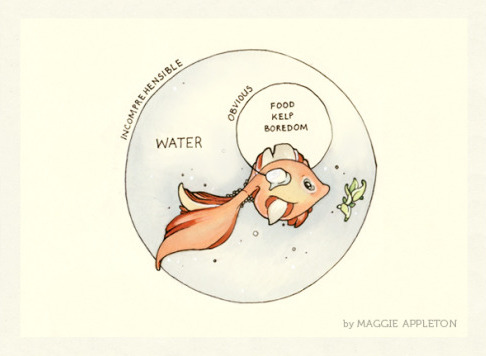
A related but different thesis involves projections from readers’ end of the communication. If it holds that representations are chained by biases, it must also hold that “aspects of an individual, which we designate as an author… are projections… of our way of handling texts” (Foucault 127). Who, or what we commonly deem as “the author” is no more than “the configuration of the author” (Foucault 127). Here it is not hard to imagine a sense in which authors die in writing—their communicative abilities lamed, their messages truncated. More interestingly, writing is not only “the sacrifice of life itself; it is a voluntary [emphasis added] obliteration of the self” (Foucault 117). The speaker of This Is Water is blatantly aware that his or her persuasion is limited. The text is interjected three times by utterances along the lines of “but if you’re worried that I plan to present myself here as the wise old fish explaining what water is to you younger fish, please don’t be. I am not the wise old fish” (Wallace 6-7). Rather, it is dutifully acknowledged that “you get to consciously decide what has meaning and what hasn’t” (Wallace 95)—that readers must figure into the interpretation of the text.
But I cannot honestly toll the death knell on authors, not seriously. They are not totally wiped out on so many levels. One might argue that an image of Wallace is too readily available: he leaves “a legacy composed not only of his novels and essays, and of pieces written about him—official obituaries, elegies, and scholarly papers—but also of a vast and growing system of Web sites, e-mails, message boards, and blogs—and comments on those blogs, and comments on those comments, ad infinitum” (Krajeski). I would argue it is not coincidence that for an author whose work is strewn with footnotes, Wallace had a similarly annotated life. He worked with mediums whose author is hard to kill. Pause on the particularity of the commencement address as a literary form, and the difference in potency of the author’s presence is apparent. Unlike fiction, where authors orchestrate characters, the speaker of This Is Water aligns with Wallace the public writer persona I construct. It is a longish interview session of “Say, what do you have to tell the bright, young minds?” The Wimsattian readers will have to confront the “problematic nature of the word ‘work’”—or, “how a work can be extracted from the millions of traces left by an individual after his death” (Foucault 119). This Is Water abounds with instances where the speaker names his or her designs: “Obviously, you can think of it whatever you wish. But please don’t dismiss it as some finger-wagging Dr. Laura sermon” (Wallace 126-127). Even when concession is made to readers’ interpretive freedom, communicative power is not annihilated. The Wimsatt-minded would maintain that even in non-fictional writing, claims made by the “I” of the text is to be attributed to an anonymous addresser, but I would be kidding with myself to give that in the speech’s inception form, delivered on a “dry and lovely morning” (Wallace 10), its addresser is not be the writer Wallace persona I keep painting. In our case, at least, I am comfortable pronouncing the author not quite dead.
In fact, it is seriously questionable whether the hardly feasible Wimsattian project is desirable, at all: Underpinning true authorial intents is impossible, but the study of authorial images is not harmful nor unfruitful. While it is true that learning about what authors say they meant cannot place meaning in the text that isn’t there in the first place, that such information has no independent authority, the image we have can serve as clues pointing to features within the text previously unnoticed, or even unnoticeable. So long as an analysis is supported with textual evidence, there is no good reason to exile statements of intents. Indeed, there is good reason not to be a Wimsattian. Investigation of authors’ images adds “discursive properties… irreducible to the rules of grammar and logic” (Foucault 137). The close reading Wimsatt and Beardsley propose is a closed reading, terrified of proliferation of text. But multiplicity is hardly daunting; it often makes the text an awful lot more interesting. Allow me to bring in a sample of Wallace’s remarks and biography outside of This Is Water in piecewise fashion, and stage how they inform the search for textual evidence revealing new readings:
Exhibit A: Like all authors, Wallace is frequently asked in interviews to touch on the design of his work. The gist of his replies is something two-fold: “Really good fiction… [would] find a way both to depict this world and to illuminate the possibilities for being alive and human in it” (McCaffery 26). With this in mind, we discover the fundamental matters of writing for Wallace in the background of This Is Water. There is in the text a detailed account of a tediously mundane supermarket trip that exemplifies the “rat race” (Wallace 123) of adult American life. The text follows up with, “[t]he point is that petty, frustrating crap like this is exactly where the work of choosing comes in” (Wallace 76): “[Y]ou get to decide how you’re going to try to see it” (Wallace 94). Taking note of how the text reconstructs “what’s dreadful” in an attempt to “move people” (McCaffery 32), This Is Water is no longer dealing only with solipsism and compassion; it is also grappling with the question of how to write.

Still from a short created by The Glossary, inspired by This Is Water
Exhibit B: On how to achieve his two-fold ambition, Wallace commented, “[r]eally good work probably comes out of a willingness to… sort of die in order to move the reader, somehow. … Maybe it’s as simple as trying to make the writing more generous and less ego-driven” (McCaffery 50-51). Suddenly it is not so difficult to hear a similar ring in This Is Water: when the text appeals to the ability “to care about other people and to sacrifice for them, over and over” (Wallace 120), we begin to wonder if the text can be extended to deliberate on the egos of authors and their “sort of” dead status. More on his method, Wallace revealed a deviation from his earlier style: “The parts of me that used to think I was different or smarter or whatever almost made me die” (Lipsky 174). This sentiment is, again, echoed in the commencement speech: “Probably the most dangerous thing about an academic education, at least in my own case, is that it enables my tendency to over-intellectualize stuff, to get lost in abstract thinking” (Wallace 48). It is unsurprising that a Wallace scholar refers to biography in a footnote when he accredits “Wallace’s more negative orientation” for inspiring a shift for “a relatively optimistic ethos” in Wallace’s successors (Konstantinou 106). The little piece of interview functions as the tipster for finding textual traces, which eventually informs a study of thematic modification.
Exhibit C (and this one is hard to ignore): What happens to This Is Water when we let in the fact that Wallace suffered depression and committed suicide three years after the speech? What of report that linked his dwindling final state with his suspension of an antidepressant, out of suspicion that it was “interfering with his creative evolution” (Max)? The water churns; the image is now one of a martyr for literature, a patron-saint of the tortured genius, a celebrity writer dude. Let us revisit the supermarket scene: “and of course there are also the glacially slow old people and the spacey people and the ADHD kids who all block the aisle, and you have to grit your teeth and try to be polite as you ask them to let you by, and eventually, finally, you get all your supper supplies, except now it turns out there aren’t enough checkout lanes open” (Wallace 70-71). The unflaggingly funny and warm address now takes on edges of chilling-in-hindsight darkness as we peer through the “obsessive, recursive, exhausting, and pathologically self-aware prose style” (Scott). When the text insists that the “capital-T Truth” of life “is about making it to thirty, or maybe even fifty, without wanting to shoot yourself in the head” (Wallace 130), we now hear Wallace addressing a ghostly self. The suicide throws open the debate of whether his death defeats his cause—does what might be considered his personal “failure” at his project undermine all its value? Or, is there a sense in which he succeeded, executing his principle of sacrificing for readers all too well? These questions we would lose, were we Wimsattian readers. Some critics, despite their “fear… that Wallace’s work will forever be read through the way that he died”, deem it impossible to fully understand Wallace’s last and unfinished novel “without reckoning in what Wallace was feeling and thinking about writing and about himself as a writer at the time he wrote it” (Cohen 59). I would not say that this reading is the “full” reading, or even the “fuller” reading, but I am ready to consider the additional insights into the book Wallace’s life sheds light on.
“Think of the old cliché about the mind being ‘an excellent servant but a terrible master.’ … It is not the least bit coincidental that adults who commit suicide with firearms nearly always shoot themselves in… the head” (Wallace 56, 58). The publisher of this booklet I quote from, when stretching This Is Water to fill 138 pages, found the liberty to remove the line that follows in the original speech: “They shoot the terrible master”. The edit’s defendants claim that “any mention of self-annihilation in Wallace’s work… now has a blast radius that obscures everything around it” (Bissell), and that the removal preserves the original message. What I see, here, is a baseless executive decision: I am skeptical that the editors could distinguish the speech’s “original meaning” in light of Wallace’s new image any better than the next reader. Their crazed obsession with the “original meaning” is such that they even chopped at the text. This fear of diverging readings is quite contradictory, when we think about it, to their starting claim that language is independent of its object of reference as well as its speaker. In the wake of a case where the death of the author is made all too literal, we find tethered to the text a ghost-shaped author, who surrenders the authoritative say on what a work “is supposed to mean”, but haunts it, nonetheless, bound and inseparable to the artifice. As long as I treat authors as sites of inquiry, critics or editors will not succeed to pre-select for me what I may or may not know, in the hopes of funneling my understanding to fit theirs. Does it matter that Wallace’s email handle was “ocapmycap@…”? After all, who can lay claim to ever pinning down anyone’s drives: “My Captain does not answer, his lips are pale and still” (Whitman). The point here is not that you must consider the author; effective criticism is not about dogmas. To use Wallace’s words, I’m only asking that you be “aware enough to give yourself a choice” (Wallace 89).[2]
Notes
[1] My approach is indebted to Michel Foucault, “What Is an Author?”
[2] This essay was read by Jessica Zong.
Works Cited
Cohen, Sameul. “To Wish to Try to Sing to the Next Generation: Infinite Jest’s History.” The Legacy of David Foster Wallace, edited by Samuel Cohen and Lee Konstantinou, University of Iowa Press, 2012.
Foucault, Michel. “What Is an Author?” Language, Counter-Memory, Practice: Selected Essays and Interviews. Cornell University Press, 1980.
Konstantinou, Lee. “No Bull: David Foster Wallace and Postironic Belief.” The Legacy of David Foster Wallace, edited by Samuel Cohen and Lee Konstantinou, University of Iowa Press, 2012.
Krajeski, Jenna. “This Is Water.” New Yorker, September 19, 2008, newyorker.com/books/page-turner/this-is-water. Accessed April 23, 2018.
Max, D. T. “The Unfinished.” New Yorker, March 9, 2009, newyorker.com/magazine/2009/03/09/the-unfinished. Accessed April 23, 2018.
Scott, A. O. “The Best Mind of His Generation.” New York Times, September 20, 2008, nytimes.com/2008/09/21/weekinreview/21scott.html. Accessed April 23, 2018.
Wallace, David Foster. “An Expanded Interview with David Foster Wallace.” Interview by Larry McCaffery, 1993. Conversations with David Foster Wallace, edited by Stephen J. Burn, University Press of Mississippi, 2012.
Wallace, David Foster. “The Lost Years and Last Days of David Foster Wallace.” Interview by David Lipsky, 2008. Conversations with David Foster Wallace, edited by Stephen J. Burn, University Press of Mississippi, 2012.
Wallace, David Foster. This Is Water: Some Thoughts, Delivered on a Significant Occasion, about Living a Compassionate Life. Little, Brown and Company, 2009.
Whitman, Walt. “O Captain! My Captain!” Leaves of Grass. Philadelphia, David McKay, 1891.