Adorno’s Jargon of Authenticity, Day 13

This next bit of Adorno we should sidle up to. We set out from a far-flung question: What happens when a scholar sets out to study small Protestant churches in the American South? Does anything of note transpire when a sociologist of religion and a squirming of Pentecostals find themselves in the same room? There are any number of books you could consult in order to answer that question: You could read the Brown University ethnographer who traveled to Virginia year after year to record “speech, chant, and song in an Appalachian Baptist church.” You could read the LSU linguist who spent his 20s transcribing sermons preached in the Baptist churches of rural Texas. You could read the PhD medievalist who ditched Chaucer in order to study folk preachers in North Carolina and Oklahoma and migrant California. So again: what happens when an anthropologist shows up in a Kentucky meetinghouse with a clipboard and a tally counter? Any of these books will lead you to three observations:

First, the scholar will engage in close observation: The man in front of the congregation is speaking in something like conversational cadences. His tone might be emphatic, his voice might be charged with emotion, but he is still in some recognizable sense addressing the worshippers, trying to make himself understood: “As the old book says…” Before long, however, explanation edges into exhortation, and the speaker’s rhythms begin to tighten. Short, repeated sentences replace longer, expository utterances. Words begin to fall into a musical meter, often a swaying, compound pulse. A sound now punctuates every period—a distinct, audible intake of breath or holy grunt; the preacher is marking time as he draws breath. In some cases, his voice compresses to a rapid, nasal monotone, as the sermon morphs into improvised, tumbling chant. In other churches, speech gives way to something like song, as the preacher’s voice locks into a musical key, selecting a tonic and then modulating to defined pitches. Sometimes, the preacher routes his speech through his nose on the high end of a phrase to pierce the room, only to drop into a low, raspy groan on the exhale.

Second, and beyond mere description, the scholar will find things to count, measuring the inner light, calculating the motions of the spirit: a tick in one column every time the preacher barks an end-stop; an x in a second column whenever a neighbor woman breaks out into spontaneous prayer. Grunts fall at three-second intervals. … A preacher typically utters between five and ten syllables between breaths. … Typically, a full minute of conversational preaching is followed by roughly thirty seconds of chant. There are charts to be generated: What percentage of the congregation’s exclamations are addressed to the preacher and what percentage to God? What does the whoop look like on a sonogram?

Third, the scholar will contravene the preachers’ account of their own conduct—and especially of its sources or causes. A hot Protestant preacher will insist, of course, that the words he speaks when preaching aright are not genuinely his own—that he “is being led by the Spirit,” that “the power is all over him,” that he chants only when the “Holy Ghost has hit him.” When he uses phrases like these, he is letting you know that his remarks have not been prepared; he is not sharing his considered wisdom. Quite the contrary: He is speaking God’s own words, which have arrived in instants of sudden, unreflective inspiration, and is thus burbling an insight that might be new to him at the very moment of its utterance. The most important thing in this scenario—the only way to stay open to the Spirit—is to relinquish a certain rhetorical effort, to “not try to do it within yourself.” Rubbish, says the Brown University ethnomusicologist, not to the preacher, but sotto voce to the reader: Holiness preaching is a “performance,” and like any performance, it is “intentional” and “rule-bound.” One folklorist thinks we can account for Pentecostal preaching by deploying the Parry-Lord theory of oral composition, as though revival-tent stompers were Homeric bards or Bosnian guslari, Shenandoah jongleurs with a stock of verbal formulae pilfered from old country gospel 45s. In a Virginia up-country church, writes the professor, “Affect is brought into being by performance.” Spirit gets reclassified here as a method or technique; a skill; a vibe generator and feeling machine.

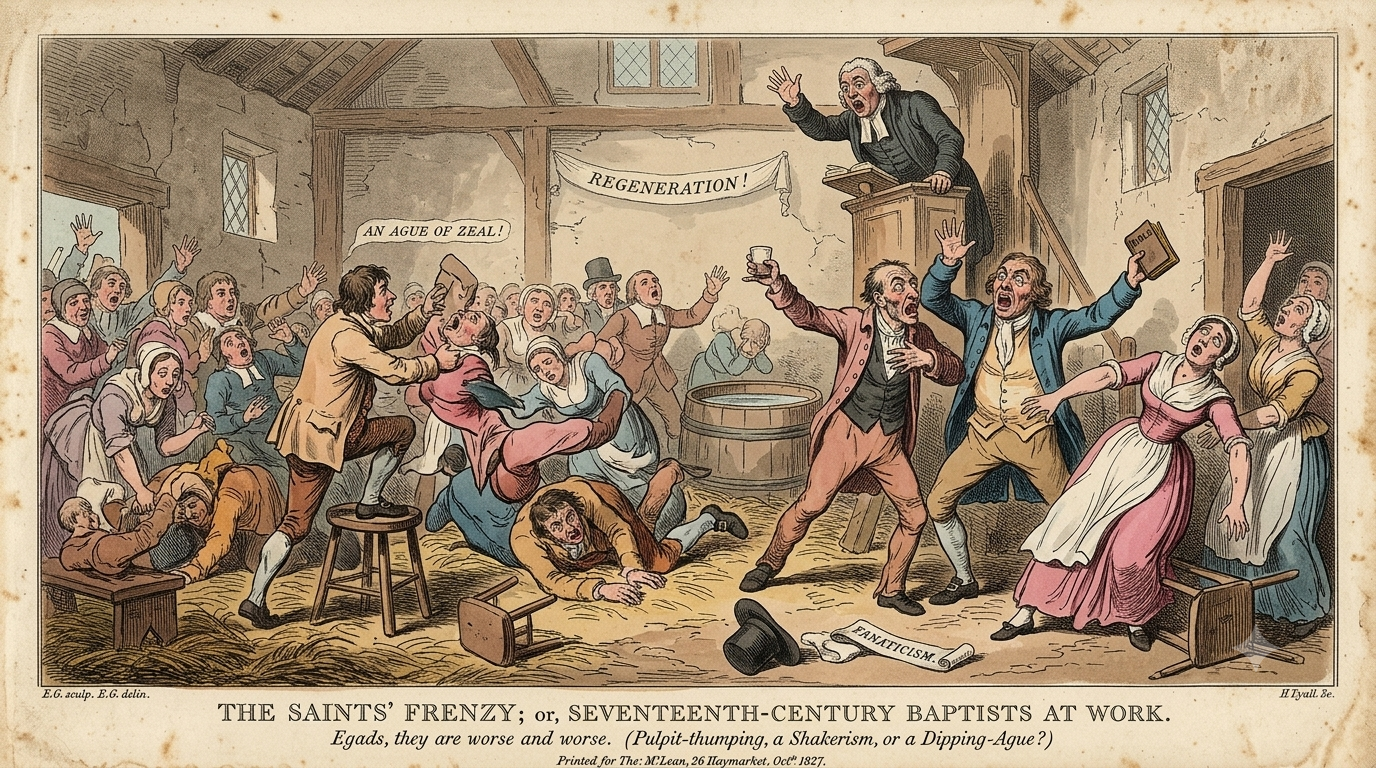
The original for all such arguments is a short text first published in 1704, usually referred to as “The Mechanical Operation of the Spirit.” It is, to all appearances, a “philosophical letter” written by an unnamed gentleman scholar with connections to the Royal Society and addressed to a fellow virtuoso living somewhere outside of England. Before the existence of scholarly journals, such letters were the primary way that scientific research was shared. In the 1660s, the Secretary of the Royal Society effectively invented the scientific periodical by contriving to have his inbound mail printed and sold: one correspondent announces that he has discovered tiny, living animalcules in human saliva; a second describes Jupiter’s Great Red Spot; a pair of experimentalists writes in to detail their attempts at transferring blood from a sheep to a human. Our author’s contribution to this invisible college is “to examine, by what Methods [a Quaker or Baptist] Teacher arrives at his Gifts or Spirit or Light; and by what Intercourse between him and his Assembly, it is cultivated and supported.” To this end, he carefully describes the Nonconformists at worship, their “perpetual Motion of See-saw,” their “long Hums at proper Periods.” He devotes a long passage to the preacher’s “Skill in tuning and toning each Word, and Syllable, and Letter, to their due Cadence”—hence, his unusual “dwelling and dilating upon” the spoken language, a “conveying of the Sound thro’ the Nose” that congregations seem to find thrilling, even if it is a kind of “Snuffling.” It is on the basis of such observations, enumerated across some twenty pages, that the scientist feels licensed to identify a causal mechanism. How, after all, do Quakers kindle the inner light? On what fuel does it run?

If I say now that a “Mechanical Operation of the Spirit” reads a lot like some improbably early entry in OUP’s Religion in America series, it is only so I can pivot and insist that the early text has some distinctive features of its own. A genteel amateur writing under a Stuart monarch will not notice exactly the same things or propose exactly the same explanations as a Berkeley-trained literary critic writing in the 1970s. Let’s take stock of the three most consequential differences:

The 1704 essay is forthrightly hostile to spiritualist religion. The distinction here is perhaps a tad subtle: The modern folklorist cannot help but classify the Pentecostal preacher as a kind of folk artist—it is the category readiest to hand—ranking the man of the spirit alongside the mining-town fiddler and the keeper of community lore and so framing the preacher’s conduct in terms that the Protestants being studied would have to reject. It’s just that the folklorist knows to screen his critique behind a murmur of admiration: He tells his learned readers that he writes in defense of the mountain people—theirs is not a “backward and deviant culture of poverty.” “I must admit I find much to admire in their efforts.” “They are outstanding performers of religious language”—and there it is, the word “performers.” Everyone stand and clap for the choir. The scholar praises the Blue Ridge Baptists for doing to a perfection something they don’t think they are doing at all—performing. Lacking the courage of his pugnacity, the folklorist demystifies the folk despite himself, this enlightener who says he rather likes the atmospherics of a dimly lit room. “The Mechanical Operation of the Spirit” isn’t like that. It drives a gleeful wedge between the spiritualist self-understanding of the early Baptists and the novel modes of materialist explanation that the natural philosopher deploys to analyze the anima. You can probably hear this in the essay’s very title, with its teasing reductionism and near-paradox: “The Mechanical Operation of this Non-mechanical Non-thing.” But that’s just the start of it. Keep reading and by the time you have finished the pamphlet you will have learned: 1) that the first preacher to achieve a penetrating, high-nasal tone landed on that adenoidal hum because syphilis had eaten away the bridge of his nose; and that others decided to emulate this, the pitch of the French disease, but without going to the trouble of contracting it first; 2) that Puritans first took to “the Twang of the Nose” to replace the droning of the bagpipes that they had more or less banned—the Nonconformist preacher makes up for Sunday’s missing music with his own rhinal skirl; 3) that Quaker men “in the Height and Orgasmus of their Spiritual exercise” commonly ejaculate into their plain, gray breeches. The difference between the old text and the new can be telegraphed in a single letter: What the modern folklorist calls “chant,” the late-Stuart virtuoso calls “cant.”

That’s the first important difference.

The second difference is that the 1704 essay is a fake, a gag, a prank. That’s the big swerve, obviously—the early letter is not real: It’s a satire, which you would have figured out already if I had told you at the outset that it was written by Jonathan Swift, who one imagines did not actually believe that Quaker women were all sex addicts. “The Mechanical Operation” first appeared in a collection alongside two other texts: A Tale of a Tub, Swift’s jokey allegory defending the Church of England against Catholicism and Dissent; and The Battle of the Books, his mock-epic recounting of the conflict between writers ancient and modern, in which the volumes of a well-stocked reading room metamorphose into their very authors and fight each other to the death on the library floor. There is thus little danger that an early eighteenth-century reader would have mistaken “The Mechanical Operation of the Spirit” for an actual scientific tract. At one point, Swift’s philosopher explains why Quakers quake: Because Quaker men never remove their hats, the heat that would otherwise dissipate through their brainpans gets trapped, blocked by a broad disc of undoffed felt, which accordingly forces the heat back into the Quaker’s body, transforming his torso into a seething kettle. This human pressure cooker will now jiggle like a stovetop regulator, rocking and dancing in frustrated cycles of lift and release. That’s why Quakers quake. The pamphlet is therefore not a materialist account of spiritualist Protestantism; it is a mock-materialist account of same; and this will have some important consequences of its own. To wit:

     The 1704 pamphlet is not vindicating science but parodying it. If the modern ethnographers attempt an awkwardly twofold affirmation, endorsing both old-time religion and their own protocols of materialist explanation by simply ignoring the evident conflict between the two, Swift is content to turn this procedure upside-down, negating both terms rather than reconciling (or failing to reconcile) them. Such is the peculiar temper of Swift’s talent, beyond his uncanny ability to parody in advance an entire category of scholarly writing—a Dewey decimal number—that didn’t exist in 1704. The “Mechanical Operation” is unmistakably burlesquing the Quakers and the Baptists; it is making them look ridiculous. But it is simultaneously sabotaging the materialist idiom that is spiritualism’s demystifying antithesis. In large part, this sabotage is the spontaneous effect of skilled mimicry. Imitation will tend all by itself to initiate a skepticism toward the imitated thing, reducing the discourse in question to a rhetoric, a set of conventions, a way of talking. Parody calls attention to the performative dimensions of its targets and thereby makes it harder for these to function as vehicles of truth, wisdom, or authority. If you can convincingly simulate the mechanical philosophy, then you are demonstrating to your reader how easy it is to fabricate outrageous lies in scientific prose.

Some clarification: By going after natural philosophy, Swift ends up mimicking the conventions of at least two other genres, since these were (some of) the ingredients out of which early scientific discourse was compounded. The first tag-along genre is travel writing, with which natural philosophy enjoyed a symbiotic relationship: Philosophers relied heavily on travelers to gather raw data about the natural world, even as travel writers gradually adopted the prose styles of the new science to lend credibility to their accounts. Swift’s fake philosopher thus sends his regards to the gentleman scientists of the Iroquois and complains that it’s been ages since he last had a letter from the indigenous researchers of the Brazilian interior. More to the point, he says that Quakers and Baptists are England’s own version of Islamic militants or Chinese millenarians—the White Lotus of Whitechapel.

The second tag-along genre is the so-called book of secrets. In a culture that lacked strong commitments to public knowledge, books of secrets were by modern standards fairly unremarkable how-to books or household manuals, which claimed, however, to be disclosing hitherto protected artisanal techniques, the steps and methods that guilds supposedly compelled their members not to share. A book of secrets would promise to initiate you into the esoteric mystery of, say, making shampoo. Swift uses this language throughout: His scientist is in a special position to analyze radical Protestant worship because he has been “initiated into the Mystery” of the chant. It will turn out, however, that the mystery is unmysterious—that the Quakers’ “venting of spiritual Gifts is nothing but a Trade.” The mechanical philosopher thus pledges to teach the reader “the whole process … as it hath fallen under my Knowledge or Experience.” The word mechanical in the satire’s title thereby acquires a second meaning. Alongside “machine-like” or “mathematizing” or “Cartesian,” mechanical also means “plebeian.” Spiritualist Protestantism is religion for mechanics—an “operation … performed by our British Workmen.”

The point I don’t want us to miss is that when the satire parrots the language of travel writing and the book of secrets, it is not altogether disclaiming the knowledge produced by those genres. You can plausibly read Swift as maintaining that Nonconformists really are like religious rebels in other parts of the world—that they present a threat that has already demonstrated itself in Safavid Persia or Almoravid Morocco. Nor is Swift just riffing when he refers to radical Protestants as “workmen”; lay preachers were in fact a conspicuous feature of early English Baptistry—shoemaker-preachers, soap-boiler preachers, a lace-maker preacheress. In these passages, then, the satire is generating something like claims: that the Quakers are a rabble, that radical religion is more heathen than Christian; &c.

But when Swift goes directly after the mechanical philosophy, this is no longer the case. The residue of epistemological sincerity is washed away. This might be easier to show than to explain. At one point, Swift’s scientist offers to give a materialist account of the brain, and if we paraphrased his claims at a high enough level of abstraction, we could make him sound like a modern neuroscientist. The brain, he says, is a composite organ. Writing around the year 1700, he obviously can’t talk about neurons and glial cells, and he doesn’t exactly understand the brain as a network of differentiated sub-structures—an organ of organs—but he insists even so that the brain is a multiplicity. What he says, specifically, is that the “Brain is only a Crowd of little Animals … like Bees in a perpendicular Swarm upon a Tree, or like a Carrion corrupted into Vermin, still preserving the Shape and Figure of the Mother Animal.” The brain is a writhing heap of maggots. And to this he adds the claim that thought is nothing more than the agitation of the brain’s sinew, though he forgivably lacks any account of neurons firing in pyrotechnic unison or chemicals traveling across synapses. What he says instead is that the brain’s skull-grubs, when exposed to heat, will bite—will “imprint the Marks of their little Teeth.” It is these lice-bites, then, that activate the nerves and so produce thought: different thoughts for different kinds of bite, different sets of the mouth or angles of dental attack. A hexagonal lice-bite “produces Poetry,” a “conical” lice-bite makes a person want to write about politics, and so on. And the only reason that Pentecostal preachers are able to discourse so fluently about God is that they’ve figured out how to keep their brain-lice hot. (“It is unlikely,” writes the ex-Chaucerian, “that all of the [Baptist] churches are hot all of the time, but it always feels that way. The buildings, often fibre or plywood siding nailed on wooden uprights that barely support the low ceiling, are in effect dutch ovens. Everyone is sweating all the time.”) This is what I meant when I said that Swift’s parody of the mechanical philosophy was subtly different from his mimicking of the travel writers or the spillers of secrets: The natural philosopher’s claims are so outlandish as to discredit themselves. Along the way, Swift produces what is perhaps the most repugnant image in the history of mind-brain reductionism: Mucus, he says, is the excrement produced by the tiny worms that make up the brain, and the runny nose you had last March was thus really maggot diarrhea. (Sooner or later, some scholar will have to examine gross-out humor’s contribution to philosophical skepticism.) This is the perfect Swiftian passage: Swift is saying that what hot Protestants take to be the voice of God is really just the buzzing of cranial mosquitoes—but he has found a way to couch that point in a materialist idiom that you will not be tempted to credit. The insult lands, and its vehicle promptly dissolves, like the self-destructing message sent by headquarters to the super-spy. Spirit isn’t just a bone; it’s a bug bite.

With Swift still open in front of us, we’re in a good position to notice some important features of Adorno’s writing. We look back to The Jargon—Adorno has just been describing how existentialist notions of authentic “utterance” give priority to the speaker over what he is speaking about:

This formal character makes the jargon well suited to demagogic ends. A person well-versed in the jargon does not need to say what he thinks, nor even really to think it: the jargon takes care of that for him and cancels the thought—it punches thought’s ticket. Authentic: the pivotal thing is that a man speaks with his whole being. In the process, something happens that the jargon itself styles an Event or an Enowning. Communication clicks into place, advertising a truth that ought to be deemed rather suspicious by virtue of the prompt and collective consensus it elicits. The attunement of the jargon carries something of an augur’s solemnity, indiscriminately conniving with any and all initiates.

Adorno is aligning three concepts here: demagogy, mechanism, and abstraction. First, he’s flagging the German existentialists’ fondness for gurus and masters. Philosopher-pilgrims trek into the Black Forest to gather kindling with Heidegger, phenomenologizing amidst the silver firs. Authenticity breeds acolytes. Adorno, of course, is taunting the neo-mandarins here: The opponents of mass society turn out to be just another iteration of the demos, a higher rabble, ontology’s fanboys. When theory boys form a circle, then, they do so mechanically, which is to say unthinkingly, brandishing philosophemes like passwords, stoked to see anyone wearing an Agamben T-shirt, flashing a thumbs-up to anyone with a Hannah Arendt sticker on their water bottle. (Mechanically: The jargon voids each thought like a canceling machine voiding a postage stamp; when speaker and listener both know the buzzwords, “communication clicks into place.”) And this automatism is only possible because the buzzwords that theory boys use in one another’s presence have ceased to mean much of anything; they have been attenuated into higher abstraction. If you have latched, for instance, onto the word “network,” you now face a rather daunting choice. Whenever you find yourself proclaiming that x (the US government, a car battery, a scientific fact) is not a thing but a network, you can either clear your schedule and do the hard work of mapping out the network’s many lines, channels, knots, and nodes; or—you can not bother. You can just dub the state a rhizome and move on. In the second case, you are flaunting the concept without actually having the thought—without synthesizing the object into the appropriate thought-form. And Adorno holds that it is the truncation of cognitive categories into unrealized verbal tags that makes it easy for theory types to form into clubs and cliques: Under-thought thoughts produce the facade of mutual understanding, simply by leaving so little to adjudicate.

To this, Swift allows us to add two important observations:

First, Adorno here slips into something rather like parody. Along the way,  he actually lets you know that he has started using the jargon, which is perhaps a lapse of satirical technique: Something happens that the Heideggerians themselves call an Ereignis. Adorno elbows you in the ribs, at which point you might look back over the last few sentences and realize that he has already begun writing in mandarin.

•This begins with the word kernig. What I have translated as “the pivotal thing” seems to have enjoyed something of a vogue among German intellectuals after World War II: “Kernig ist….” That’s non-standard German, unlisted in this usage even in large German dictionaries. The word kernig is ordinary enough—it’s an adjective derived from the noun Kern (a core” or a “kernel” or the “pit” of a stone fruit). In modern German, it means “pithy” or “robust” or “hearty,” even something like “down-to-earth.” But none of those translations work here. If you stick with “core,” however, the meaning is clear enough. “The core thing is…” “That a man speaks with his whole being” is the crux, the key, the root. The petty existentialists seem to have used the word to boast that they were cutting to the heart of the matter. Kernig is meant to carry a grounded, unpretentious weight, evoking something pared down and foundational—it’s an agrarian riff on plain speech and maybe even a kind of hayseed Wesenschau: “Corny is….”

•“Attunement” you probably recognize—it’s Heidegger’s Gestimmtheit, a fundamental mood, a way of being attuned to the world, an emotional coloration that allows some of the world’s things to appear readily and others not at all.

•What an English-speaker is unlikely to catch is that even capital-K Kommunikation was existentialist jargon when Adorno was writing. “Communication” was a term strongly associated with Karl Jaspers, for whom it meant a rare, radical openness between two human beings or the “loving struggle” of people in unguarded dialogue; Adorno is thus harrumphing when he observes that existentialist communication is actually  perfunctory, snicking into place like a handle catching in a latch. And across these sentences, he is suddenly piling on the jargon, stringing its buzzwords together in what briefly resembles pastiche. A lot of readers like Adorno best when he’s being catty, but it’s more than that: One is reminded here that dialectics is and always has been a close cousin to satire, declining to contradict its philosophical rivals from the outside, reluctant to oppose their claims with some finally elective counter-claims of its own, temporarily inhabiting any position that catches its attention so as to discern the latter’s failures through feats of extrapolation and exaggeration.

     The other thing that Swift brings to the table is that double negation: both he and Adorno describe the mechanical operation of the spirit while endorsing neither the mechanism nor the spirit. It’s easy to get this wrong when discussing Adorno: You might have read “The Culture Industry” and concluded that Adorno was striking a conventionally anti-industrial pose. You might even recall that the word “culture” began as a synonym for “growing” or “farming” or “tending the land”: agriculture, the farming of crops; silviculture, the farming of trees; viticulture, the farming of grapes for wine. The word “culture” is intrinsically agrarian; our familiar use of the term asks us to see art as the practice of self-cultivation or as a way of tending humans the way one might tend stalks—helping them grow. All by itself, the word associates painting and music and literature with peasants and provincials. It should be harder than it is to treat the word “cultured” as a synonym for “urbane.” And the term “culture industry” thus teeters on oxymoron in almost exactly the same register as “factory farming.” Each phrase suggests a process that has swallowed up its historical antithesis—same (technological) process, same (rural) antithesis. At no point does Adorno sound more like a mandarin than when he comes out against industrialization in this way; and when he identifies the automatism of the jargon—of language that punches thought’s ticket—he is thus dinging the neo-mandarins of the 1950s with one of their own arguments. The people most likely to reject mechanism lapse repeatedly back into intellectual mechanism. If we stopped here, however, we would be left with the impression that Adorno was defending culture in the terms that come most readily to the humanist—as the domain of independent thought and free inwardness. But that obviously isn’t Adorno’s way. His more typical position is to target philosophy’s hubris—its elevation of Mind or Spirit to an absolute self-generating principle that denies its material dependence. To wit:

•The signature of every idealism is rage. [Negative Dialectics]

•[The typical intellectual] hypostasizes as an absolute his intellect [his Geist, his spirit], which was only formed through contact with economic reality and abstract exchange relations, and which can become intellect [spirit] solely by reflecting on its own conditions. [Minima Moralia]

•Idealism … is governed unknowingly by an ideology which says that [anything that is other to thought] is worth almost nothing, so that the unity of the self-sustaining thought can devour it in good conscience. [Negative Dialectics]

•Philosophy of any ambition treats as suspect the idea that the object has primacy; resistance to that idea has been institutionalized since Fichte. [Negative Dialectics]

The challenge when reading Adorno, then—and it is this challenge that Swift obligingly alerts us to—is to grasp a critique of mechanism that does not issue mechanically in an affirmation of the non-mechanical spirit. Adorno is going after the jargoneers not only for their routinized use of language, but also for the elevated and putatively autonomous intellectualism that this language claims to enable but actually undermines. Nor can we be all that surprised to find Adorno refusing to pit spirit against mechanism (or, by extension, culture against industry). Pitting A against B is not how the dialectic works. The dialectical philosopher cannot stand on one side of the cracking wishbone and boast about coming up with the longer piece.

Adorno’s Jargon of Authenticity, Day 12

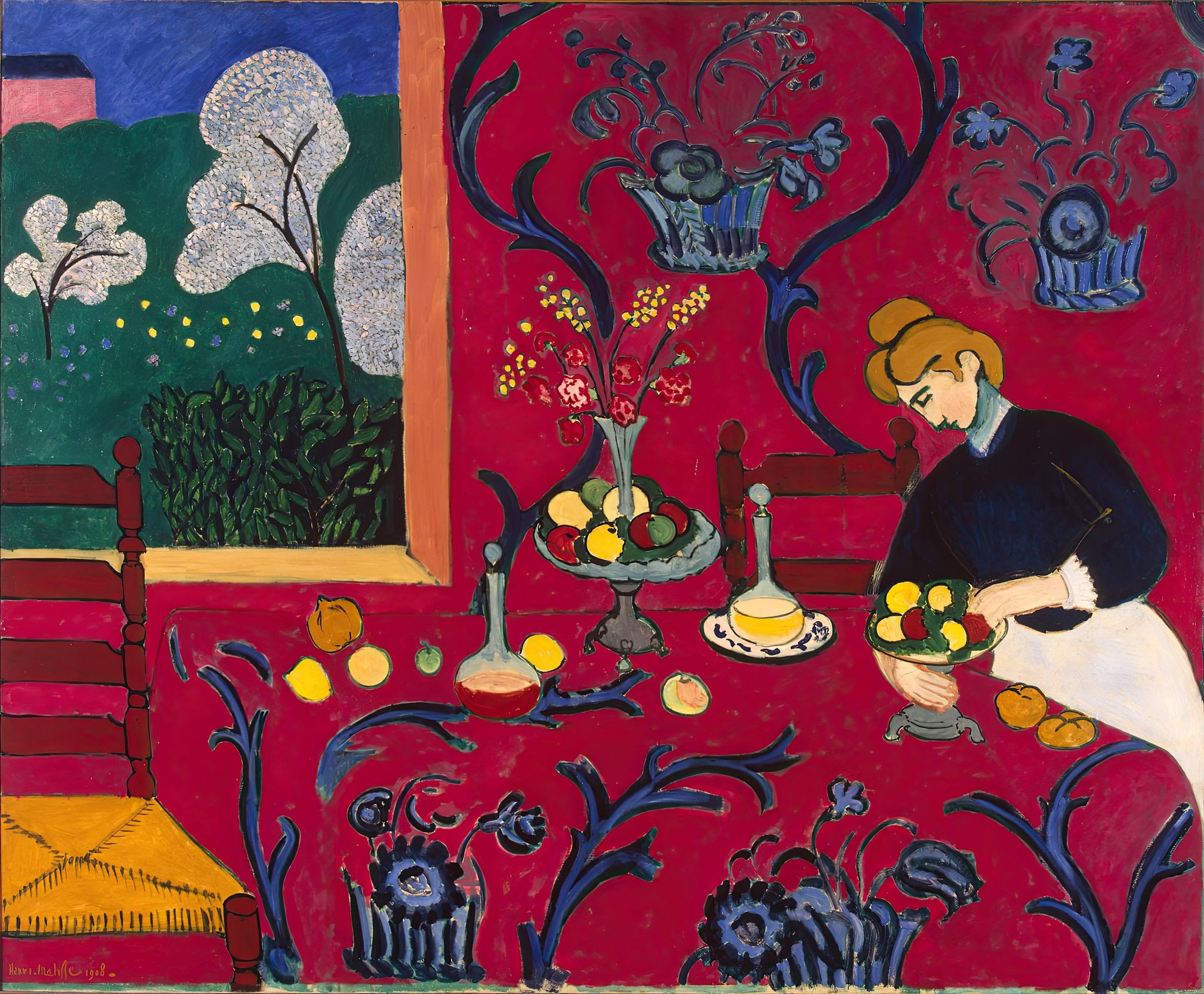
The Dessert: Harmony in Red (The Red Room), 1907. Creator: Henri Matisse. (Photo by Heritage Art/Heritage Images via Getty Images)

The task in front of us now is to get comfortable with the German word Aussage. Let’s start from scratch by noting that Aussage tacks the prefix aus- to the root –sag-. These happen to be two German words with near English equivalents that show very little etymological drift and whose meanings you could accordingly guess: aus means “out”; -sag- means “say.” Together, they form the verb aussagen, “to say out,” or, better, “to state” or “declare.” In modern German, you are most likely to hear the word Aussage—a “saying out”—in one of two domains. 1) Aussage is a legal term meaning “testimony” or a “statement.” You can tell a German policeman that you wish to make an Aussage. In Germany, you can’t exactly plead the fifth, but you can “withhold die Aussage.” Perjury is false-saying-out: one word, no hyphens. 2) At the same time, Aussage appears routinely in philosophical writing, where it means “a proposition”—a sentence capable of being true or false: an assertion. In German, propositional logic is Aussagenlogik.

So apparently the lesser German existentialists and neo-mandarins took a shine to the word Aussage. I hadn’t noticed this before Adorno pointed it out, but he seems to have been right about this. We don’t have to take his word for it. We might consider, for instance, a short essay that appeared in 1969 in the house journal of the Union of Swiss Freethinkers. The author of that essay wants his readers to know that he’s not all that impressed by Europe’s generation of 1968—the longhairs, the student activists, the young leftists tossing around words like “establishment” and “revolution.” As best he can tell—and this really is the heart of the essay—the hippies just want to play pinball. (“I walk into a restaurant stocked with arcade games of all kinds, and I never get over my amazement at the rapture, nay, the ecstasy, with which young people have at these contraptions.”) The essay quickly sketches in a few antitheses; it names the opposites of pinball, various activities that carry the substance that pinball machines putatively lack. The first is what I think I am meant to call lovemaking: “When I was young, I had better things … to do with my girlfriends than play arcade games.” One is charmed, at least, to find a European conservative complaining that the hippies were insufficiently interested in sex. The second, more predictably, is reading: “It is impossible to imagine one of these young people ever picking up a book, except perhaps some tawdry crime novel.” Third, and most tellingly, the essay identifies what should really be going on in a bar: People should be talking, and not just talking, but attitudinizing, sounding off, insulting politicians, being disagreeable. This kind of barstool punditry, the author says, gets a bad rap: It might be ill-informed; it might barely be cogent; but a visitor will marvel even so at the sight of half-drunk men speaking their minds. The essay’s point, then, is that one cannot envision Switzerland’s hairy and pinball-besotted teenagers holding their own at the Stammtisch. And its way of putting this is to point out that young people “do not sit together in order to have a conversation, because they have nothing to say”—or rather: they “are have no Aussage at their disposal.” They “neglect the life of the mind”; they are—and this is the name of the essay—a “Youth without Aussage.”

The following year, a Swiss humor magazine published a single column complaining that Aussage was taking over conversational German like an invasive species, a rapidly growing weed: “like ribwort.” This second author clearly had educated German-speakers in mind. It’s the sort of word, he says, that people reach for to gussy up a late modernist art that has lost its ability to surprise: “the composer who has the underside of the piano beaten with a hammer, the playwright who banters his thrownness-into-nothingness into the bottomless depths of sheer boredom.” Artists of this kind “have nothing to say, and yet they make an Aussage.” These are the usages that survive in everyday German, even now, when the word gets used in connection with film or literature or art. “That novel makes a strong political Aussage.” “What was that movie trying to say? What was the Aussage?” If something is “meaningful” or “substantive” or “persuasive,” or if it “carries weight,” you can say that it is aussagekräftig: statement-strong. It doesn’t have to be a museum installation. It could be, like, your cover letter. The word has plainly survived the Swiss satirist’s scorn. “Aussage,” he wrote in 1970, is a meaningless, “nothing-saying” word. Some writers, the ones who can’t “scrape together anything readable,” can at least “scrape an Aussage into the light.”

Adorno was not alone, at any rate, when he wrote the following:

The word Aussage [statement or testimony] … would have us believe that the speaker’s very existence communicates itself along with the [statement’s] subject matter and that it is the former that confers upon the latter its dignity. All it would take to render speech inauthentic, the jargon intimates, would be to remove the surplus furnished by the speaker—an utterance that paid strict heed to the matter at hand [aka the thing] would be a fateful lapse.

As of the early 1960s, an Aussage derived its authority from “the surplus furnished by the speaker.” What we can say now, then, is that the jargoneers’ use of Aussage was in some respects rather close to the contemporary American idiom “I’m just speaking my truth.” Both suggest a determination to speak authentically, to convey the substance of one’s experience without trimming it to fit and without caring if the declaration rubs other people the wrong way. And both achieve authenticity only by subjectivizing truth, transforming a conviction into an immediate, non-negotiable claim on reality. Of course, the two idioms—“to make an Aussage” and to “speak your truth” occupy rather different sociological registers. Adorno is about to tell us that the word Aussage reeks of Augurenernst—the “solemnity of the augurs,” Roman priests interpreting the will of the gods. And indeed the word seems to have been favored by West Germany’s hierocrats—professors and intellectuals and well-spoken radio pastors. An Aussage is —or was—spoken by initiates to signal the profundity of educated men. “Speaking your truth,” meanwhile, emerged out of humanist psychology, 12-step recovery programs, and feminist consciousness raising. Its paradigmatic speaker is thus the survivor or self-actualizer. And yet both rely on a double shot of subjectivity to shut down further reflection: once a statement is grounded in existential authenticity, questioning its factual accuracy or logical coherence is framed as a breach of ethics or an attack on personhood. The Swiss hater-of-pinball said that the bearers-of-Aussage need possess neither “knowledge” nor “insight”; it is enough for a person to have a position. A German art critic, writing in the 1950s, praised the Fauves for giving up on illusionism—for no longer trying to capture what the eye sees—for seeking a merely “formal order” of bold outlines and unmixed color. “The main Aussage” of a Fauvist canvas, he wrote, “lies in its color harmony,” an “arrangement” of bright blocks that delights the viewer before he even registers what the painting is representing. Haftmann went so far as to say that this formalism initiates “the destruction of the object.” (91) And there it is: The Aussage cancels the thing, the matter, die Sache. (Haftmann also wrote, of Max Beckmann, that “every one of his pictures is an existential statement”—an Aussage aus der Existenz. (273)) And with that, Adorno has identified yet one more way in which the subject can smother the object—bracket it—render it irrelevant: You can extinguish the object with your truth.


Jargon of Authenticity, Day 11

Adorno was just arguing that the jargon of German existentialism is not, in fact, a specialized terminology; it is, rather, a tone, a line reading, a way of hitting even ordinary words so as to insinuate that these carry higher meanings, trans-semantic sublimities recorded in no dictionary. He goes on. The jargon…

…takes control of the pre-conceptual, mimetic element of language and directs it toward its own desired circuits of response (or networks of effect).

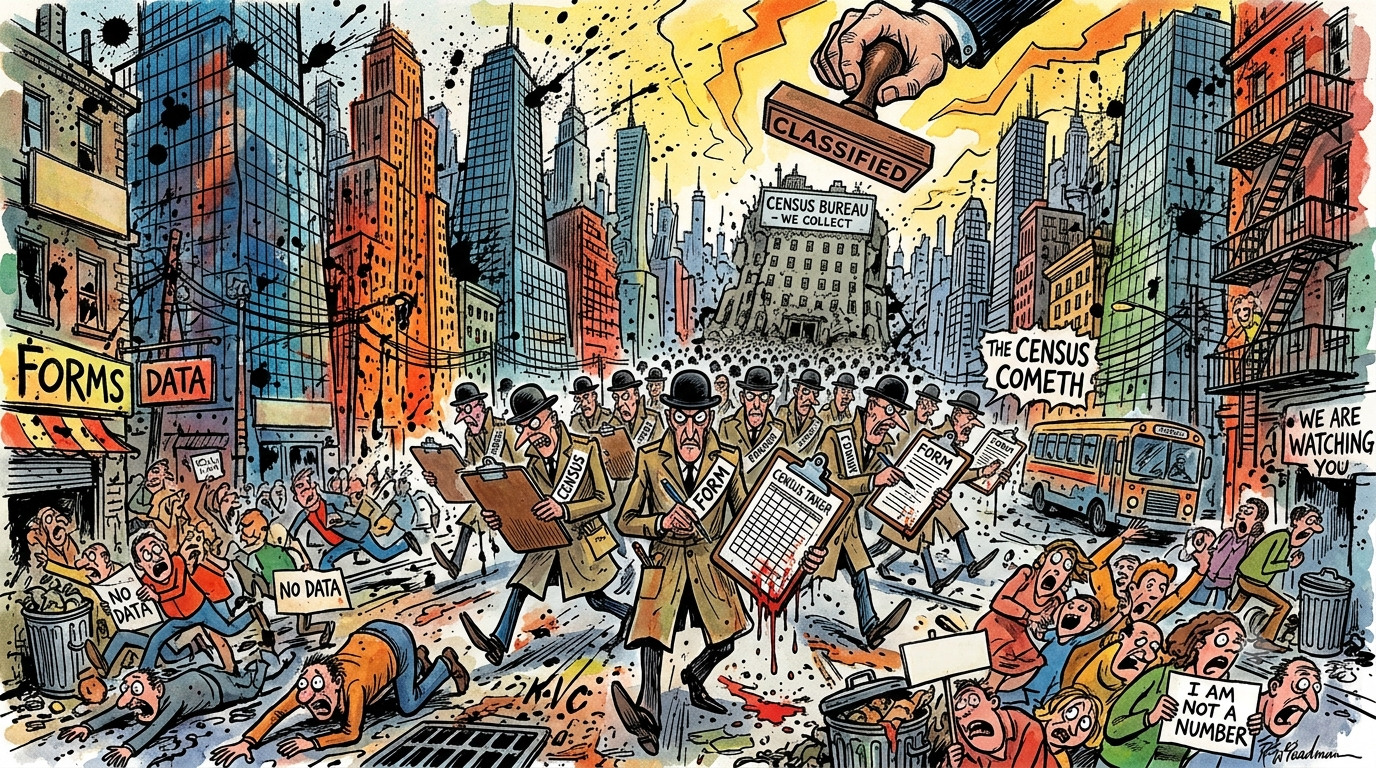
There is an unease in this sentence that won’t be apparent until we have parsed a couple of its terms. First, “pre-conceptual”: The jargon, we read, seizes hold of “the pre-conceptual element of language.” That claim immediately pushes us onto terrain that will perhaps be unfamiliar to an apprentice Adornian. Let’s recall a much quoted sentence from the opening pages of Negative Dialectics, to the effect that “objects do not go into their concepts without leaving a remainder.” Here, at least, we are on solid footing, setting out from one of critical theory’s most widely shared insights: that the administered society exercises power over the motley stuff of the world by slotting it into a homogenizing grid of classification. The Chinese government, preparing to conduct a census, first determines in some informal way that its citizens currently claim more than 400 different ethnic identities, 85% of which it has preemptively eliminated by the time the census forms go out. Administration’s first and most insidious act is to impose an artificial legibility upon the world. But this is not actually what Adorno is saying in Negative Dialectics—far from it. Instead, he has taken that familiar Left Weberian case and radicalized it in two directions at once. First, Adorno has, via Kant, identified classification as a mental faculty and to that extent de-historicized it. Classification is not just the persistent program of the world’s modern bureaucracies; it has aways been one of the mind’s most fundamental compulsions. Judgment, after all, is thought’s own sorting mechanism; Verstand ongoingly synthesizes sense data into objects and then with judgment’s help organizes these into sets or classes. This idea would seem to take the wind out of any Left Weberian political project—any anti-authoritarian bid to dismantle the mechanisms of discipline, surveillance and administration. For try as we might to mobilize against digital tracking online or to abolish the DSMIII, there surely isn’t much point in protesting standardization at its cognitive source, otherwise known as the mind’s readiness to call a plate a plate.

And yet at the same time, Adorno is claiming that the mind—the Verstand, “the concept”—does face resistance. “Objects do not go into their concepts without leaving a remainder.” Concepts, this is to say, cannot capture the specificity of the many objects that they bundle together. In order to successfully and accurately classify this object as “an apple,” the mind has to disregard an open-ended list of this apple’s characteristics: its varietal, its shade of red or green or both, the orchard of its provenance, its sheer thereness. Normally, one writes such sentences in the spirit of nominalist indignation. But by the time he was drafting Negative Dialectics, Adorno had apparently decided that the concept’s insulting indifference to the object’s particularities was also a mercy. Concepts, I just said, cannot capture the specificity of objects. Something about the object—all objects—remains uncaptured, elusive, at liberty. What we often take to be true of certain self-emancipating groups—the queer, the nomadic, those who will not be governed—turns out to be true of all things. The Ding an sich is always a fugitive, concealed in the fastness of its epistemological marronage.

Next step: If you were called upon to explain Adorno’s position (in Negative Dialectics), you might find yourself spontaneously translating his claim into linguistic terms. Where Adorno writes “concept,” you might instead say “term” or “word” or “name.” I have definitely done this. Thus, when glossing Kant’s third Critique, you might say that the person contemplating the world aesthetically and finding it beautiful is, for the moment, losing the names for things. So, too, you might say here, in order to explain the doctrine of non-identity, that no thing disappears into its name, or even: There is something in the thing that resists its naming, that the name cannot touch.

It is because this is such an attractive paraphrase that we need to reach back to the beginning of this section and retrieve the sentence with which we started: The jargon takes control of the pre-conceptual element of language. That’s a humdinger. We were juts  treating “the concept” and “the word” as near synonyms, in a manner that many if not all semioticians would endorse; they are the mind’s twin tools of classification and categorization. “What is this? What do I call this? How do I label this?” But Adorno, we can now appreciate, is allowing that there is after all a difference between concepts and words—that something in language is itself non-conceptual. And in that case we actually have in front of us two different exits from the box-ticking constrictions of the Understanding. One doesn’t usually read Adorno and find the avenues of escape multiplying. But there it is: The concept’s grasp on language is no more complete than it is on the object.

Grand—but what does this actually mean? Adorno’s point is not actually all that abstruse. If anything, it will, once explained, risk seeming disappointingly familiar. It’s what English professors have known since the 1940s as “the heresy of paraphrase—that mantra of the undergraduate literature classroom; the idea, in other words, that how a piece of writing is written is at least as meaningful as what it is nominally saying. The literary critic is the person with a knack for looking at a sentence, grasping its meaning, intuitively considering all the different ways—the other ways, the rival ways, the untaken ways—this same meaning could have been couched, and then spelling out the significance of the author’s having chosen this formulation and not any of those hypothetical others. The literary critic is a specialist in the “pre-conceptual element of language”—form, style, tone, sundry non-propositional verbal effects. (“Pre-conceptual”? One is tempted to correct Adorno by substituting “non-conceptual,” since the suffix “pre-“ requires one to adopt and when called upon defend some notion of sequence: tone comes first—or came first. Anyone determined to stick with the pre- could point to the many philosophers of language who have speculated that language must have begun with coos and twitterings and averbal chatter. Concepts came later.)

The word to which Adorno conjoins the adjective “pre-conceptual” is “mimetic”: the non-conceptual element of language is also mimetic. There is a lot to say about the role of this term in Adorno’s thinking, but for now, it might be enough to swap in two other m-words, either of which will approximate his point well enough. The first is “materialist.” If you strip away everything that is conceptual in a sentence—anything that resembles a definition or an idea, anything one might call “content”—then all that is left is words as sounds or marks. Sometimes as I speak, not often, my lungs force a blast of air upward into my throat, which then presses its way through my rigid, constricted vocal chords. My throat tightens and my jaw flares, and my words emerge with a sharp, distorted timbre: I am angry. If I now note that the other word is “magic,” as in Walter Benjamin’s Sprachmagie, I am only making the same point: Words can make things happen regardless of what they mean and even if they mean nothing at all. Language considered as material is for many purposes indistinguishable from language considered as magic.

For the moment, the one thing to know about the word “mimesis” is that it names the cognitive stance that Adorno most champions. It is the concept that scholars point to first when they want to insist that Adorno wasn’t the anti-political pessimist that caricatures and intro courses make him out to be. Mimesis is the alternative to Enlightenment or the belly-turned-mind. Sometimes the mind (or reason or the subject) seems determined to absorb the world into itself, to overcome the subject-object antithesis by letting the subject swallow its opposite number. But sometimes, less often, the mind does not insist on its own priority, and the subject yields to the object. That’s mimesis. Adorno, then, is once again flagging his proximity to the post-war neo-mandarins. They care about the right things: the non-conceptual, the mimetic. But he is also describing the process by which repetition latches onto the non-standardizable and so standardizes it after all. When American critical theorists began promoting the word “queer,” were they registering their discontent with sexual classification as such? Or were they molding that very discontent into a new classification, training the non-identical how to function as an identity?


Jargon of Authenticity, Day 10

10.

Adorno was just pointing out that the jargon typically works not by coining new words but by repurposing ordinary ones—everyday German locutions whose usage will for the foreseeable future be shadowed by Heideggerian murmurings. He goes on:

What is and is not jargon is decided by whether a word is written with an intonation that positions it as transcending its own meaning; whether individual words are supercharged at the expense of the sentence, the judgment, and the achieved thought. Accordingly, the character of the jargon is profoundly formal: it ensures that whatever it is after is largely sensed and accepted through the mere delivery of the words and without any regard for their content.

The phrase that jumps out here is “written with an intonation,” since intonations, being oral, are precisely what written language lacks—the rising and falling of the voice, some surge of audible feeling or elective emphasis. Adorno seems to be saying, then, that a word can be written in a way that invites flashes of punctual declamation: Say this word with a tremolo. Be sure to elongate the vowel. This is what allows otherwise unexceptional words to function as jargon—they are jargonized by performance. Common nouns obtrude from even commoner sentences when plain-sung as micro-liturgies. The quaver in your voice will signal that workaday x means something more—something finer—than what the schmoes take x to mean. Adorno the musicologist has noticed that some philosophical prose seems to come with implicit mood markings: agitato, lacrimoso, espressivo.

Spotting this claim should now prod us to adjust in one consequential way our sense of what Adorno is up to in this book. I wrote earlier that Adorno was compiling a devil’s dictionary—and he is—but that’s not all he’s doing. It’s the formalism of this last passage that we won’t want to overlook. If Adorno were just writing a devil’s dictionary, he would have to tell us what the German neo-mandarins meant when they talked about “the task” or “an utterance,” and he’d have to explain why what they meant was bullshit: an ideological mystification, an ethical dodge, a misplaced priority. But for now he is claiming that those meanings don’t actually matter, because what the jargon produces is not in the first instance a set of claims whose substance could be parsed and debated. The jargon’s real function is to pump out a vibe of low-rent profundity: numinosity by the fistful.

What Adorno is asking us to do, then, is to step back and consider the ways that a word—any word or at least a great many words—can begin to function as jargon. One reaches immediately for the easily parodied hallmarks of late-stage Heideggerese: the runaway hyphenation (Sich-selbst-vorweg-schon-bei-seiner-Welt-sein), the nouns redoubled as their own verbs (the world worlds, the thing things), the solemn advertence to etymology, which one undertakes in most instances by yanking at a German word’s prefix, tugging it free as though with a pull ring so that the reader can encounter the subsequent root in semiotically recharged isolation: Ent-fernung, Ent-schlossenheit. Even Dasein eventually became Da-sein.

If we now look beyond the Anglo-Heideggerians to consider theory-types more generally—native English speakers who “do theory” and are steeped in the traditions of Continental philosophy and its North American offshoots—then two mannerisms will jump out: two ready-to-hand devices of jargon-creation. These are, of course, verbal stencils.  You don’t need an achieved thought to use them; you just need to apply the grammatical formula. And unsurprisingly, they have both been imported from the German mandarins:

1) Take a noun. Write the everyday adjective derived from that noun. Place a “the” in front of that descriptor and use this new substantialization—this nominalized adjective—in place of the original term. For “politics,” write “the political.” For art, write “the aesthetic.” For society, write “the social.” There are ways to justify this procedure, of course; thinkers determined not to reify politics—resolved to resist its cordoning off into an autonomous social sphere with its own institutions and practices and professionals—might write “the political” in order to make clear that they think that politics is everywhere, in the manner of an aspect or Hegelian Moment, and not just in Carson City. Idealism is, however, the price one pays for this de-reification, as the theorist of the political, having thus sublimated poltiká, fails to say anything of consequence about real political alliances, programs, or struggles. The adjective, once promoted to noun, carries its own quiet negation with it. Often enough, the person writing about “the political” is letting you know that they will not be writing about politics, that they don’t think politics are the point. The terms will now begin to dichotomize: the political will mean “I didn’t say politics”; the aesthetic, “I didn’t say art”; as each nominalization begins to carry its anchoring practices only as a disavowed vacancy: No, not society—I didn’t say society. Anyone who reads extensively in the critical humanities can verify that this Schmitt-tic has by now taken hold of (and etherealized) any number of things once deemed concrete: the curatorial, the sonic, the planetary. I’m told they all have “sites.”

The second mannerism is similar enough to the first that we’ll need to think hard about how they are nonetheless different. The procedure, however, is easily analyzed:

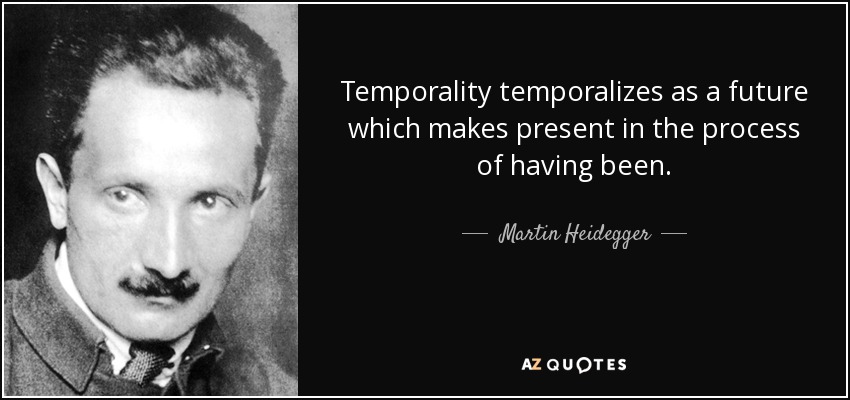
2) Take an already abstract noun: “time,” say, or “space.” Record its adjectival form: “temporal” or “spatial.” Now add whatever ending will turn this back into a noun: “temporality” or “spatiality.” Finally, shelve the shorter word and write the pentasyllable wherever possible. This operation can, like the last, be defended. The idea here is that we shouldn’t give automatic priority to mathematical clock-time or the countable boxes of the Cartesian grid. We shouldn’t treat the stopwatch and surveyor’s tape as though they were the true measures of time and space. The terms “temporality” and “spatiality” are to that extent pluralizing, keyed to the claim that there are lots of different ways of experiencing time and space; or of representing time and space; or of socially constructing time and space.  There is no time per se; there are multiple temporalities. There is no space as such, only multiple spatialities. Newtonianism is just the start of it. The mind, tempted to treat time and space as mere things or neutral containers, must be startled into seeing them again as processes or framings, and the gambit will be to push the terms morphologically further away from object-hood, into second-order abstraction. And yet the -alities are nonetheless rather puzzling. They come directly from Heidegger, for one thing, in the form of Zeitlichkeit and Räumlichkeit, and so simply are the jargon of authenticity, surviving undiminished some sixty years after Adorno tried to put such words to rest. But what kind of screwy and self-sabotaging Heideggerianism is this that convinces its adherents to ditch a well-watered Saxon root like “time” in favor of its Latin equivalent, and then requires that we further distend this bit of Norman-colonial Latinity with an Old French suffix? The terms spatiality and temporality are meant to draw our attention to “the lived experience of x,” but such words automatically sound more academic, formal, and attenuated to English speakers. Each such word is thus pulling in two directions at once, offering to rescue lived experience while accidentally building a linguistic wall that affectively distances the reader from the very experience it is trying to foreground. That process reaches its culmination with those theory-types who write “temporality” even when they mean “time” or “spatiality” when “space” would do just as well. The derived term pivots and swallows up its parent. A professor of media studies at Stanford writes that “Optical effects [in sci-fi movies] … re-integrate the spatiality of the spectacle with the ‘actual’ spatiality of the theater to create a phenomenologically significant experience.” The word “actual” is, of course, the giveaway. On the roster of topos words, “space” is one of the language’s relatively concrete options, at least as compared to geography and topography and topology and chorology and bathymetry The philologists, it’s true, are fond of pitting “space” against “place,” insisting that “place” is the properly particularizing word and that “space” always carries with it the geometric forces of de-localization. There’s something to that, of course, but in everyday usage, “space” is often plenty particular. You can sit in one. All the professor wants to say, therefore, is that the represented space of the movie dovetails with the real space of the movie theater. But instead of writing “real space,” he opts for the de-realized term (spatiality) which he then haplessly nudges back towards concretion (actual spatiality), while insisting via scare quotes that he is doing no such thing (“actual” spatiality). You’re not going to catch him calling a room a room.

Adorno’s Jargon of Authenticity


I plan over the next couple of days to resume my commentary on Adorno’s Jargon of Authenticity. I thought it might help in the meantime if I gathered in one place all of the entries thus far. So here, as a list, are links to the first nine entries.

Day 1: Why is Adorno going after why Eugen Rosenstock and Franz Rosenzweig?

Day 2: The contradictions of existentialist religion

Day 3: Sacrificing thought to wish away change

Day 4: Heidegger checks in. 

Day 5: Their jargon — and ours. 

Day 6: Repetitively produced profundity.

Day 7: Counterfeiting connection to the world.

Day 8: Routinizing language against routine. 

Day 9: A jargon that sounds like everyday speech. 

Readers who prefer a pdf formatted like a book can find that here.

Hegel’s Lectures on Fine Art, Part 2

 You might be interested in the problems Hegel has — by his own admission — beginning his lectures on art. He feels like he should begin by giving a definition of art, though that’s not quite the way he puts it, and the difference matters. What, he asks, is the “concept” of art? Can we give a philosophically elaborated definition? A professor writing in the 2020s would probably just say a “theory of art,” except that the word “theory” almost always suggests something provisional. (“I have a theory” means “I’m about to say something ingenious, but it might not be right.”) But the “concept,” as Hegel understands it, isn’t provisional. Just the opposite. In order to work out the “concept” of art, you would need to be able to say what makes it “necessary.” You could think of it this way: Every human society that researchers have ever encountered has something that we would call art. Art is basically ubiquitous — and in that sense a human necessity — and the question would be why? Why do human groups everywhere always produce art (of some kind)? The philosophical approach to art turns on that question.

         The problem is, Hegel now says, that you can’t answer this question if all you’re talking about is art. If you want to say what gives rise to art, you have to look beyond art (to the nature of the human mind, say) in order to say what need the former is fulfilling. And at this point he says: But I don’t want to have to produce an entire theory of the mind — I don’t want to talk you through my whole system all over again. The point of these lectures is to talk about art. So for now, let’s just take art as given, and let’s begin by reflecting on the semi-philosophical things that people already believe about art. And if you ever work through my entire system, then maybe you’ll be in a position to understand the “concept” of art. But not now.

So off he goes. Hegel clears some pages to consider some once common  ideas about art. He begins by pointing out that art isn’t naturally occurring, that it is human and perhaps even akin to work. “Not only has art at its command the whole wealth of natural forms in the brilliant variety of their appearance, but also the creative imagination has power to expatiate inexhaustibly beyond their limit in products of its own.” (9) You might notice how this aligns art with technology: it is the ability to produce in new ways, beyond nature.

As English-speakers, we can remark here that the word “art” used to mean “skill” and that the word “artist” still has the word “artisan” as one of its closest cousins. That observation brings the question of “craft” in its train, and the question of craft is itself a question of rules. Can you learn to make art just by  learning a craft or just by following the rules? Can you give somebody an art-making instruction booklet? And to this Hegel says: No. The work of Geist cannot be brought under a rule (or a law). This jumps out, in the German context, because Germany was the cradle of the Protestant Reformation, and some Protestants have always taken very seriously the idea that Christians are saved by the spirit (Geist) and not by the law — that Christianity is not a matter of following rules. Hegel points out that if you consult writing manuals or handbooks of art, they will try to give you rules — and some of those rules will be valid enough, but a lot of them will by stupidly underdetermined (ie, they won’t actually tell you what to do and in that sense will hardly count as rules).

Hegel next says that the neoclassical emphasis on rules and correctness eventually generated a backlash in the cult of the genius — the Great Creator not bound by rules. That’s the old German notion of “genius”; the word used to mean something like “outsider artist,” someone who creates great art without having been trained. The notion of “talent,” similarly, is akin to grace in the religious sense: It is the gift you can’t give yourself. The silliest idea promoted by the theorists of genius is that some artists can create without at all reflecting on what they are doing—wholly immersed and intoxicated and riding the rush. The idea here is that artists create in a fit of Begeisterung — Knox’s translation has “inspiration,” which isn’t bad, but it’s actually the German word for religious “enthusiasm,” and it’s the word that Germans used to hurl at Protestant religious fanatics — people who thought they’d been struck by the spirit. Anyway, Hegel’s point is that even though it’s wrong to think that art can be reduced to rules, it does nonetheless require some craft or technique. That probably sounds commonsensical, but his reasoning is still distinctive: Art is a matter of the spirit/the mind/Geist, and Geist can’t be bound by rules. He’s already said, in fact, that art enacts a certain freedom, “escaping the fetters of rule and regularity”—it is the adventure of fantasy and invention. But at the same time, art is Geist-made-real, Geist actualized, Geist in object form. That’s the whole point of art: Art allows for a certain reunion or reintegration, “cheering and animating the dull and withered dryness of the idea, reconciling with reality its abstraction and its dissociation therefrom, and supplying out of the real world what is lacking to the concept.” “Art gives actuality” and begins when somebody feels compelled to find a way of representing something that is not given to the senses. And in the passage to material form, Geist can’t simply reject all rules. The artists have to remember that they were once artisans.

Finally, he says some art is contentless, notably music—which means it can be mastered by the young and the stupid. (I think he means Mozart.) But if you want to write poetry, you will have to know the world in its detail; you need to possess a worldly intelligence. (And that, he says, is why older writers are generally to be preferred to younger one.) There is a question here of Vollkommenheit—a rationalist aesthetics of plenitude or concordia discors. Music is basically empty (though, surely, one wishes to say back to Hegel,  it is capable of achieving Vollkommenheit on formal grounds alone). Literature, however, takes the sundry materials of the world and arranges them into intricate mental forms.

Hegel’s Lectures on Fine Art, Part 1

I would like to give some encouragement to readers who have been thinking about maybe tackling Hegel’s Aesthetics aka his Lectures on Fine Art. Hegel had a lot to say on the topic; his collected lectures clock in at more than 1,000 pages. Let’s now worry about the sheer daunting expanse of the thing. For now, I will be content to offer some commentary on its much thumbed introduction, following the Knox translation.

But first some groundwork. Anything that Hegel has to say about art is only going to make sense in the context of his system as a whole. Hegel holds that the task of philosophy is to help us conceptualize what he calls the Absolute, by which he means the world apprehended as a network of distributed and mutually constitutive points. But the Absolute is not just any network; it is Hegel’s term, rather, for a network with mind; a thinking network, therefore; a network capable of reflecting on itself and setting its own ends. This distinction—between networks with and without mind—is fundamental to Hegel’s project. It is the difference, saliently, between a free market and a market whose actors are invited to reflect on the economic system in which they are swept up, to make judgments upon that system, and to assign to it moral and political ends. That second kind of network we might not even think to call a “market” any more.

That’s the first important point. The next thing to understand is that Hegel thinks that there are three human endeavors that will all help us apprehend the Absolute. The first is philosophy. The other two are religion and art:

-religion, because, followed through to a certain terminus, it will fix our attention on the work of mind in the world (or spirit in the word—mind and spirit are the same word in Hegel’s German) and so bring us close to the Absolute, which is the fusing of material networks with mind;

-art, because, more simply, it is the mind or spirit in material form.

This last is Hegel’s master claim about art, which we can, for a start, specify in three ways:

1) If I remark now that the reconciliation of subject and object is central to Hegel’s philosophy, then I am once again circling around the Absolute. The canonical early modern philosophers tended to treat subject and object as opposed terms. This was clearest in the matter of epistemology, which was central to European philosophy for several generations. Is the world knowable? How do we know things? How do we know that we know things? Perhaps you can see without special explanation that those questions tend to position the mind as separate from the world—and also to make of the world a Big Puzzle in need of solving. To reconcile the opposition of subject and object requires that we not organize our philosophy around such questions. Is it possible to think of the mind and the world as integrated or unified – not as strangers to each other?

2) Hegel’s big claim about art is that it is great because it has clear ways of doing this (in ways that Kant, Schiller, and the Schlegels had already made identified). But then, Hegel goes on, lots of things can do this—can bring together the material world and the mind: revolution can do this, and so can thoughtful practice, and so likewise can religion. This is one of the ways Hegel is unlike the philosophers he otherwise resembles. He doesn’t think we are especially stuck in this regard. There are several different ways of reconciling subject and object. “Art is one of the means which dissolve and reduce to unity the … opposition and contradiction between … self-concentrated Geist and nature.” (56)

3) And when all is said and done, these other things are probably better than art.


Adorno on beauty, Part 2


       Adorno continues:

However, putting the concept of beauty on the Index — as many psychologies have done with the concept of the soul and many sociologies with that of society — would amount to resignation on the part of aesthetics.

The claim that most needs explaining is the bit between the dashes: Psychology, which is nominally the study of the psyche or soul, long ago dispensed with the category of the soul. That observation probably isn’t all that surprising. It might, in fact, just be a familiar point about secularization. Christians used to think that people had souls, but the psychologists have doubtless convinced you by now that all you really have is a “mind” or a “self.” Give the neurologists a chance and they’ll probably talk you out of having a mind. It’s Adorno’s second example that could make a person wonder: Sociologists often try to get by without a concept of society. Adorno, I hasten to point out, is right about this: Michael Mann begins his great trilogy on The Sources of Social Power by remarking that he would, if he could “abolish the concept of ‘society’ altogether,” though he promptly grants that this “may seem an odd position for a sociologist to adopt.” Maybe it’s not that odd, though. No-one knows better than a sociologist not to treat a society like a thing—not to say that society does x and society does y. It is Mann’s recommendation, therefore, that we treat any society as a congeries of “multiple overlapping and intersecting power networks”—networks whose respective borders are unlikely to line up, meaning that the network of economic power will tend to share some but not all of its territory with, say, the network of administrative power. In nearly all cases, the economy and the administration (and the culture and the military) will have different maps. They won’t coalesce into a single, discrete “society.”

There are other ways of giving up on the concept of society, of course, but Mann’s version is at least perspicuous. What we’ll want to see now is that Adorno’s observation holds quite generally—that disciplines routinely turn against their foundational concepts and name-bestowing objects of study.  The scholars of religion are quick to tell you that the term “religion” isn’t good for much—that no-one has ever come up with a definition of religion that covers all the instances one intuitively wishes to group under that name; or worse, that this particular term—re-ligio, a “re-reading” or a “binding fast”—is heavy with Western-for-which-read-Christian assumptions, in a manner that inevitably misdescribes all other religions, subtly rearranging them in order to make them more like Christianity or at least more intelligible to Christians. The historian of Japanese Buddhism finds late-Tokugawa officials, having just guaranteed New England merchants “freedom of religion,”  turning to each other and asking: What did we just grant them? Freedom of what now? Or again: Scholars of literature are the ones who have had to worry that the distinctions we draw between “literary” and “non-literary” writing are finally quite arbitrary. The avid but amateur reader knows that some books have fully earned their status as literature; the literature professor is less sure. The professors have also had to face the fact that the very term “literature” acquired its current meaning rather late—across the late eighteenth century, if the lexicographers are right—which means that whatever Shakespeare thought he was doing, he couldn’t have been writing “literature.” It is at this point that we will have to worry whether we aren’t making a recondite mistake whenever we read as literature a text that was written before there was “literature.” That’s a claim that can itself be made in impeccably literary terms: The word literature is itself a feat of verbal creation, a category created where formerly there was none. There are no works of literature per se, only works that we describe as literature and that we could equally well describe otherwise.

If you sit with these positions for a minute, you will be in a better position to appreciate how unexpected this sentence of Adorno’s is. For such self-consciousness about one’s central concepts—a reflexive turn heightened unto skepticism—is just the sort of thing that critical theorists are always asking for. A scholar of Buddhism who rejects the category of “religion” is a “critical historian of religion.” The literature professor who told his colleagues circa 1987 that “there was no such thing as literature” had gone over to “theory.” What we can now say is that Adorno is urging us not to do this—he is asking us to avoid the critical turn—at least for now and at least as regards aesthetics. He is suggesting that we not place beauty between scare quotes and so delaying the project of a critical aesthetics. More surprising still, he seems to associate the critical attitude with the apparatus of Catholic censorship—that’s the Index that appears early in the sentence: the pope’s Index Librorum Prohibitorum, the Index of Forbidden Books, which was still in effect when Adorno started work on Aesthetic Theory. Sometimes, one suspects, intense self-consciousness about concepts mutates into the rote policing of language. And Adorno isn’t having it.

Adorno on beauty, Part 1


Can there be an Adornian theory of beauty? It is not a category that one expects Adorno to have been drawn to. In one section of Aesthetic Theory, he calls for “a radically darkened art,” and that, of course, is just Adorno playing to type. That’s the Adorno who has inspired multiple American punk bands to release albums called Minima Moralia. A page or two later, still in Aesthetic Theory, he praises one version of modern poetry for having “defected to the enemy” — for having declared war, I guess, upon poetic things. Adorno would seem to prefer a verse that poisons nightingales and shoots skylarks from the air. Later in the same volume, he dedicates an entire essay to the ugly, and there we will find him praising “the penchant of modern art for the nauseating and physically revolting.” “The apologists for the status quo,” he says, get to ruin the world confident that the artists will beautify at least some of the resulting wreckage. In the midst of general ugliness, they will create pockets of “idle beauty.” So maybe that’s the Adornian theory of beauty right there—and maybe it’s theory you’d been expecting: Beauty is the happy face that kept artists put upon catastrophe.

The surprise, then, is to realize that this is not, in fact, Adorno’s final word on beauty. Yes, fine: Beauty is affirmation and apology and kitsch. But are we willing to consider the possibility that there is more to beauty that its readiness to acquiesce? Can negative dialectics find something worth affirming in beauty—and will that something itself be negative? Can you picture Adorno with a nosegay in his fist?

The way to start answering these questions is to read the essay  on beauty that begins at the bottom of p. 50 in Aesthetic Theory. Here’s the first sentence:

If anything, it is beauty that originated in the ugly, and not the reverse.

And with that, new questions already interpose themselves—specific questions to replace the general ones with which we began. Why, after all, does Adorno start here? What does this sentence even mean? What is he after? The trick will be to figure out who (broadly) Adorno is disagreeing with — and to realize going into it that the answer is likely to involve metaphysics. Why might someone think that beautiful things are primary or original and ugly ones in some sense secondary? Here, then, is a chain of argumentation: A person might not unreasonably hold that all things possess form, each thing its form, and they might think, further, that form typically involves purpose or function. Iron has served many different purposes over the centuries, and each change of purpose has been accompanied by a change in form; iron can come to us variably as a lathe treadle or a hand-crank corn sheller or a smelting ladle. Cartilage, too, takes different forms: it is there, in not readily visualized fashion, in your knee (to protect the bone), but also there, juttingly, in your outer ear (where it captures and directs sound waves into the ear canal). It is this simple point about form—different forms for different purposes—that will do most of the hard work for the classical theory of beauty. We are, after all, in the habit of judging things to be well-formed. That particular phrasing may not come to you intuitively, but this species of judgment surely does. You are accustomed to assessing the fitness of the things. But then I don’t want to just give up on the phrasing, which adds a little something of its own. For if I call something “well-formed,” I might just be saying that it is good, that it was well designed for its purpose. (“In a well-formed watermeadow it is as necessary to keep it perfectly dry at one time as it is to place it under water at another.”) But equally, I might be saying that it is handsome, or shapely; I might even be casting about for a way to call a man beautiful. The word “well-formed,” then, is the term from ordinary language that without strain conjoins the beautiful and the good. My point is that if you continue on in this connection, you might eventually find yourself arguing that the human mind is set up to apprehend fit things as beautiful—or even that fit things simply are beautiful and that the experience of beauty is the delight we take in their fitness. That, then, would be your opportunity to claim that beauty is primary (which — you can glance now back up to the top of the paragraph — is the opposite of what Adorno is arguing): Everything, again, has a form; and a large majority of things are at least moderately well-formed, if only because things that are not well-formed tend not to stick around for very long: the ill-formed, the anomaly, the freak.

The task now is to flip that argument on its head. The view that takes ugliness to be primary will have to adopt a competing metaphysics. Here’s one way to get at the thing: In Virgil’s Aeneid, as in most other classical epics, the stakes of a great many episodes are properly cosmic. As readers, we’re not just following Aeneas—we’re not just concerned for the hero, not just reading to find out what happens to him next, not just hoping that it will fare well with him. We’re reading, rather, to find out what will happen to, well, everything — to the entire cosmos. We are awaiting the verdict on the nature of reality.

  I think this is especially clear in the first book of the Aeneid—ie, early in the poem—when the Trojan ships are first scattered by a great storm. (That’s the tempest that blows Aeneas’ band of refugees to the shores of Dido’s Carthage.) You might remember: Juno has created this storm in order to vex the Trojans, and in order to do so, she has had to approach the divine wind-keeper and seduce him into turning loose the squalls over whom he has custody. As Virgil tells it, the winds are universally known to be dangerous and so kept in prison. Killer squalls, held in a dungeon:

But high in his stronghold Aeolus wields his scepter,
soothing their passions, tempering their fury,
Should he fail, surely they’d blow the world away,
Hurling the land and sea and deep sky through space.
Fearing this, the almighty Father banished the winds
to that black cavern, piled above them a mountain mass
and imposed on all a king empowered, by binding pact,
to rein them back on command or let them gallop free. (Fagles 1.69-76)

What I hope you’ll notice is how generalized the language becomes here—that’s the mark of the epic shifting over to rude ontology. It’s not just that the winds can damage Sardinia or the Florida coast. They can “blow the world away.” We might notice how the poem shifts for a single line into a sublime and elemental sci-fi image: The stuff of the planet whirling in a void. When reading an epic, you should stop whenever you run into sci-fi language like this, because that’s when the epic is turning metaphysical. And what we see here is the possibility of a world of contending and unruly forces; Dryden’s translation of the same pages speaks of “mixed confusion.” But let’s notice, too—because this is crucial—that this disorder is just a possibility, since the gods have undertaken a cosmological effort to keep the world ordered when it is not naturally and by necessity ordered. You might say, then, that there are rival ontologies in the Aeneid—a ontology of order vs. an ontology of disorder (or chaos or strife). The epic isn’t only concerned with the founding of Rome — it’s trying to figure out whether order or disorder is going to win in the cosmos—and of course it superimposes that battle of cosmic principles onto the Roman story. Maybe the more accurate way to put this would be to say that the poem posits a single, riven ontology: the universe is capable equally of order and disorder. Order might be in evidence, but the possibility of cataclysmic disorder can never be discounted. Order is available, but only through commitment and effort—including the efforts of regal gods whose powers are great but not entire.

        What I’m trying to say is that the storm isn’t just an ordinary, old narrative obstacle. If anything, it functions a bit like the especially nasty pre-credit kill with which some horror movies begin. Virgil’s epic starts by flaunting its nightmare and apocalyptic antithesis, as the poet sets off to write against the chaos and mixed confusion that the reader glimpses in the storm. The Trojans, as a people, have been scattered. And Aeneas’ ships have now just been scattered—that’s a scattering within a scattering, a diaspora twice-dispersed. If you can grab hold of the epic’s ontological thread, you might be able to make sense of the Aeneid as a poem against the scattering and against the storm. Early on, Venus tells Aeneas that she has seen “scatt’ring” birds regather into a flock—“all united in a goodly team.”

Such, then, is what it might mean to claim that ugliness comes first and that beauty follows on: The fundamental condition of the cosmos is disorder, chaos, or strife. Order and form and purpose and beauty must accordingly be built (and guarded and, where necessary, repaired). That’s the position that Adorno wants us, at least, to consider—though his opening phrase, “if anything,” is enough to suggest that he doesn’t really credit this version any more than he does its opposite, it being a hallmark of dialectical philosophy that antitheses arrive in pairs, as polarized conceptual fields, and that one couldn’t possibly talk about either “ugliness” or “beauty” if the other weren’t already in view. Let’s agree, then, that the ugly and the beautiful are coeval, but having said that, let’s also consider the status of beauty in a world that is fundamentally geared towards ruin.

Jargon of Authenticity, Day 9

The question that arises at this point is how we can identify a word as belonging to the jargon of German existentialism. The English-speaking reader probably won’t have this problem. If you’re American and reading someone under the spell of German existentialism, chances are you’re going to be able to tell, even if you didn’t know it when you picked up the book. And the reason you’re going to be able to tell is that there will be this set of words that the author will have either left in German or gratuitously capitalized. But the German reader has to make due without these clues, since the word Dasein really is just the German word for “existence.” German also capitalizes the noun form of Being whenever it appears. Adorno, moreover, has noticed that the words that make up the jargon of existentialism aren’t, in fact, the more obviously offbeat entries in the Heideggerian lexicon; they aren’t “the presence presences” or Beyng-with-a-y. For the most part, the jargon is made up of words like “queer” — an ordinary, if contested, English word that became central to the history of American Foucauldianism even though it didn’t originate with Foucault himself.

        So how again do you recognize a word as jargon? Here’s Adorno:

Many of them [the terms in question] could be used in other constellations with nary a wink at the jargon: the word Aussage [“statement” or “utterance”], when an epistemologist needs a concise way of designating the judgments of predication…

Here it is enough to know that the word Aussage [“statement”] shows up routinely in German discussions of Aristotelian or Fregean predication. It’s the term for any claim that we might plausibly judge to be true or false, for which Anglophone philosophers prefer the rather fussier “proposition.”

       So Aussage has a perfectly reasonable use outside the jargon. And so does the word “authenticity” itself:

or the word eigentlich [“authentic”]—though here one must be careful—including as an adjective, whenever the essential is to be distinguished from the accidental…

Adorno says that “authentic” is fair game even when it’s an adjective, and the reason he needs to tack on that extra reassurance is that in German, the word eigentlich is first and foremost an adverb, so common and conversational as to have lost much of its proper meaning. If a German says “Why not?” — in the sense of “Might as well” — he is likely to insert an eigentlich in the middle: “Why eigentlich not?” Or perhaps you’ve made an assumption about your German friend: “You must have hated that movie.” And she responds: “Actually, no. Eigentlich nicht.” Sometimes the word has the force of “anyway” — to indicate that you are getting around impatiently to a question that you’ve been meaning to ask or that you are expressing your belated confusion: “What are you doing anyway?” or “What exactly are you doing?” “Was machst du denn eigentlich?” The point is that no-one is going to tell Germans to stop using eigentlich in any of these several vernacular and semantically bleached ways. It would be silly to even try. But to that implicit concession, Adorno has added two points: First, that eigentlich in its dictionary form is not altogether useless; we will occasionally want to know whether a particular something is “authentic.” Second, that the existentialist use of eigentlich is something else again, deviating importantly from its dictionary usage.

        We’ll also notice that Adorno is a bit nervous about the word “authentic,” even before it was seized on by the existentialists: “here one must be careful” — presumably on by now familiar anti-essentialist grounds. Adorno doesn’t want anybody presiding over who or what gets to count as authentic. One might wonder, then, why he doesn’t just give up on the word altogether. Why include it on his list of the jargon’s innocent uses, when he doesn’t think the word is all that innocent? The answer is simple, which is that he knows he has used the word himself, in earlier writing, and he is pre-empting the hostile reader who might otherwise be tempted to point this out. He finds himself compelled, in other words, to make a little confession, like so: The jargon includes ordinary words, “statement” or “authentic”…

or the word “inauthentic,” where something fractured is meant, an expression that no longer lines up directly with what is expressed: “Radio broadcasts of traditional music, music conceived in the categories of live performance, have as their undercoat a feeling of the as if, of the inauthentic.”

The point not to miss is that the quotation comes from Adorno’s The Faithful Repetiteur, which had only just appeared in 1963, the year before The Jargon was published. Adorno, in other words, is quoting himself. He’s caught himself using the word that this entire volume seems to be arguing against—the word that provides the book with its sneering title—and he accordingly feels compelled to account for himself:

In this case, the word “inauthentic” is performing a critical function, the determinate negation of something illusory. 

It’s not clear to me that what Adorno is describing really is a “determinate negation.” (That’s Hegel’s term for the idea that the mind can grasp any particular thing only in contradistinction to other relevant objects. The mind cannot apprehend the identity of an object directly, in the absence of contrast or opposition; something can be cognized as what it is only by also knowing what it is not.) If anything, all Adorno seems to be doing here is assuring the reader that he, at least, isn’t using the word “inauthentic” ideologically, in order to prop up some other class of objects—in this case performances—as “authentic.” He is simply combating a certain media lie—the illusion that the radio is giving us the real thing—and he is doing this, he implies, by amplifying the feeling of inauthenticity that has been part of our experience of the radio all along.

    He continues:

The jargon, however, extracts “authenticity”—and its opposite—from out of any such context of insight and understanding. 

If I say “Everybody knows that reality television isn’t real,” I am not making strong claims about the nature of reality or our ability to know it. I’m not claiming to be able to give a metaphysical account of how reality is actually constituted. All I’m saying is that this thing that purports to be real is palpably fake (and that its fakeness is widely acknowledged). I also haven’t introduced the word “real” into the conversation; when I say that reality television is not real, I am simply holding the genre to the standard of its own choosing. The problem, then, with the existentialists is that they do claim to know what makes some people authentic and others not, and they are willing to make that determination of anyone and everyone, even of people who never claimed to be authentic in the first place — people, that is, who haven’t invoked the criterion.

But it turns out that you can only go so far in protecting the words from the jargon:

One isn’t about to hold the word Auftrag — an “order,” “errand,” “task,” or “mission” — against a company that has just received one. But possibilities of this kind remain crabbed and abstract. Anyone who presses them too far is headed for a blankly nominalist theory of language, in which words are nothing more than exchangeable tokens, untouched by history. 

This last sentence is trickier than it initially appears. Adorno seems to be warning his readers against nominalism—that’s the idea that most words (all words?) are just names and that the concepts that these refer to don’t rest on anything real. The spin-off of nominalism that most of us are steeped in is some version or another of “the social and discursive construction of reality.” It’s the position you are taking any time you announce that “gender isn’t real” or “race isn’t real”—that these are above all ways of talking. We classify people and things one way; we could just as well classify them lots of other ways. The puzzle here is that Adorno is demonstrably a nominalist, as are nearly all critical theorists and indeed anyone who has read a lot of Nietzsche. It is genuinely odd to find Adorno shoo-ing his readers off the path to nominalism. And recognizing this should allow us to see that Adorno is not, in fact, condemning nominalism as such; he’s not actually promoting the realism that wants us to believe that gender and race aren’t just constructs. It is only a certain extreme nominalism that he wants to guard against—not all nominalism, just the blank and ahistorical kind. The mistake would be to treat each individual usage of a word as though it were a stipulative definition, empowered blithely to elect its own meaning: Let x mean y. And the problem with stipulative definitions is that they instruct us to ignore the entire range of ambiguous and secondary meanings that nearly any word will have accrued. They require us to suppress whatever associations come to mind and are to that extent de-contextualizing, asking us to prescind individual words from their broader verbal and social contexts. (That’s what Adorno means when he says that this approach is “crabbed and abstract.”) The alternative, of course, would be to let the context back in—to let the word be “touched by history.” But in that case, we can’t continue to use the German words enlisted by the right-wing existentialists by pretending that those sub-Heideggerian usages don’t exist or don’t apply. A German speaker’s verbal and social context now includes the jargon, which can’t be wished away.

He goes on:

History makes its way into every word and so blocks each one from retrieving its putative Ursinn, its original definition and primal sense, which is what the jargon is always chasing after. 

The last clause undertakes a characteristically Adornian reversal — so quick and dainty a spatula-flip that a reader could easily read right past it or register it only as a fleeting perplexity. Adorno, after all, wasn’t addressing the people who embrace the jargon; he was addressing the ones who reject it, the ones who want to keep their language uncontaminated by the weird philosophers. What this last clause is saying, therefore, is that the two groups converge on a quintessentially Heideggerian mistake, which is to think that they can resurrect at will the earlier meanings of a word. The jargoneers want to return language to Homeric Greece and the barbarian forests beyond the Roman limes. The anti-jargoneers aren’t as ambitious; they just want to protect the common usages that predated the jargon itself. But at heart, the impulse is the same: if they aren’t careful, the opponents of existentialism will repeat the errors of their enemies.