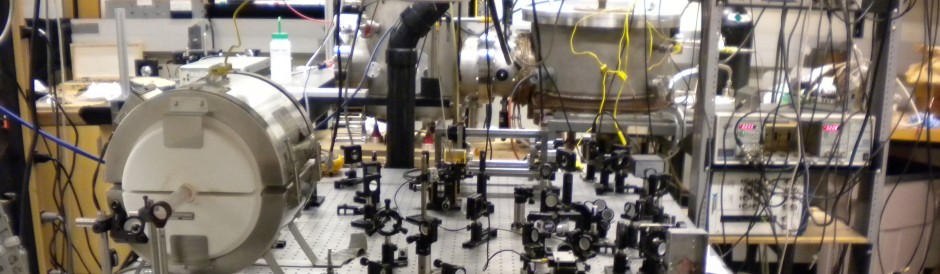
We are grateful for the generous support of the NSF/RUI program for the past thirty years, and for support (early on) from the NIST Precision Measurement Program and from Research Corporation for Scientific Advancement.

Majumder Group News
SEEKING NEW POSTDOC !
After a number of very productive years leading our work in the lab, helping to mentor many students at all stages of their education, and also teaching part-time for the physics department, postdoc John Lacy will be leaving us later this summer to begin a tenure-track faculty postion at Furman University in Greenville, SC. With great confidence in his future success, we wish him the very best in this new adventure, though of course we will miss his presence at Williams and in our group tremendously.
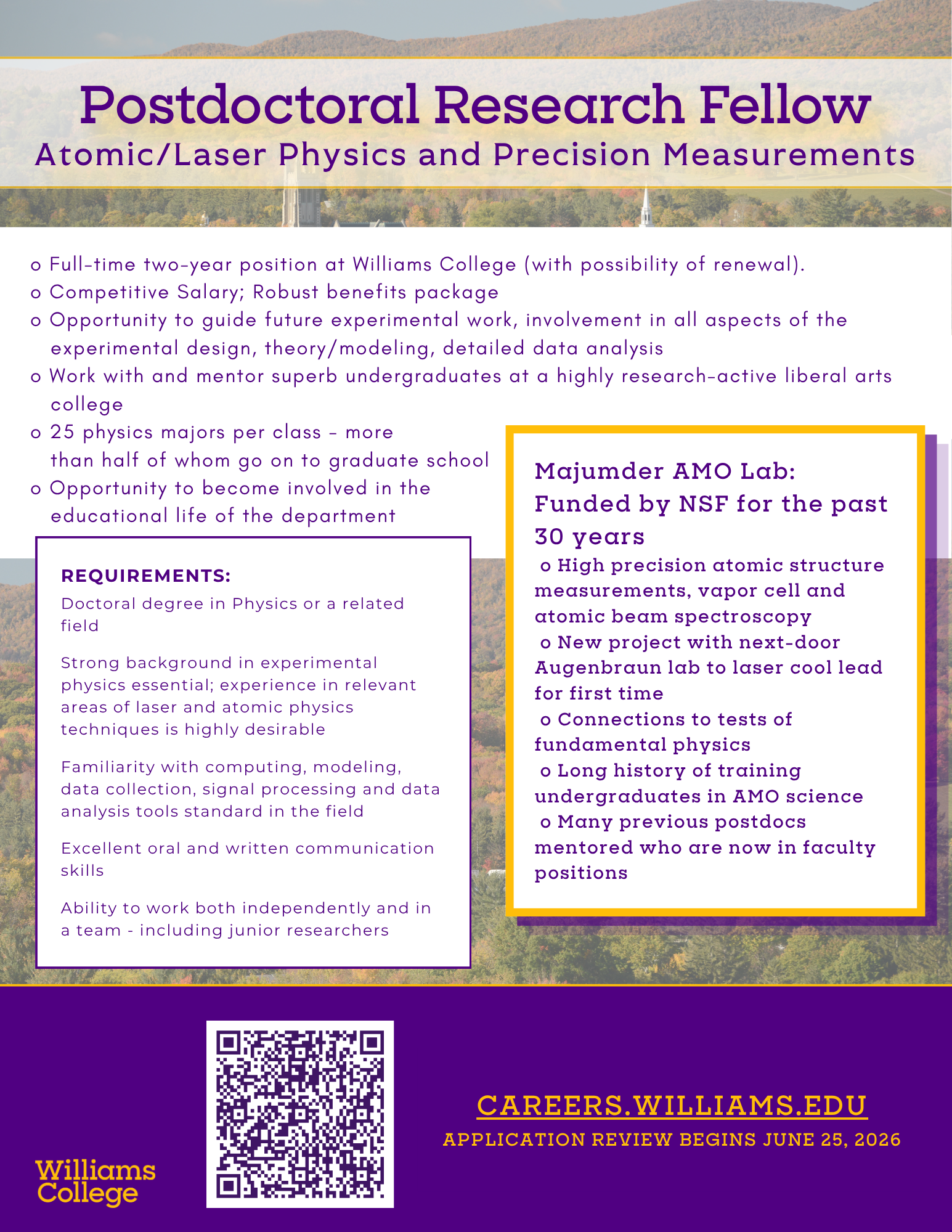
A new NSF-funded Postdoctoral Fellow position has been approved. If you are interested in the work of our group would like to learn more PLEASE read ahead and then I encourage you to get in touch! ([email protected]).
Link to Williams Job Advertisement
May 2026:
Congratulations to thesis students Charlene Peng ’26 and Gautam Ramasamy ’26 on successful completion of their senior theses and their impressive four-year Williams careers! They will be continuing their careers in AMO experimental physics at Harvard University and Colorado St. Univ. respectively.
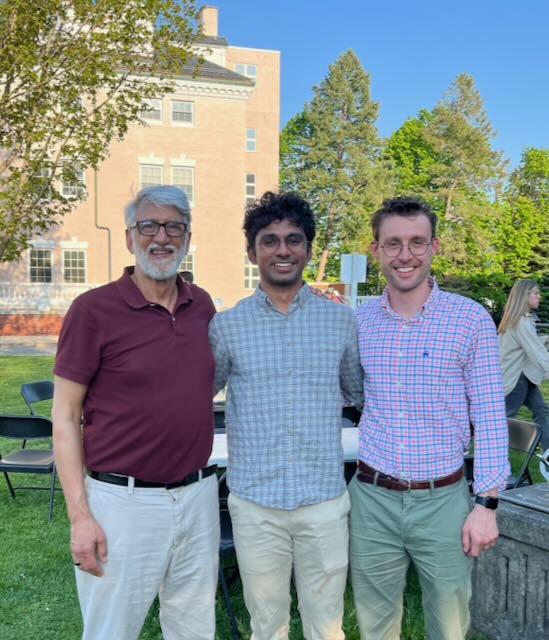
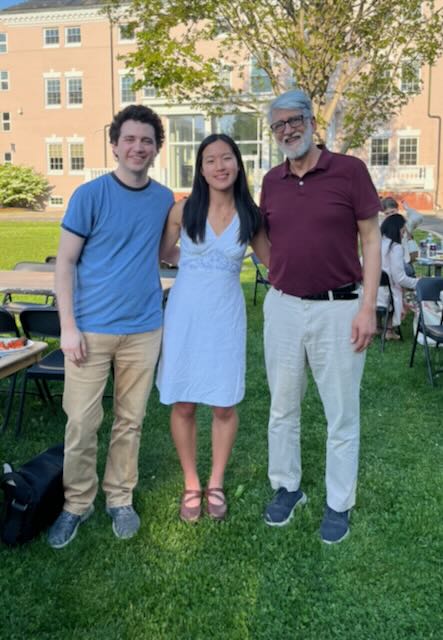
Charlene worked on a series of projects connected both to the diatomic molecule spectroscopy that is at the center of Prof. Augenbraun’s work, and also to the goal of demonstrating laser cooling of Pb atoms for the first time. The latter development work involved resurrecting an old CW Ti:Sapph laser to produce substantial, single frequency near-IR power at 736 nm. This radiation will now be frequency doubled in a bowtie ring cavity in our lab to produce sufficient near-UV power at 368 nm to implement transverse 1D cooling of our lead atomic beam. Charlene will be joining the Doyle Cold Molecule AMO group at Harvard (the fifth thesis student from our group to make that transition).
Charlene’s various projects and accomplishments are summarized in her senior thesis: Peng thesis
In other projects related to the atomic beam work, we have used an RF modulation technique to lock a 1279 nm laser tuned to the ground-state M1 (3P0-3P1) transition in lead. Coupled with a low-power ECDL system (cooled to 0 degrees Celsius) to reach 368 nm, we are now setting up to study 2-step excitation in the atomic beam. We are also installing a new fluorescence detection system which will utilize this 368 nm ‘cycling’ transition in the beam to monitor atomic beam lead metastable (6p^2) 3P1-state population. This work will be taken up by new class of 2027 thesis students Lindsay Gadsden and Avery Allen and senior Gabi Rodriguez.
Gautam made substantial progress on our two-step, two-color isotope shift spectroscopy work this year, getting excellent preliminary results and demonstrating feasibility of a method using AOM first-step laser chopping (for Doppler-free spectroscopy), and tunable FM sidebands (using a fiber-based EOM) in a co- / counter-propagating spectroscopy protocol with which we can, in a single 1-hour experiment, extract isotope shifts in both of the two step transitions at once with precision at the 1 MHz level or below. Rising junior Jackson McFerron ’28 will be working with postdoc John Lacy (in his final couple of months at Williams) to continue this work through the summer.
Here is Gautam’s thesis: Ramasamy thesis
Both Charlene and Gautam will be joining postdoc John Lacy, colleague Ben Augenbraun, and Tiku at DAMOP 2026 where we are presenting this poster: DAMOP26 poster
John will also be giving a 10 minute talk on the isotope shift spectroscopy work. Slides are here:
2025-26 Academic Year:
We are very grateful for the renewal of NSF support, especially in these uncertain times in the world of science funding. With this support in place, we are, first, pursuing heated vapor cell measurements of lead atomic structure. In particular, we are completing isotope shift and HFS measurements in various Pb low-lying transitions/states using a set of single-isotope-enriched quartz cells. This work is being lead by long-time postdoc John Lacy with the aid of thesis student Gautam Ramasamy ’26. These measurements utilize fast AOM-based modulation and RF lock-in detection of two-step transitions providing Doppler-free spectra. Fiber-based EOM modulation adds known RF sidebands for frequency calibration and referencing in our spectra.
Meanwhile, we are redesigning our long-standing Atomic Beam apparatus to allow for precision Stark spectroscopy of lead (following decades of experience with similar Stark effect work in thallium and indium). This would include Stark shift/polarizability measurements of the 368 nm and 406 nm excited state E1 transitions, in each case using pre-pumping to the metastable lower state via M1 or E2 transitions, and lock-in detection of E1 transmission in a large, precisely-calibrated static electric field. We will also design a downstream fluorescence detection system of the metastable 3P1 state employing the cycling 368 nm transition, collection optics, and a PMT. With high S/N detectability of this population, we can then pursue a Stark-induced amplitude measurement where by ground-state atoms are excited to this metastable state via a IR 1283 nm laser driving an M1 transition. We would then measurement the fractional increase in absorptivity in the presence of the static electric field as a function of field strength and laser polarization.
Demonstration of successful optical cycling within the Type II (6p2) 3P1 – (6p7s) 3P0 368 nm E1 transition will be a key step for our next project which is the first demonstration of Pb (transverse) laser cooling using this cycling transition. This work is being undertaken in collaboration with Prof. Ben Augebraun ’15 (former Apker-award winning thesis student). Ben’s NSF-supported work involves developing and studying new diatomic molecules with potential applications to fundamental tests (searches for EDMs in these systems). He and collaborators identified a series of diatomic molecules containing Pb and ‘coinage’ metals Au and Ag that have excellent potential EDM sensitivity. Both silver and gold are readily laser-coolable, and we plan to collaborate on studying Pb laser cooling (first by demonstrating transverse 1D cooling of this Type II transition in our atomic beam apparatus). This will require generating substantial UV power which we are in the process of generating via a system that includes a CW Ti-Sapph laser and a ring-doubling cavity.
The atomic beam and laser cooling project are being pursued by our two labs with the help this year of thesis students Elena Deegan-Krause ’26 and Charlene Peng ’26.
Summer 2025:
Recent experimental projects in the lab, including a list of publications, presentations, and student researchers is summarized here (part of the final NSF report for the expiring grant): 2025 research summary
We we continue to pursue our 2-step Doppler-free lead isotope spectroscopy work referred to below and welcome into the lab Ben Wien ’28 a rising sophomore getting his first taste of research. Gautam Ramasamy ’26 who worked on this project last summer, will return in the fall to begin a senior thesis in the lab, and will likely continue to collaborate with us on this project. He is currently working as a summer research assistant in the Zweirlein Lab at MIT and we look forward to welcoming him back into our lab soon with the benefit of that excellent AMO experience!
Another summer highlight was attending the 2025 Atomic Physics Gordon Research Conference with Charlie Doret (’02 – now faculty colleague, former thesis student), and John Lacy. John presented this poster about our current work: GRC Poster 2025, and Tiku was a discussion leader for one of the sessions. We also ran into many former students (see photo) during a wonderful week!
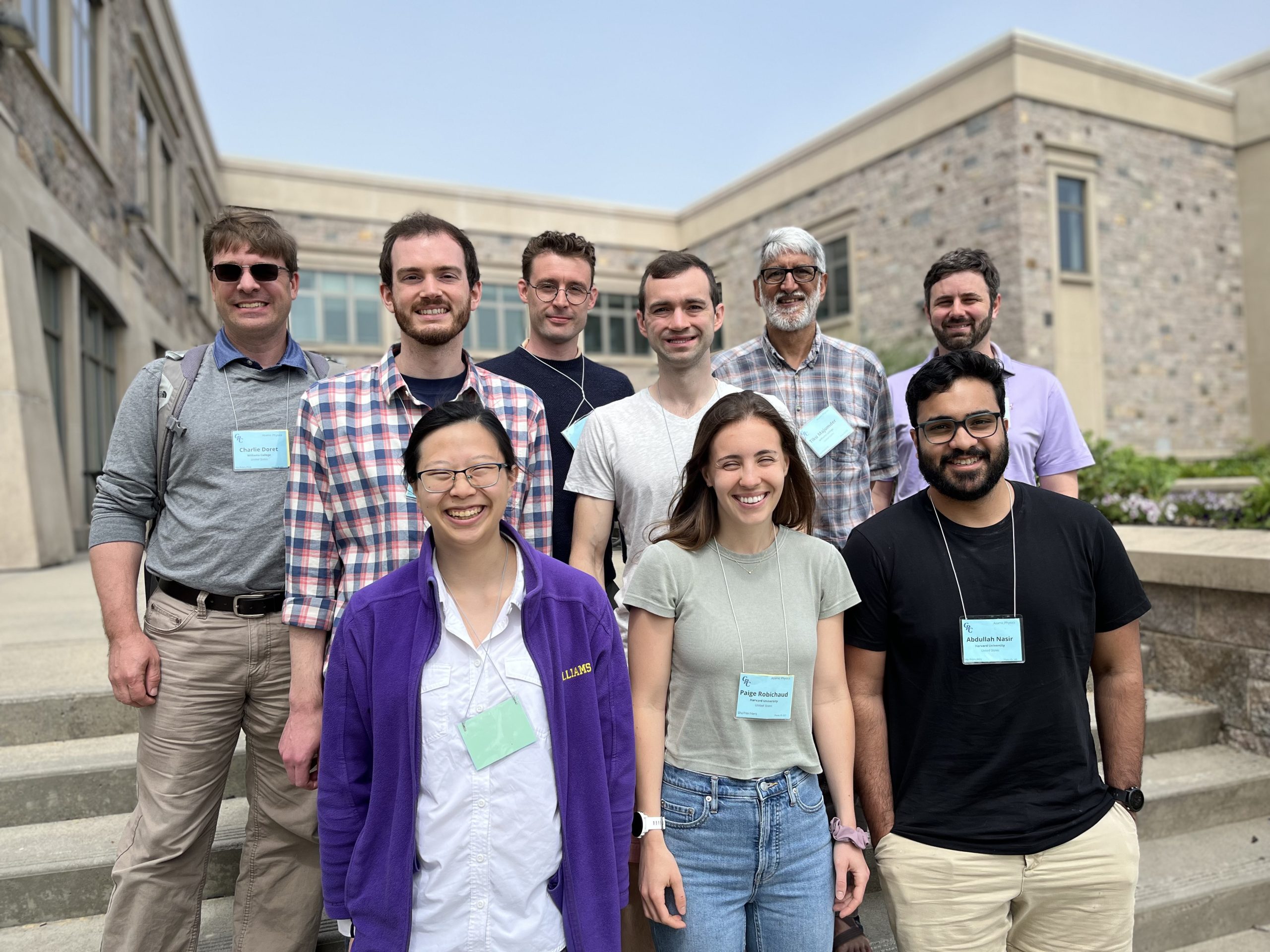
(L-R) back: Charlie Doret ’02, John Lacy, Tiku, Paul Hess ’08
middle row: Nathaniel Vilas ’17, Felix Knollman ’19
front row: Abby Kinney ’24, Paige Robichaud ’21, Abdullah Nasir ’20
Looking forward, we are now turning our focus to re-engaging our atomic beam system, now with lead atoms in a molybdenum crucible, to jump-start new spectroscopy experiments in Pb, including the first polarizability and Stark-effect precision measurements in this atom, and also, excitingly, gearing up to demonstrate for the first time LASER COOLING in the lead atomic system. The motivation for the laser cooling project, which will begin as a demonstration of transverse (1D) cooling, besides its utility in producing a ‘brighter/denser” atomic beam, stems for the potential creation of cold diatomic molecules containg Pb and a ‘coinage’ metal (Au or Ag). Such diatomics have a number of properties which make them excellent potential candidates for future EDM studies as noted in this recent publication by new Williams faculty colleague (and former thesis student) Ben Augenbraun (’15) and his colleagues: Augenbraun24.
This overlapping interest and experience with atomic beam spectroscopy in general and lead spectroscopy in particular on our side, and extensive laser-cooling experience, cold molecule experience, and the fortuitous acquisition of a Ti-Sapphire laser, has led up to starting a collaborative project to make sufficient 368 nm laser (by frequency-doubling), and then use this for the J=0 to J=1 cycling transition and demonstrate laser cooling. This overlapping project represented a portion of each of our recently submitted NSF proposals, which were (happily, gratefully) both recently funded which will certainly facilitate this ongoing project. Two rising senior physics majors, Elena Deegin-Krause ’26 and Charlene Peng ’26 are working on development projects associated with this atomic beam work. Charlene is currently working on resurrecting an old (LAS) bowtie frequency-doubling cavity used 25 years ago in our group to produce UV light for thallium spectroscopy. Elena will focus on designing and demonstrating a new downstream fluorescence detection scheme for atoms in the metastable (6p^2) 3P1 state (the originating state for the laser cooling / cycling transition). This will eventually be used to image the atomic beam for future demonstration of transverse cooling.
We will first use this detection technique to demonstrate ‘optical cycling’ and collect high S/N population count measurements. Then, in an initial experimental effort, we will detect the population increase when we direct the an IR laser tuned to the 1279 nm M1 ground state transition to add population to this metastable state. This M1 transition spectrum, in the presence of a large static electric field, and magnetic field to resolve the sublevels, will allow measurement of the so-called Stark-induced transition amplitude. Given the precisely calculable amplitude of the M1 transition, measurement of the fractional increase in absorptivity in this transition in the presence of a precisely calibrated electric field with a given polarization will allow a benchmark measurement which can be directly compared to atomic theory.
2024-25 Academic Year:
During this academic year, work in the lab continued on several fronts pursuing precision measurements of lead transition amplitudes and, using two-step, Doppler-free spectroscopy, precision measurements of hyperfine structure and isotope shifts in low-lying lead energy levels. Long-time postdoc John Lacy took the leadership role in moving forward projects, ably assisted by senior thesis student Carter Anderson ’25, and independent-study study Julia Matin ‘25.5.
With John taking the lead, final data collection and detailed analysis was completed for our transition Pb amplitude measurements and this work was published in the spring, with John and former thesis student Abby Kinney ’24 as co-authors. These sub-1% precision measurements were nearly an order-of-magnitude more accurate than previous work, and were in excellent agreement with the latest ab initio calculations from our theory collaborators in the Safronova Group: Lead E1 Amplitudes PRA 2025
Meanwhile, Carter Anderson ’25 refined the work from the previous summer and developed an experimental design that produced isotope shift and hyperfine structure spectra of lead isotopes suitable for new precision measurements of various transitions and hyperfine splittings. The work involves overlapping one (locked) laser tuned to a weak (M1 or E2) first-step transition to enhance the intermediate population of the excited state and modulate that pumping at ~1 MHz using an AOM. We overlap that laser beam interacting with the hot lead atoms with a second step (E1) laser and use an RF lock-in amplifier to extract Doppler-free spectra which (using both ‘CO’ and ‘COUNTER’ propagating geometries) allow us to extract isotope shift information in both transitions in a single transmission spectrum. Carter will begin in the Physics Ph.D. program at the University of Toronto this fall, and we wish him the very best! Details of Carter’s work can be found in his senior thesis here: 2025 Carter Anderson Thesis
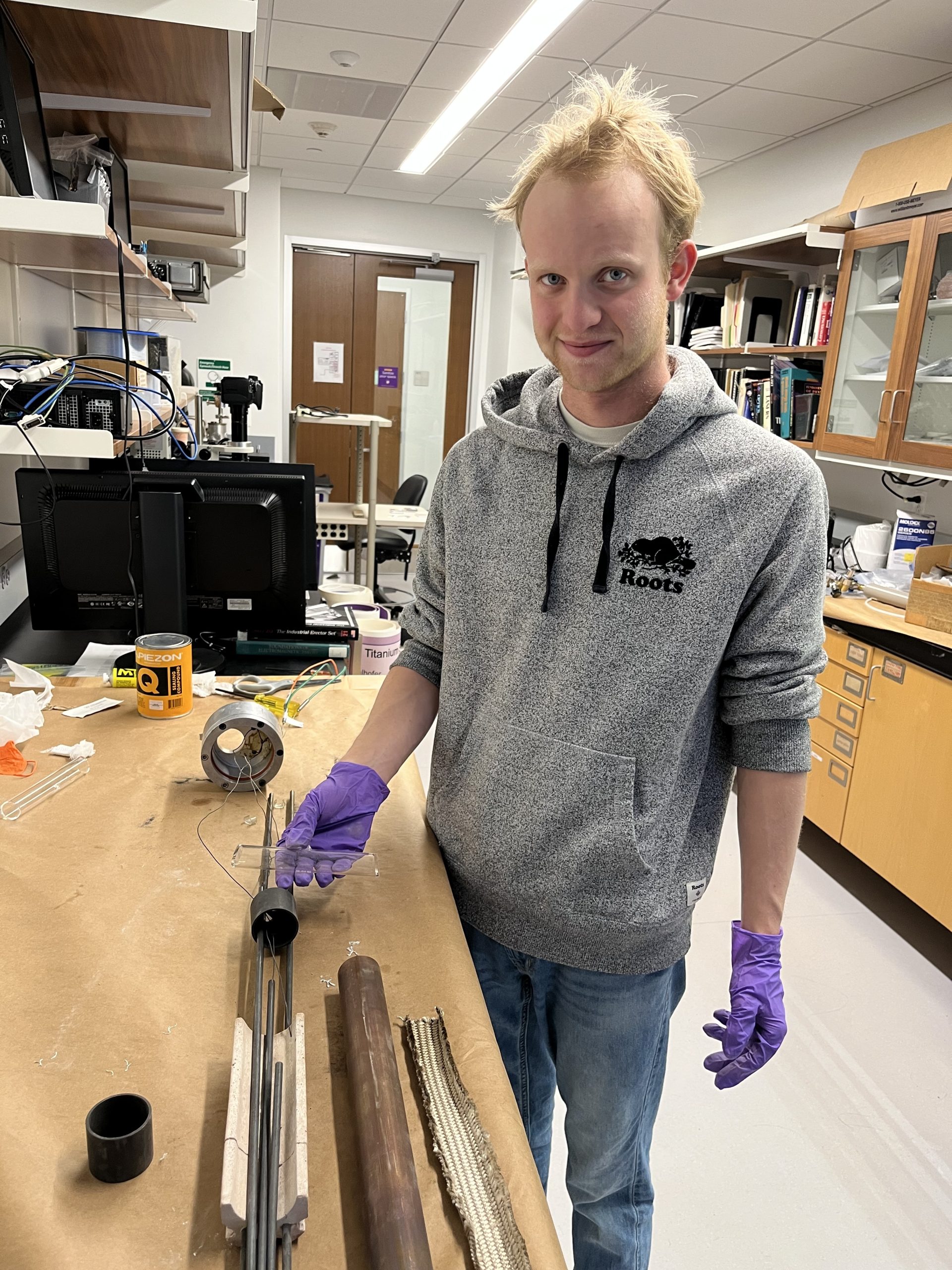
Carter loading lead cells for insertion into furnace:
Julia Matin ‘25.5 joined our group in January (during Winter Study) and rapidly came up to speed learning about our ECDL lasers, our heated vapor cell and furnaces, and our spectroscopy techniques. This spring she completed a successful demonstration of a laser locking technique for one of our ‘first step’ IR lasers (at 1279 nm), using a small frequency modulation of the laser (via current modulation), transmission signals a Doppler-broadened vapor cell absorption feature, a lock-in amplifier, and p.i.d control electronics. Her development work is summarized in this report: Julia Matin Report
Summer 2024:
Work in the lab focused on completion of data collection and analysis for our Faraday-rotation-based measurements of two lead E1 transition amplitudes – work led by long-time postdoc John Lacy. In a separate project two undergraduates, Gautam Ramasamy ’26 and Karleigh Bath (Bryn Mawr) ’25 worked on optics, laser developed, and initial data collection to demonstrate the feasibility of a new two-step, Doppler-free excitation scheme using pairs of heated, isotopically-pure lead cells to measure HFS and Isotope Shifts in several low-lying transitions for the first time or with substantially improved accuracy. John and just-graduated thesis student Charles Yang ’24 attended the 2024 DAMOP conference in Fort Worth, TX where they presented a poster and John gave a talk. Tiku and John then attended the 2024 ICAP conference in London in July. Here are two posters from the summer – the first from ICAP and second prepared by the students for the end-of-summer Williams Summer Science Program poster session.
ICAP_2024_poster
SSPposter_Summer_2024
Spring 2024:
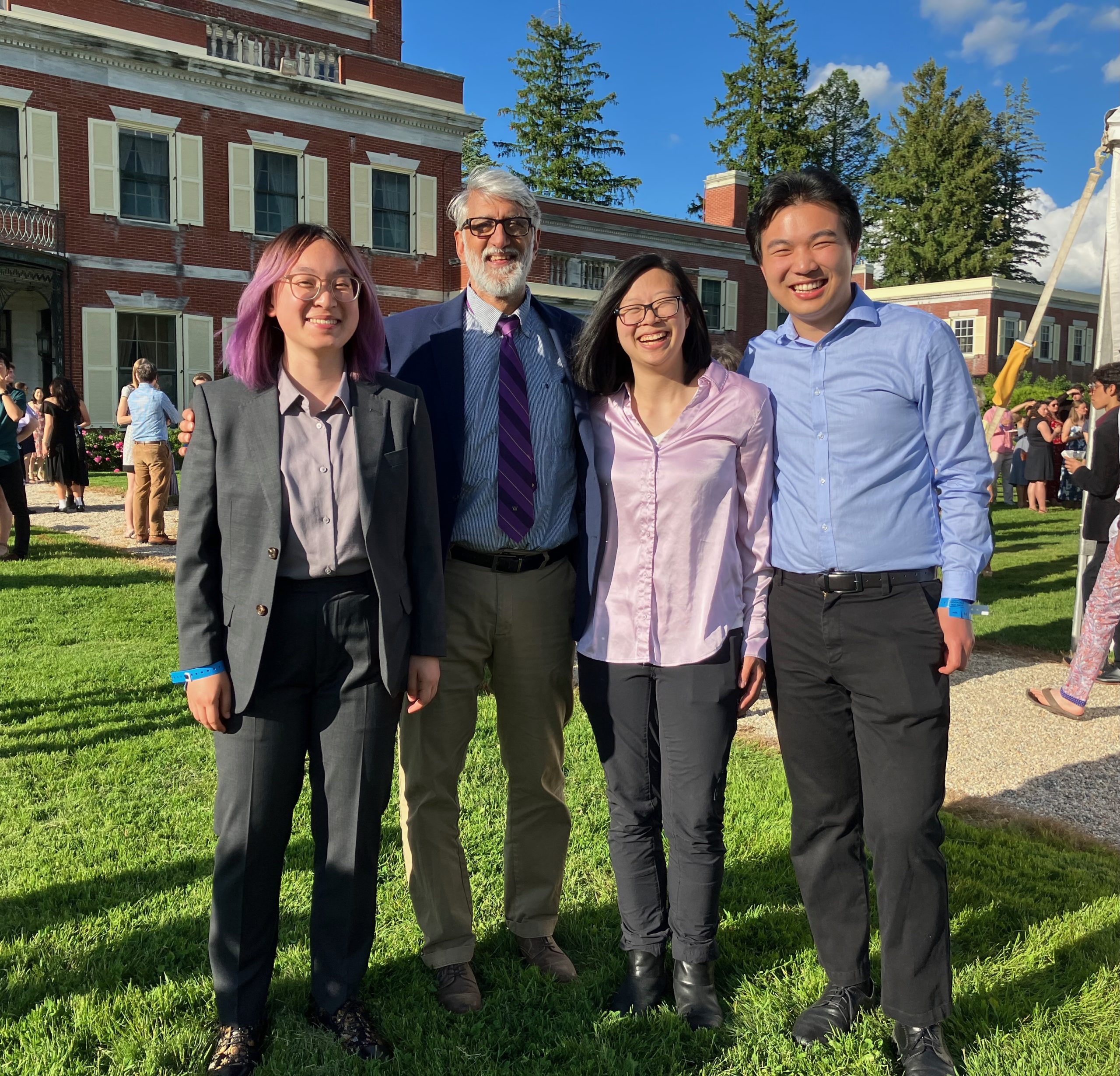
Congratulations to Abby Kinney ’24, Robin Wang ’24, and Charles Yang ’24 on the culmination of their wonderful Williams careers, completion of impressive senior theses, and their exciting graduate school plans for next year (all planning to continue research in the general area of AMO / quantum optics).
This spring also saw the publication of a ‘methods’ paper characterizing, modeling, and implementing a uniaxial CeF3 crystal for UV Faraday spectroscopy. Two current/recent thesis students, Abby Kinney and Gabriel Patenotte ’21, are co-authors…. Photonics paper 2024.
Long-time postdoc John Lacy and Charles will be attending the DAMOP conference in Ft. Worth, Texas in early June, where John will give a 10-minute talk, and they will also present this poster, which describes work of all three thesis students this year (more details below):
DAMOP 2024 Poster
Abby’s thesis describes a measurement of an excited-state <E1> transition amplitude in Pb using high-precision Faraday rotation spectroscopy, and the comparison of two different transitions (one IR, one near-UV) under a very well controlled magnetic field and temperature environment. Her preliminary data analysis shows excellent agreement with the ab initio calculations of our theory collaborators. We will be completing this measurement and quickly following it up with a very similar ‘amplitude ratio’ measurement focusing on the 406 nm (6p2) 3P2 – (6p7s) 3P1 transition this summer. Abby will be attending University of Chicago to begin a Physics Ph.D. in the fall. Here is a link to Abby’s thesis: Kinney Thesis 2024
Robin’s thesis focuses on development of key tools for an upcoming atomic beam ‘polarizability’ measurement similar to many noted below by recent thesis students. But here, for the first time, we have a Pb atomic beam, and will undertake a two-laser experiment where an IR laser, tuned to the ground-state M1 experiment at 1279 nm, will ‘pre-pump’ atoms to the metastable 3P1 state (increasing the small thermal population by 1 to 2 orders of magnitude), and then, using modulation of that beam and lock in detection of the absorption signal by our 368 nm UV laser, we will measure the Stark shift of the (6p2) 3P1 – (6p7s) 3P1 E1 transition in electric fields of order 20 kV/cm. Robin successfully designed a new laser system, a new optical build-up cavity for in-vacuum use and demonstrated locking of both laser and cavity. This work will be continued in 2024-25. Robin will be beginning a Ph.D. in the Quantum Science and Engineering Program at Harvard this fall. Here is a link to Robin’s thesis: Wang Thesis 2024
Charles’ these demonstrated for the first time two-step, Doppler-free spectroscopy in lead. A heated vapor cell of lead (~800 C), he used a first-step IR laser at 939 nm tuned to the ‘forbidden’ E2 transition to pump a (modest) number of atoms to the (6p2) 3P2 – state. This was modulated on and off at various frequencies between 1 kHz and 10 MHz using an acousto-optic modulator (AOM). Then, using our blue laser overlapping with the IR laser, and scanning through the (6p2) 3P2 – (6p7s) 3P1 transition, and an RF lock-in amplifier referenced to the AOM modulation frequency, he studied the blue laser transmission lock-in signal. At low frequencies, the high Pb density rapidly causes velocity-changing collisions of IR excited atoms and re-thermalization, but above 1 MHz substantial Doppler narrowing can be seen. With clean, Doppler-free blue signals, we will now use various ‘natural abundance’ and isotopically-enriched Pb cells to measure both IR and blue transition isotope shifts and HFS values as we scan the blue laser with precisely calibrated Fabry-Perot cavity. Charles will begin a Physics Ph.D at Rice University in the fall. Here is a link to Charles’ thesis: Yang Thesis 2024.
Newest hire in (physical) chemistry at Williams!:
Excited to welcome back to Williams recent thesis student Ben Augenbraun ’15, winner of the 2015 A.P.S. Apker Award, PhD/Postdoc in the Doyle Cold Molecule group at Harvard, and now newly hired experimental Physical Chemistry Assistant Prof. at Williams. Ben is setting up a molecular spectroscopy lab (for the moment right adjacent to our lab, while other renovations are underway). So cool for me, the old guy in the department, to now have two wonderful former students as Williams faculty colleagues:
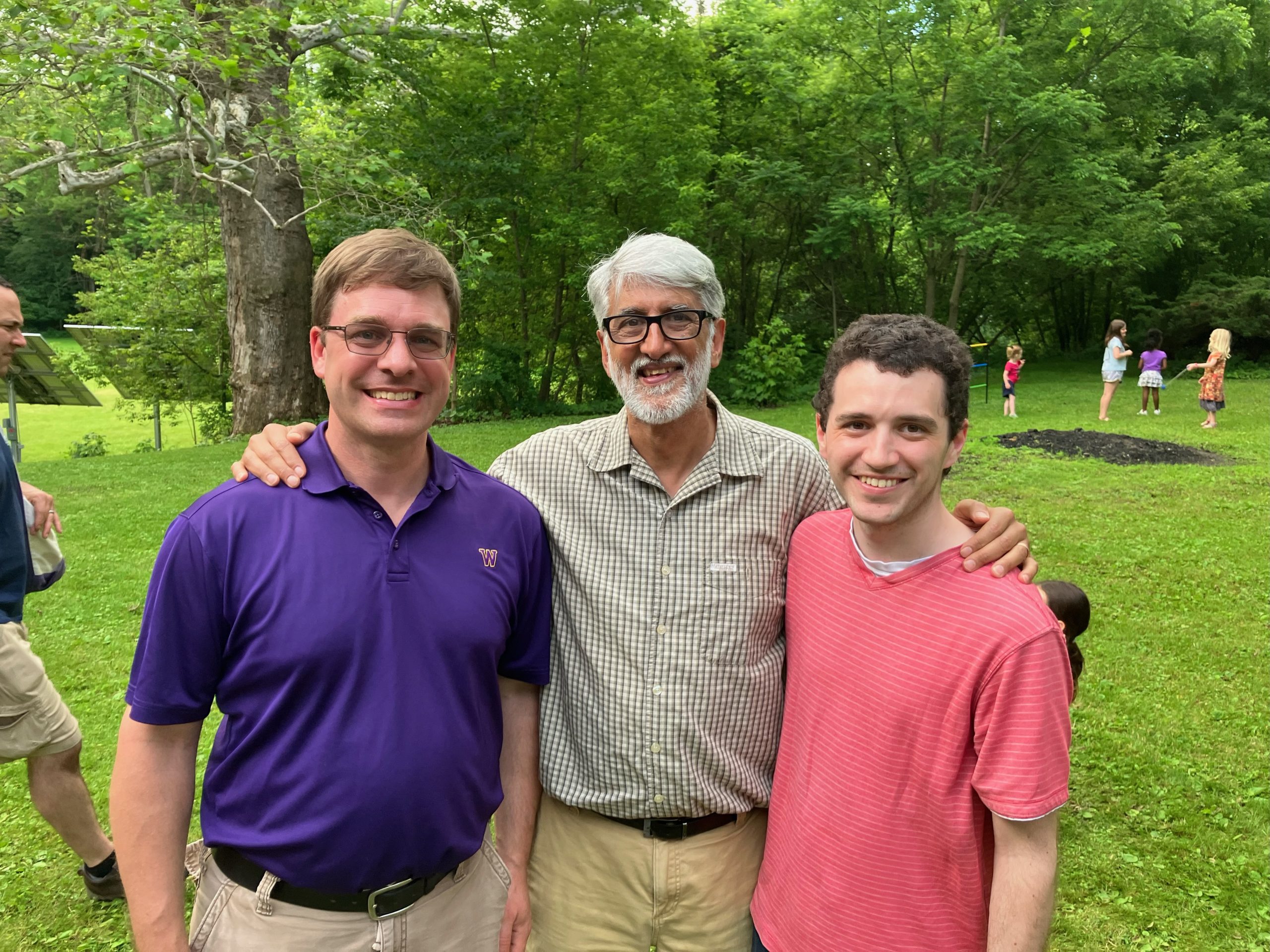 Commencement 2024: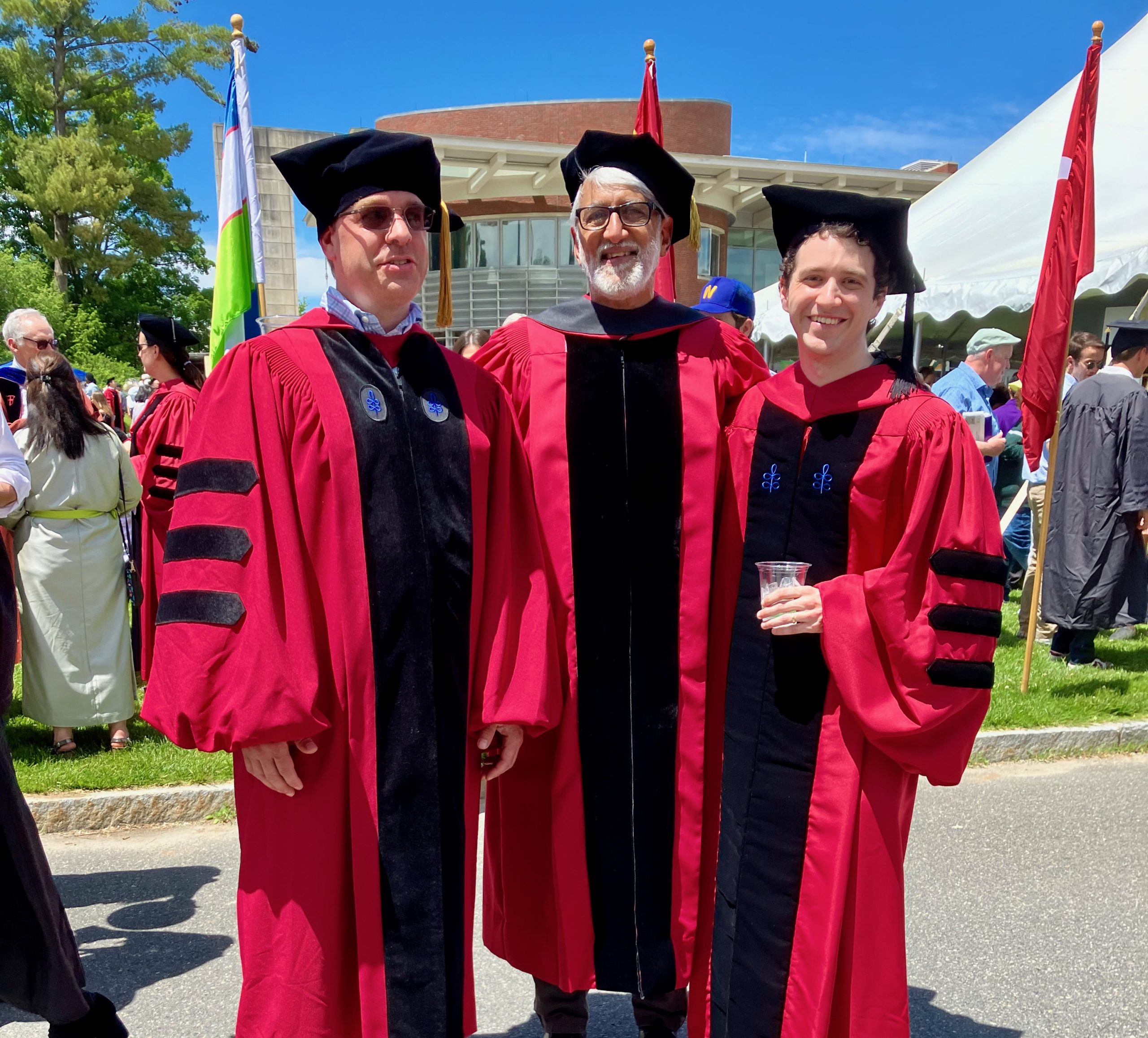
Summer/Fall 2023
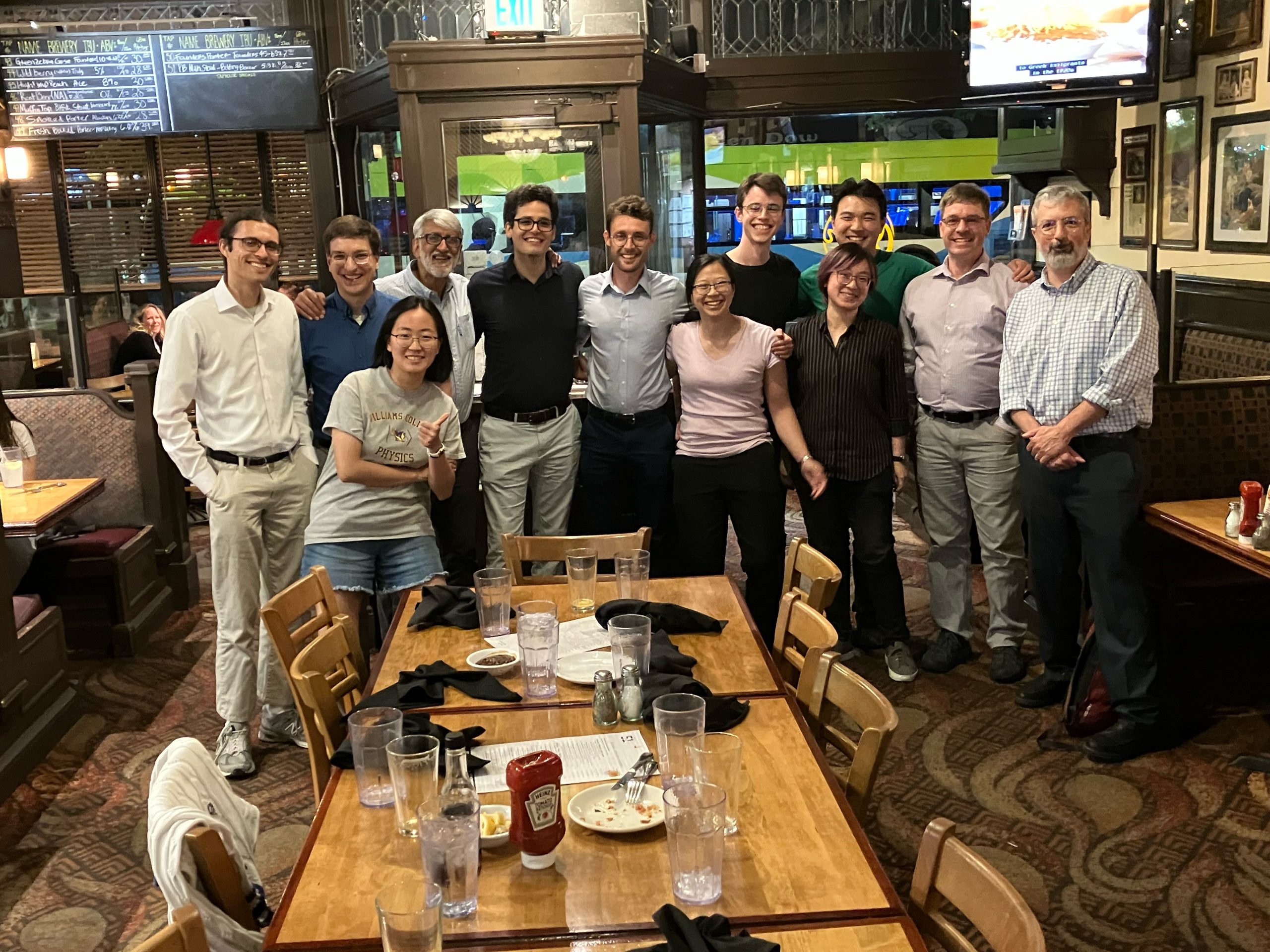
In summer of 2023, we were thrilled welcome back three rising seniors, Abby Kinney, Robin Wang, and Charles Yang to begin thesis work in the Majumder lab. An early highlight for this group was attending the June 2023 DAMOP annual conference in Spokane, WA. The students helped in the preparation and presentation. Here is the DAMOP 2023 poster: DAMOP 2023 poster.pdf
And here a photo of Ephs in attendance [in addition to current students and faculty, this includes (L-R): Matthew Roychowdhury ’21, Justin Brown ’05, Nathan Schine ’13 (newly hired Asst Prof at JQI/U Maryland!), Gabriel Pattenote ’21, and Josh Grossman ’96].
Thesis projects of current seniors:
Abby Kinney ’24 has been focusing on taking data for the M1/E1 Faraday spectroscopy comparison experiment, work which includes careful optimization of signal/noise for both lasers using the common Ce-F3 crystal, calibration of the comparative Verdet constants at the two wavelengths, and precise and accurate temperature measurements of the Pb quartz vapor within our furnace.
Robin Wang ’24, who worked in our lab two summer previous, is working on reviving our Atomic Beam apparatus for a polarizability measurement of this same E1 transition, but with the key addition of a pre-pump arrangement to enhance by several orders of magnitude the effective 3P1 population that is the starting point of the E1 transition. This will be achieved by the use of a frequency-locked IR laser tuned to the 1279 nm 3P0-3P1 M1 transition, and a high-finesse, in-vacuum cavity (also locked) 10 cm upstream of the E1 interaction region where the HV electric field plates are located.
Charles Yang ’24, is working on a similar two-step excitation scheme, but here with the 939 nm 3P0-3P2 E2 transition (even more forbidden) overlapping with the 406 nm laser tuned to an E1 transition originating from the 3P2 state. The thermal population of the 3P2 state without laser pumping is only 10^-6, but we can easily see enhancement of the 406 spectroscopic signal when we overlap the 939 laser and modulate it and use a lock-in amplifier to detect the 406 nm transition signal. We are now setting up to modulate the 939 signal via an acousto-optic modulator at a frequency sufficiently high (~ 100 kHz) to see Doppler narrowing of the blue laser signal since the modulation time constant is now smaller than the time constant for velocity-changing collisions. This will allow Doppler-free spectroscopy, HFS/Isotope measurements, and will set up for the next experiment in the atomic beam apparatus (in analogy to Robin’s project above).
All three students are now in the midst of applying to graduate programs in physics and applied physics for fall 2024.
Highlights of 2022-23
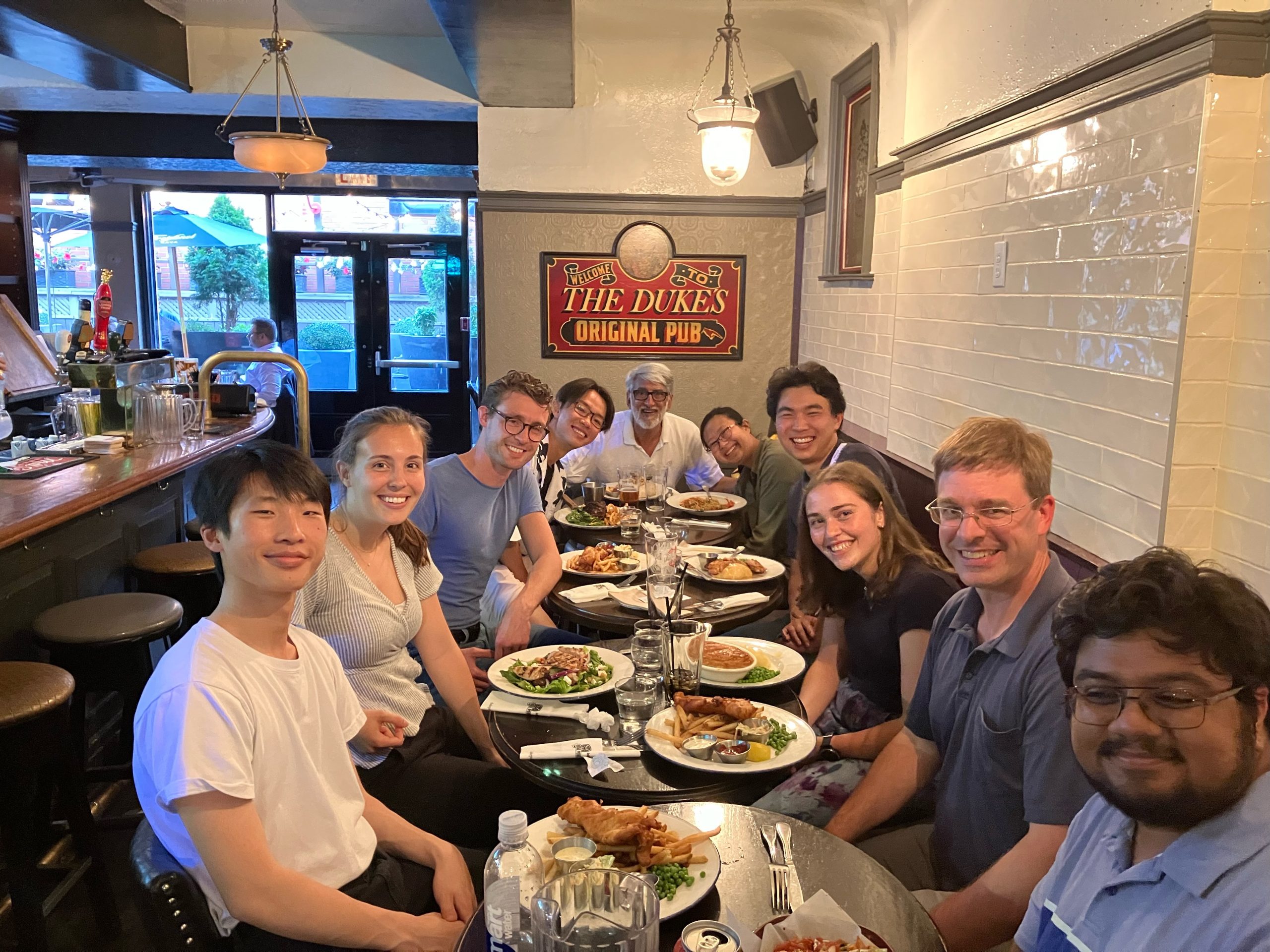
During the summer of 2022, summer research assistants Abby Kinney ’24 and Charles Yang ’24 pursued several in-progress projects alluded to below: Pb spectroscopy and transition amplitude measurements. A highlight of the summer was a ‘road trip’ to the (postponed from 2020) biennial International Conference on Atomic Physics in Toronto, CA attend by Abby, Charles, postdoc John Lacy, Tiku, as well as Prof. Charlie Doret and several of his students. Students in both groups presented posters and attended five days of spectacular invited talks by world-experts in all areas of AMO physics. Here is the poster from ICAP 22: ICAP 2022 Poster
And a photo of students / faculty in attendance (students (L-R): Timmy Chang ’23 (now at Stanford), Paige Robichaud ’21 (now at Harvard), Benny Wang ’22 (now at Stanford), Ashay Patel ’18 (now at Caltech), along with current students Abby Kinney, Charles Yang, and Sonya Dutton).
Research activities in 2021-22
During the summer and fall of the 2021-22 academic year, Charlotte Jones ’22 began her thesis work, and research assistants Russell Blakey ’23, Robin Wang ’24, and Abby Kinney ’24 also made important contributions. Postdoc John Lacy again took on an important leadership role, mentoring students, working closely along side them, and setting overall goals and agendas for the group. We are pursuing further high-precision transition amplitude measurements in the Pb system, using both a UV (368 nm) laser system, and a blue (406 nm) laser system. As we have realized (and as Gabriel Patenotte further demonstrated in his thesis work last year (see below)), we can directly compare the observed absorptivity of hot Pb samples in vapor cells at two wavelengths – using the ground-state M1 transition (3P0 – 3P1, 1279 nm) as a normalization/reference as we originally did in our 2019 paper which appeared in PRA.
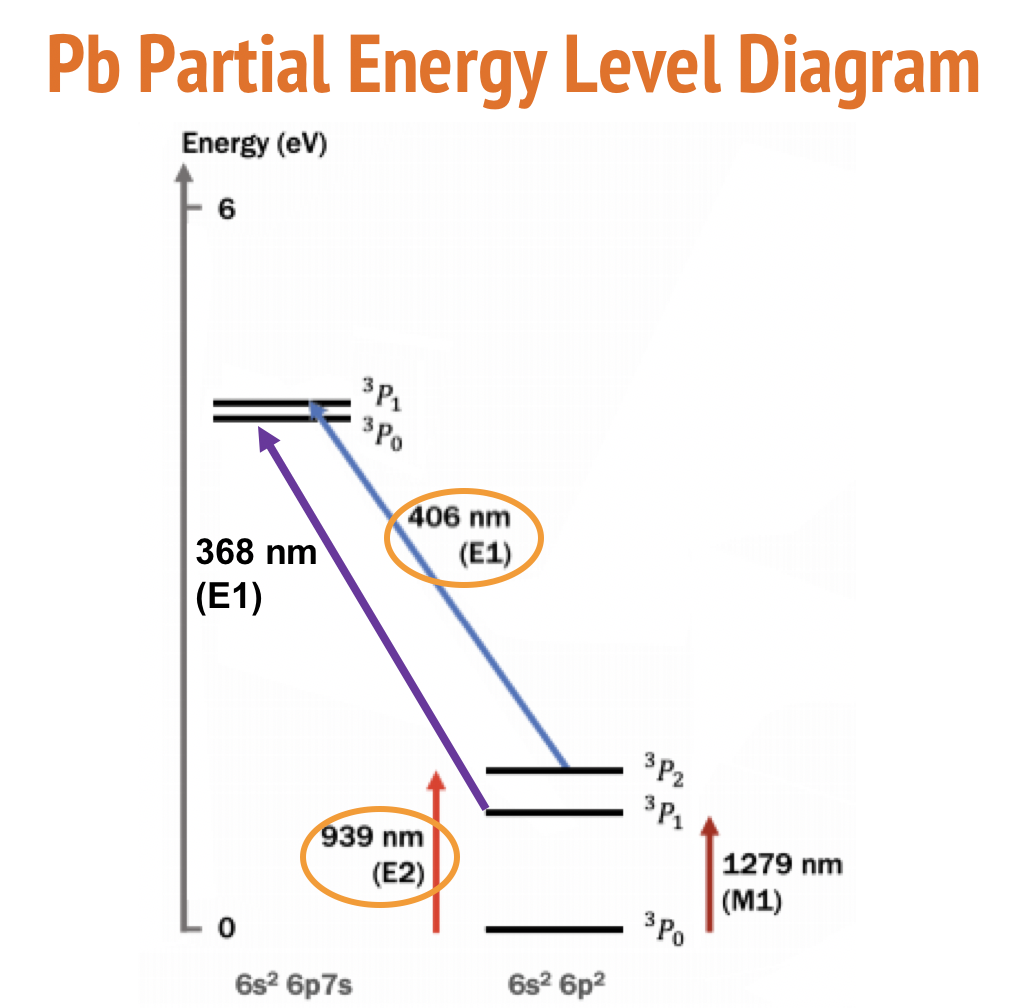
Interestingly, the excited-state E1 transitions (see energy level diagram above), which are 5-6 orders of magnitude ‘stronger’ than the ‘forbidden’ M1 and E2 transitions, happen to feature roughly comparable REDUCTION in signal strength due to the small Boltzmann factor associated with the excited states from which these E1 transitions originate. As it turns out (see Patenotte thesis for example), at temperatures in the 800-900 C range, both excited state E1 transitions show absorptivity comparable in size to the forbidden ground-state transitions. The challenge, then, is to accurately determine the sample temperature. We are exploring encasing the quartz cells in stainless steel tubes, and mounting several special-purpose ‘S’ type thermocouples which have temperature accuracies quoted at +/- 1 degree Celsius at these temperatures. This accuracy will be sufficient to allow an absolute transition amplitude measurement for the E1 transitions at the 1% level or better.
Prior to these measurements we are using the various lasers to measure isotope shifts (IS) and Pb-207 hyperfine splittings (HFS) using side-by-side cells in both dual transmission spectroscopy and dual Faraday spectroscopy setups. We are completing the first direct IS and HFS measurements in the 939 nm transition, which are looking to be in good agreement with, and more precise than, indirect ‘inferred’ values from various older measurements of other nearby transitions.
We are pushing forward with a comprehensive re-measurement of both IS and HFS values in the 939 nm E2, 1279 nm M1, and 406 nm E1 transitions using careful calibration of our scans (via adding RF sidebands to FP transmission spectra) and then using those same scans to remove laser scan nonlinearities – something we have extensive experience with! Charlotte’s 2022 thesis will include these spectroscopy results, as well as preliminary work towards the aforementioned 406/1279 transition amplitude comparison experiment using our Faraday polarimeter / vacuum furnace and a Pb-208 cell with accurate temperature monitoring.
Highlights of 2020-2021 academic year
In another challenging academic year with significant COVID-related restrictions, two class of ’21 thesis students completed impressive work in collaboration with postdoc John Lacy. We continued to focus on making measurements of atomic properties of multi-valence Group III and IV atomic systems. This work currently centers on the Pb system, the first measurement of which was published in 2019.
Patrick Postec ’21 developed and tested a new ‘heat pipe oven’ designed to provide the capability of higher temperatures and higher optical depth operation for future investigation of particularly weak transitions in Pb and potential Sn (another Group IV system). Patrick took a position at Americorps for 2021-22, and has now completed applications to start a Ph.D. program in mechanical engineering which will focus on alternative energy and sustainability.
Gabriel Patenotte ’21 completed several years of association with our group, having designed, constructed, and optimized a new UV diode laser system that operates near zero degrees (Celsius) to reach the 368 nm (6p2) 3P1 –> (6p7s) 3P0 (E1) transition in Pb. This laser now routinely outputs 10 mW of power and can scan single mode over nearly 20 GHz at this transition wavelength. Gabriel also completed a preliminary (but very promising) comparative absorptivity measurement of this E1 transition in Pb compared to the ground-state M1 transition (whose QM linestrength is very accurately known). Finally, he completed substantial atomic structure and modeling calculations to look at the Stark shift and Faraday rotation details of an atomic-beam-based measurement of Pb polarizability in this excited E1 transition. Gabriel is now in his first year as a Ph.D. student in the physics department at Harvard, pursuing cold-molecule science in the Ni group. He joins recent Majumder group members Abdullah Nasir ’20, Nathaniel Vilas ’17, and Ben Augenbraun ’15 who all made a similar transition from Williams to AMO physics at Harvard.
Congratulations to both Patrick and Gabriel! Here are these most recent theses:
And here is the most recent group poster, given (virtually) at DAMOP 2021.
June 2020
Congratulations to Abdullah Nasir ’20 on his graduation. It’s been a pleasure having him as part of our lab team, starting with a summer after his freshman year, and now culminating with excellent thesis work, especially in this crazy year in which much less was possible in the lab physically. We look forward to having him around for a little longer this summer, and then wish him the very best of luck at Harvard where he will be starting in the physics Ph.D. program this fall.
Here is his thesis: Nasir_Thesis
We are also participating in virtual DAMOP 2020, and have prepared this poster: DAMOP2020 Poster
And, undaunted, we had our annual Ephs @ DAMOP gathering, which was exceptionally well-attended, with Williams graduates from 1966 to 2021 represented, as well as current and former Majumder group postdocs!
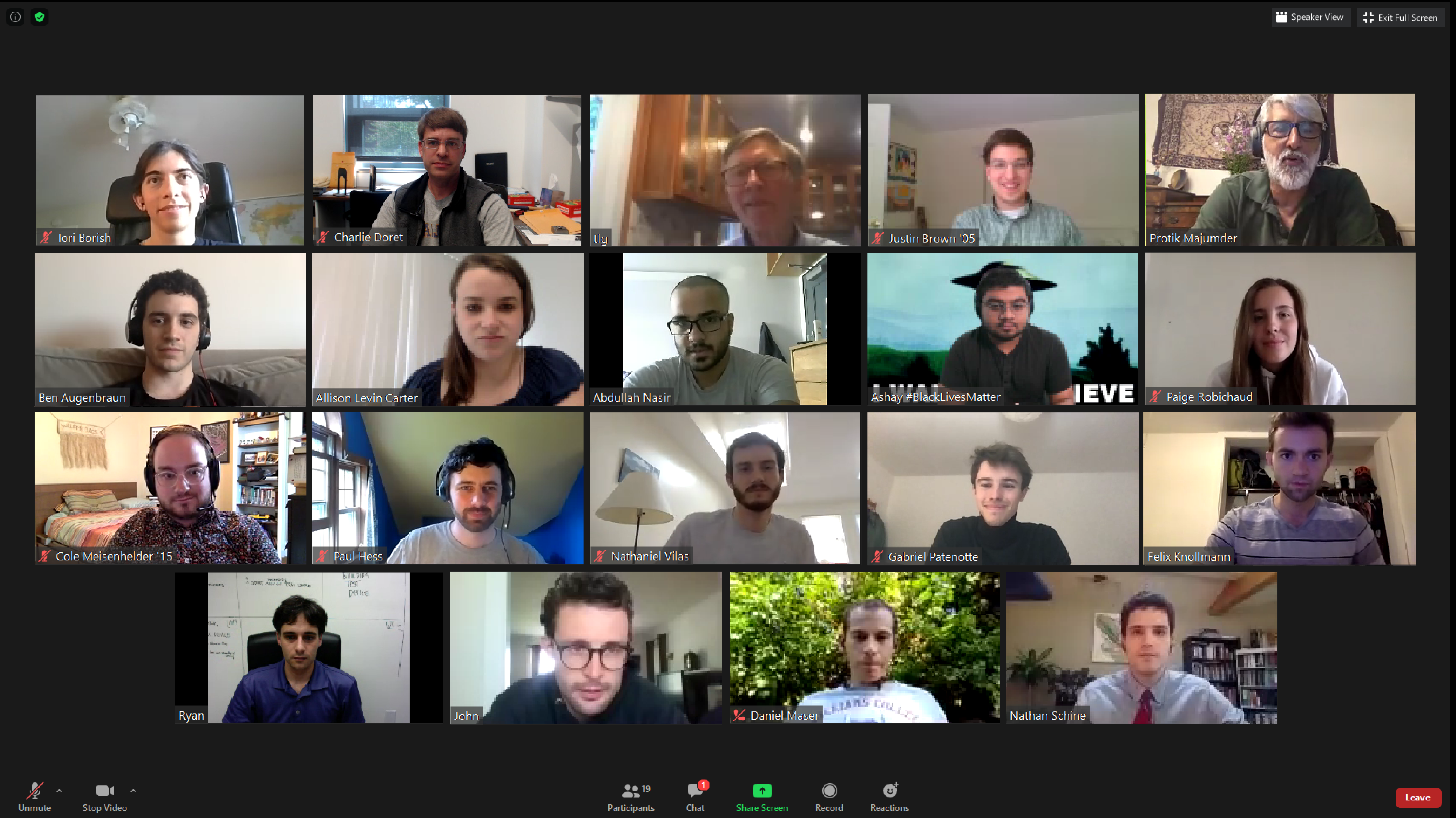
We look forward to a summer of productive, if still virtual work with incoming thesis students Gabriel Patenotte ’21, and Patrick Postec ’21.
May 2020
Its been quite a six months since the last update. I want to salute the amazing work of postdoc John Lacy and thesis student Abdullah Nasir ’20, as well as junior Gabriel Patenotte ’21 who will be starting his thesis work this summer. In a time of unprecedented disruption and crisis, all of the team members have remained focused, productive, and as optimistic and positive as possible.
Through the winter and early spring, we focused as a team on two projects :
(1) translating our Faraday Rotation Spectroscopy (FRS) technique to our atomic beam apparatus, and to completely rebuilding our source / furnace and vacuum system to accommodate a new Pb atomic beam source.
(2) optimizing design and testing the behavior of our new 368.5 nm UV diode laser system which operates slightly below zero (Celsius) and now allows routine single-mode tuning around the Pb (6s2 6p2) 3P1 –> (6s2 6p7s) 3P0 E1 transition, which we have observed in a vapor cell.
Next steps as of March were to optimize the beam operation, and search for M1 FRS signals in the ABU. With the arrival of COVID-19, we went into a more virtual, shutdown mode. John and Abdullah have been focusing both on a series of theory / simulation problems associated with measuring Polarizability (static E-field) in the presence of magnetic field necessary for FRS, as well as studying the small tensor polarizability component of the 3P1 state.
We look forward to a slow return to lab work soon.
November 2019
Welcome to our new postdoc, Dr. John Lacy, who arrived at the beginning of November from the UK, where he recently completed his D.Phil. at U. Sussex, having earlier done his Bachelors degree at Cambridge Univ. John did his doctoral work in the area of development of novel electron Penning traps. He is quickly integrating himself into all Majumder lab projects, working closely with Abdullah Nasir ’20 (thesis student) and Gabriel Pattenote ’21 and Declan Smith ’21 (research students) on both vapor cell and atomic beam experiments.
Our latest Pb Faraday spectroscopy work, completed in collaboration with theory co-authors Marianna Safronova and Sergey Porsev, has appeared in Physical Review A:
https://journals.aps.org/pra/abstract/10.1103/PhysRevA.100.052506
We are working to extend this high-precision polarimetry technique to the atomic beam environment, for spectroscopy and polarizability measurement in Lead, and also for precise isotope shift / HFS work in a ‘double polarimeter’ setup using our lead furnace.
June 2019
We have settled in to our new lab in the South Science Building. This year saw completion of our Lead transition amplitude / Faraday polarimetry measurement, led by postdoc Dan Maser. This work, with Safronova group co-authors, is being written up now.
Sophomores Gabriel Pattenote ’21 and Sameer Khanbhai ’21 continued their work with our group throughout the year. Gabriel and Dan designed, constructed, and successfully tested a new UV laser system (368.5 nm) with which we did preliminary excited-state spectroscopy of Pb atoms in a cell. Abdullah Nasir ’20 returned to the group to work over WSP in January, and will begin his senior thesis work in the Majumder lab this summer pursuing Pb atomic beam spectroscopy experiments. He will be joined by rising juniors Declan Smith ’21 and Duncan McCarthy ’21 this summer.
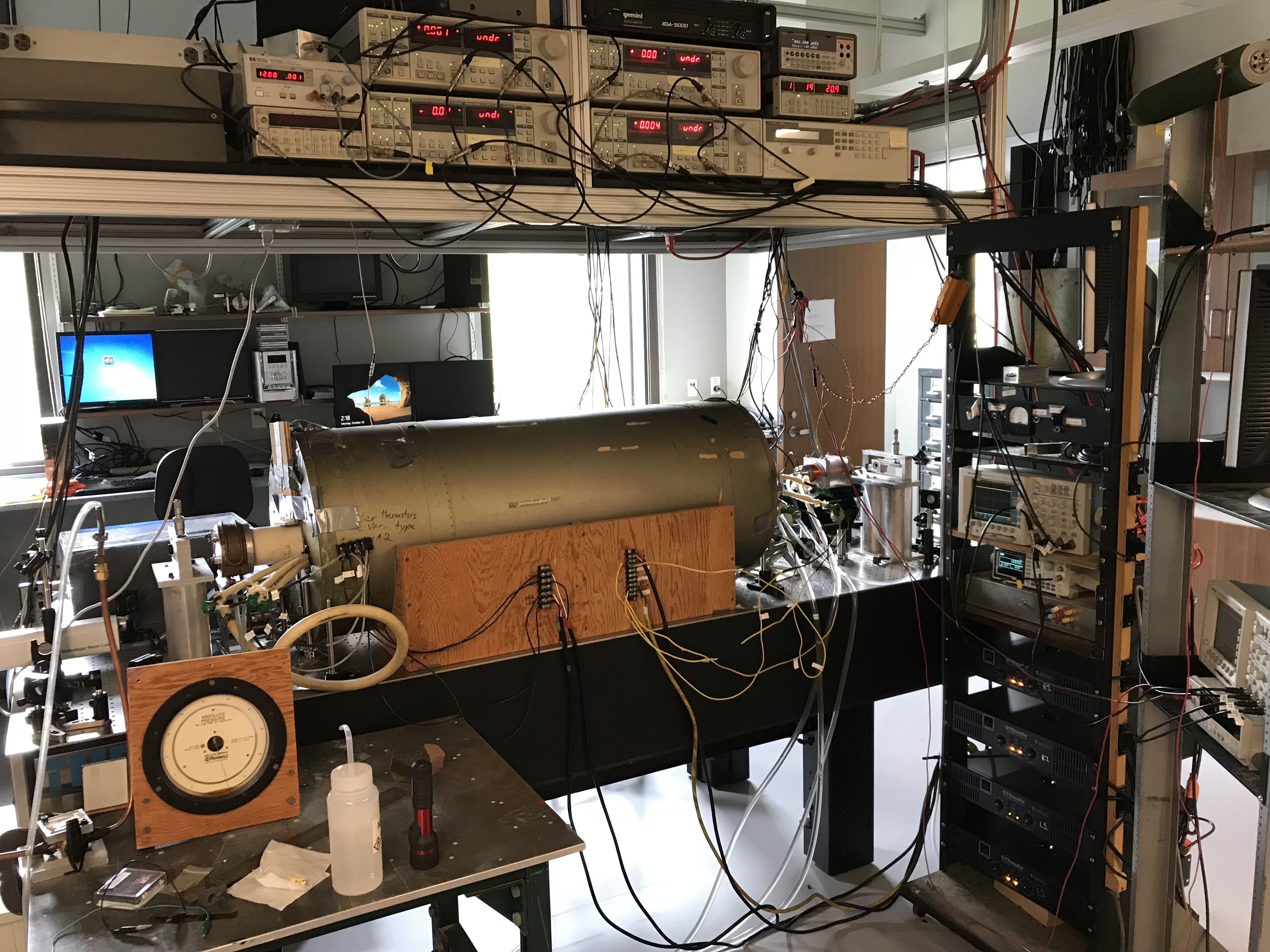
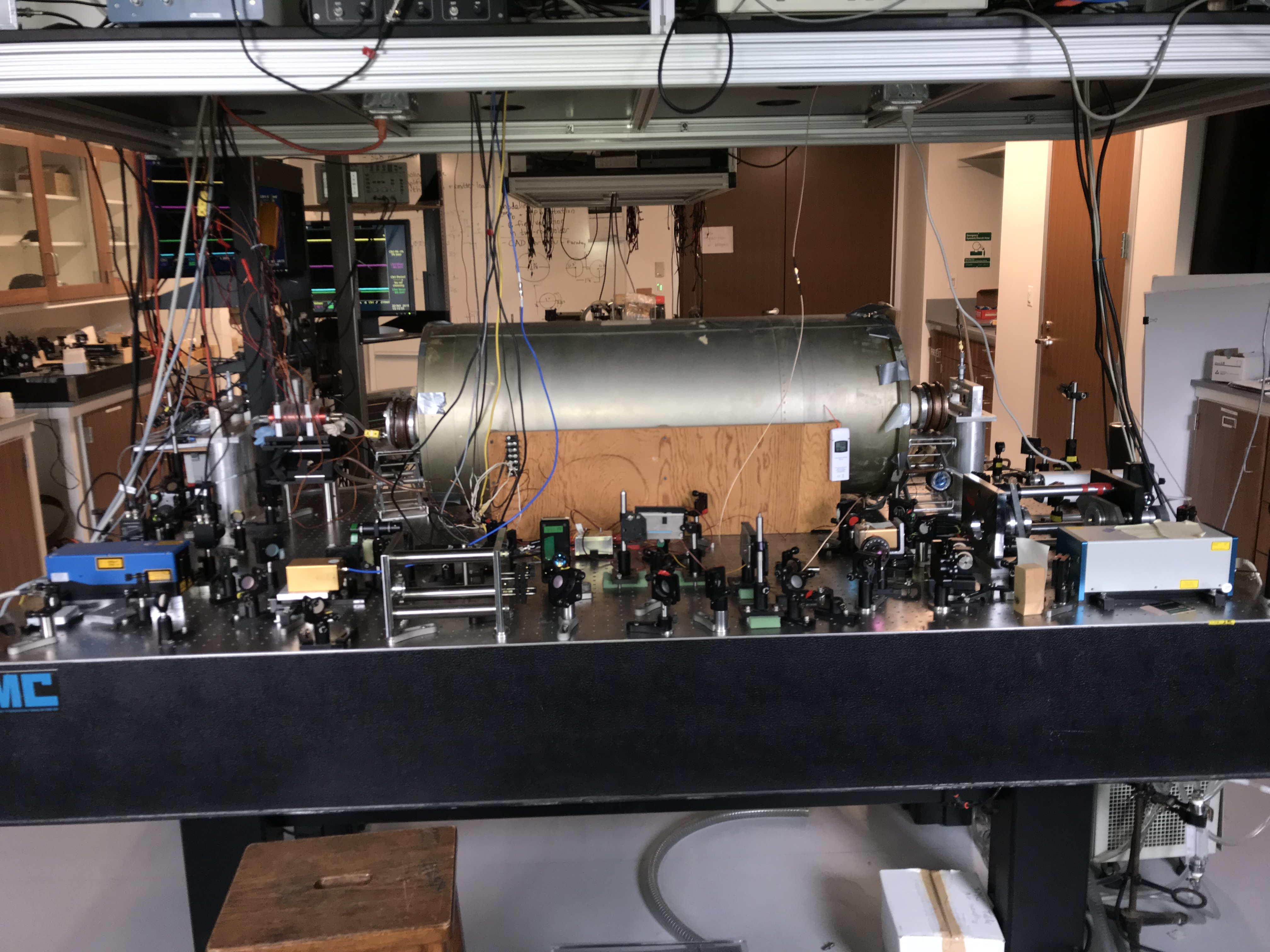
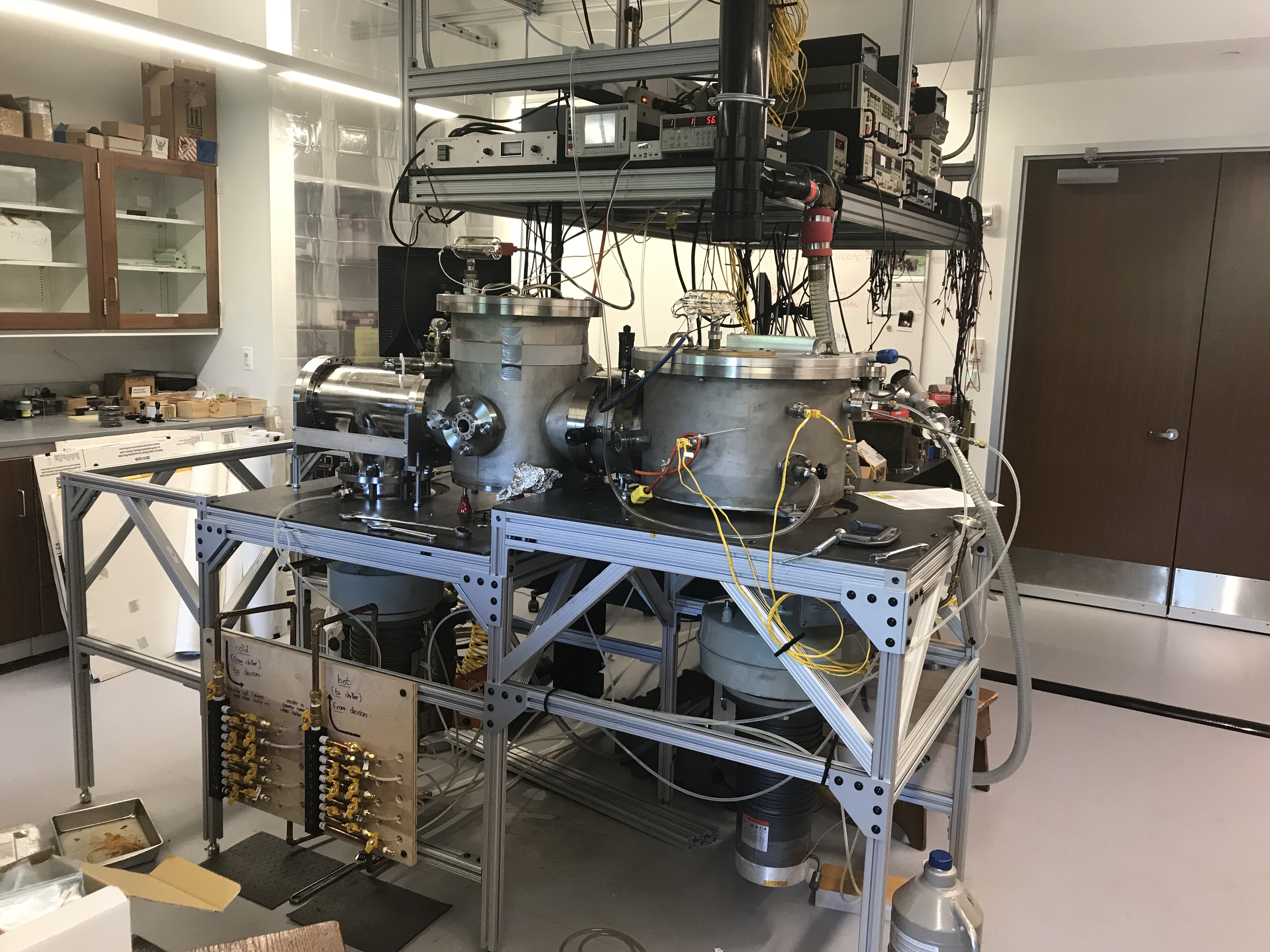
vapor cell furnace and polarimetry ABU reincarnated in new lab!
May 2019
Tiku and Dan attended the 50th annual DAMOP meeting in Milwaukee, WI at the end of May. Dan presented a 10-minute talk on our Pb quadrupole transition amplitude measurement. PPT slides here:
https://williams0.sharepoint.com/:p:/g/EdGGqgX-hFxMjXUjqDnp_z8BCDexQwHDSXw8fW1VWH4oLg
We also presented a poster on this and upcoming work in the group:
DAMOP_2019_poster
We caught up with many recent alums!
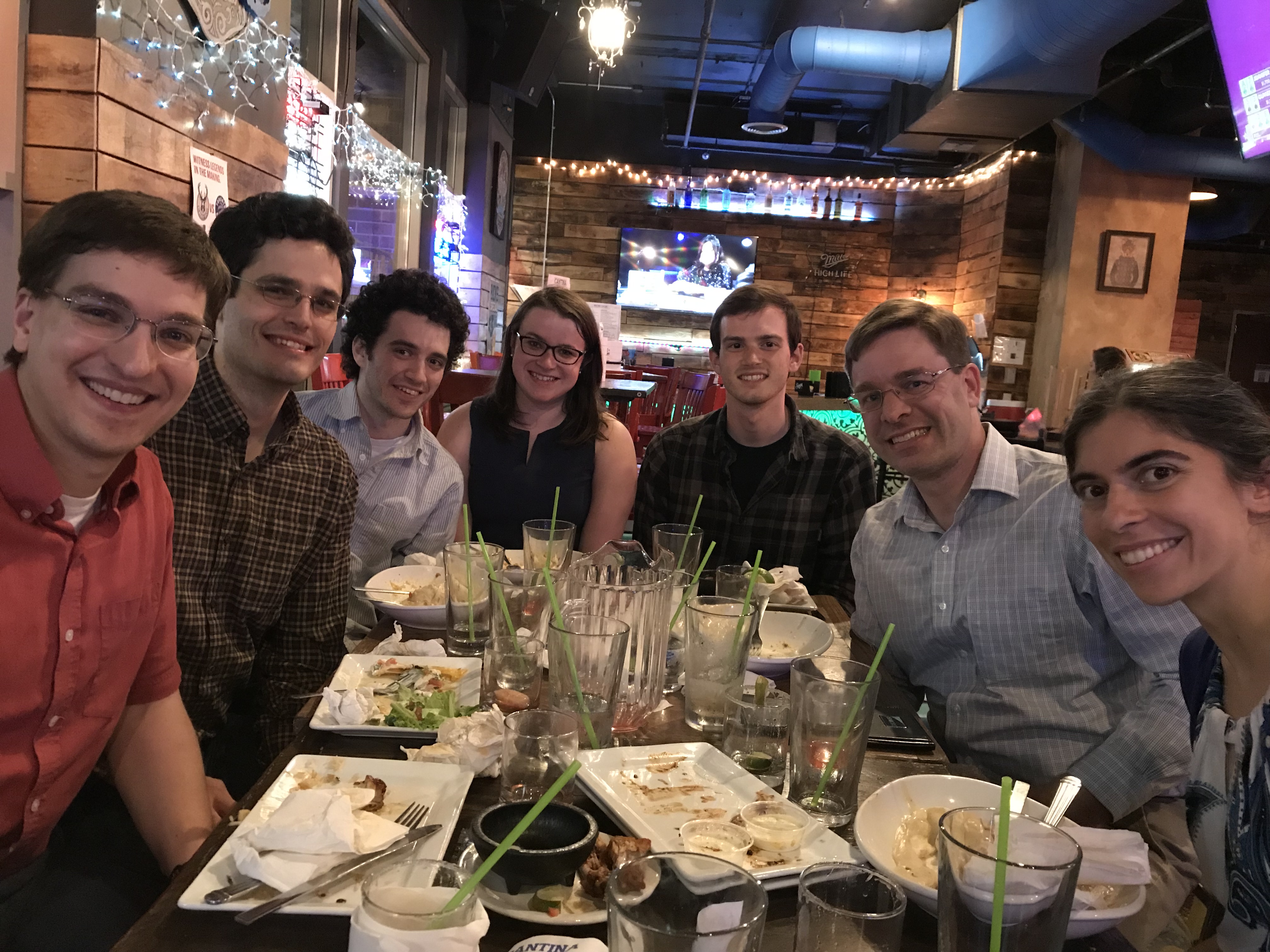
Justin Brown ’05, Nathan Schine ’13, Ben Augenbraun ’15, Allison Carter ’16, Nathaniel Vilas ’17, Prof. Charlie Doret ’02, Tori Borish ’12
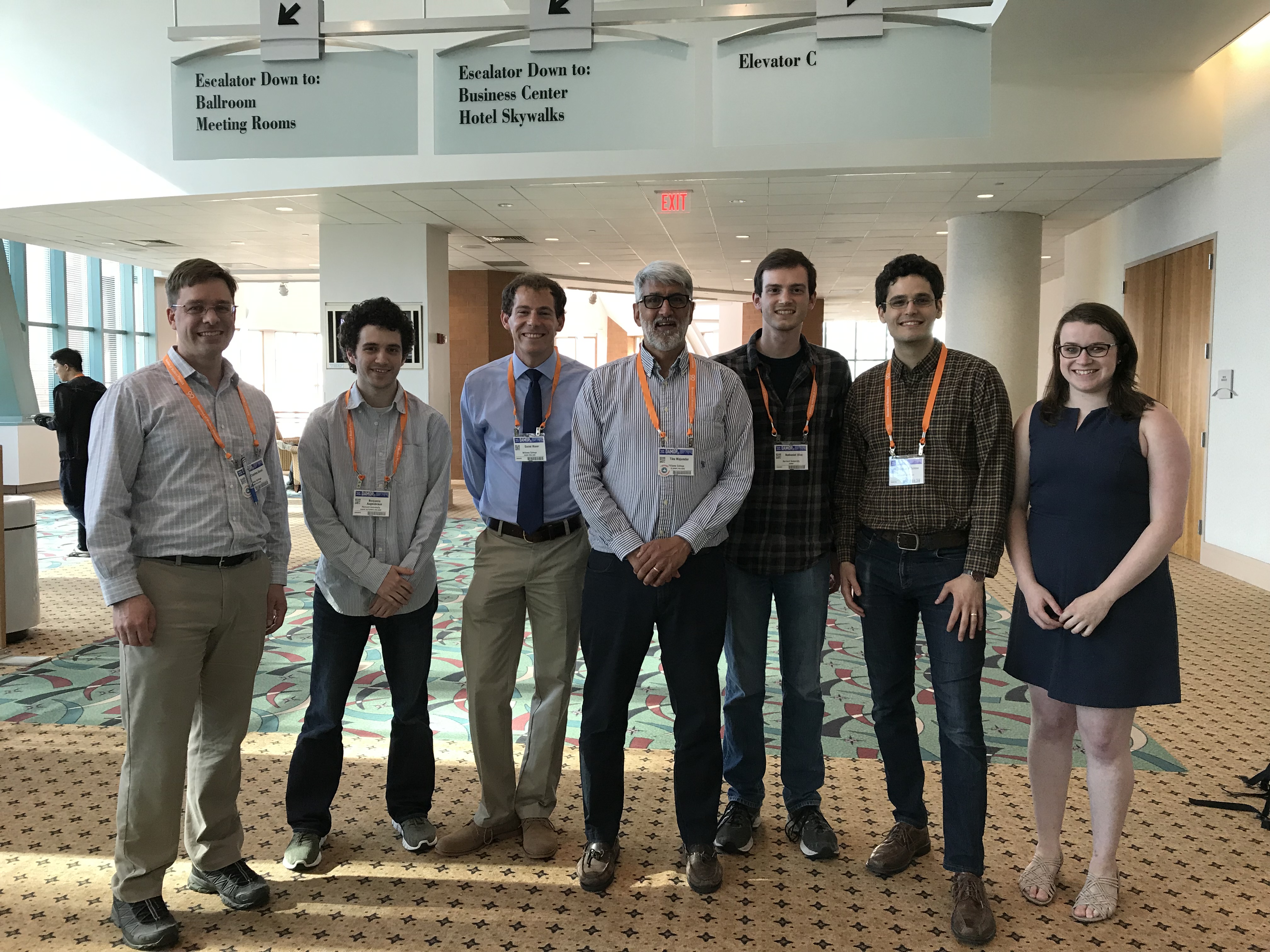
Majumder group alums @ DAMOP 2019
(L-R): Charlie Doret ’02 (Asst Prof @ Williams), Ben Augenbraun ’15, Dr. Dan Maser (Asst. Prof @ Conn College), Nathaniel Vilas ’17, Nathan Schine ’13, Allison Carter ’16
April 2019
Congratulations to Postdoc Dan Maser, who has accepted a tenure-track faculty position at Connecticut College in New London, CT!! Dan will be building up a new lab to do laser spectroscopy of trace atmospheric molecules using frequency-comb technology. We will truly miss Dan’s energy, expertise, and leadership in the group, but wish him the very, very best in his new adventure!
June 2018
Looking forward to unpacking and setting up our experiments in our brand new lab, Room 006 of the South Science Building, with Postdoc Dan Maser, and research assistants Gabe Pattenote ’21, and Sameer Khanbhai ’21.
Postdoc Dan Maser and thesis student Bingyi Wang ’18 attended the annual DAMOP meeting, as well as the precision measurement workshop that preceded it, in Fort Lauderdale, FL. Here is a .pdf of the poster that they presented on our recent Indium polarizability measurements, including our latest results published in February.
DAMOP poster_2018 (1.6 MB)
Congratulations to Bingyi Wang ’18, who graduated magna cum laude & Phi Beta Kappa, on June 3rd, an is headed to Stanford this fall. Here is her thesis:
Bingyi_Wang_Thesis(3.4 MB)
February 2018
Congratulations to Bingyi Wang ’18, current thesis student, for being chosen as one of the inaugural cohort of Knight-Hennessey Scholars at Stanford University, where she will be beginning in the Physics Ph.D. program. Bingyi was one of 50 scholars out of several thousand applicants!
February 2018
Our latest Indium atomic beam polarizability measurements have been published, with Marianna Safronova’s group contributing ab initio calculations, so that for the first time we can systematically compare two side-by-side calculational methods (the so-called Coupled Cluster method and the Configuration Interaction / All-order method). Our latest results for the polarizability of the 7p states and earlier results for the 6p and 6s states show clear ‘preference’ for the latter theory method for the case of these excited states in this trivalent atom.
Co-authors from our group are Nathaniel Vilas ’17, Bingyi Wang ’18, and recent and current postdocs Milinda Rupasinghe and Dan Maser.
https://journals.aps.org/pra/abstract/10.1103/PhysRevA.97.022507
October 2017
We are very happy to welcome new postdoc Dr. Daniel Maser to our group. Dan completed his undergraduate degree at Berkeley, and his Ph.D. at the Univ. of Colorado, working in Scott Diddams’ lab at NIST building new frequency-comb-based mid-IR laser sources for sensing applications.
Dan will immediately join current thesis student Bingyi Wang ’18 as we complete our latest indium ABU polarizability experiment, and also continue our Pb transition amplitude / Faraday polarimetry work begun last year by Eli Hoenig ’17.
DAMOP 2017, Sacramento, CA June 5-9, 2017
A great week in Sacramento with lots of current and former students and colleagues!
Current Majumder group attendees: Nathaniel Vilas ’17, Eli Hoenig ’17, Postdoc Milinda Rupasinghe, Joined by Prof. Charlie Doret, three of his students, and Prof. Swati Singh.
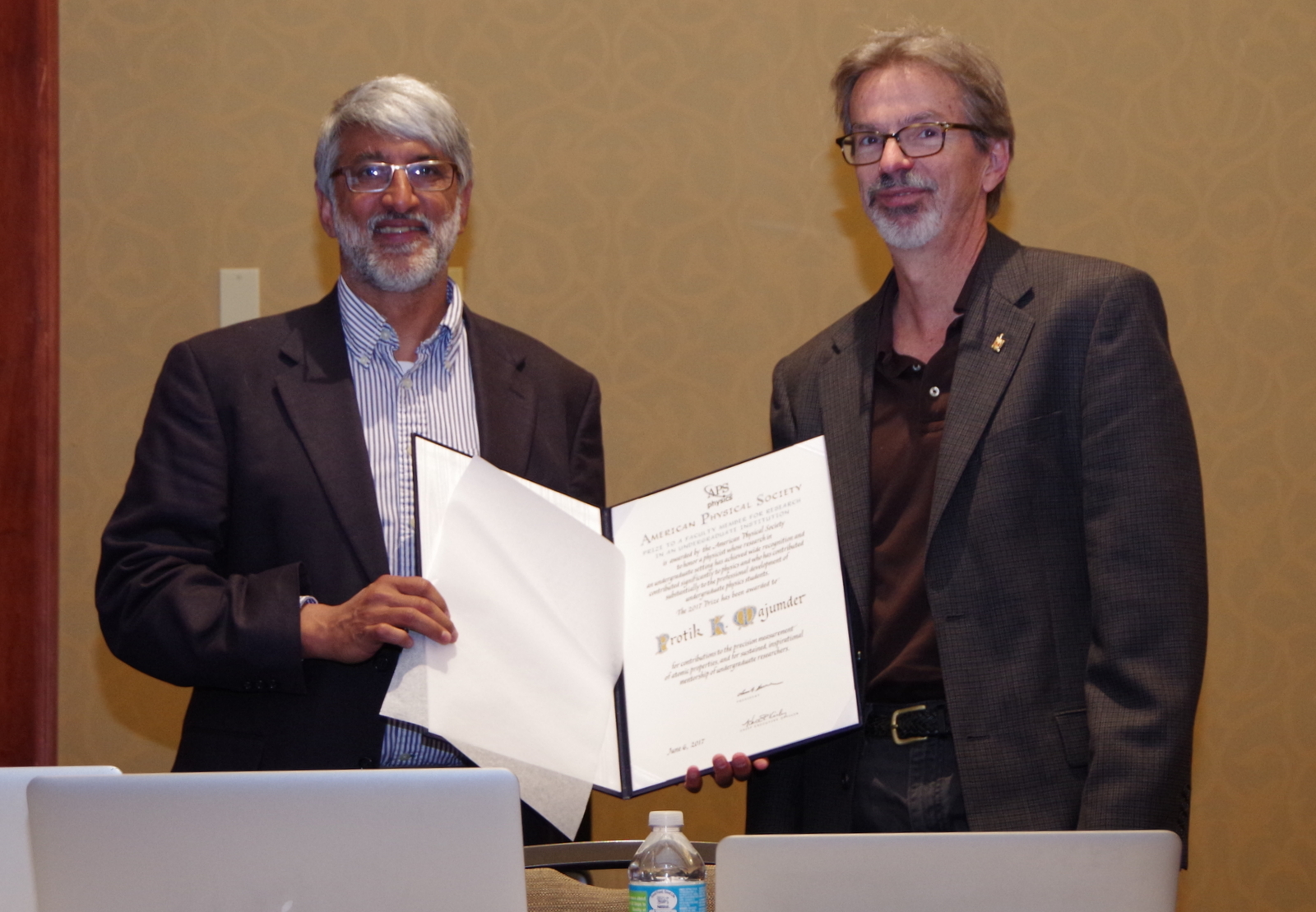 Receiving APS Prize w/current DAMOP chair Steve Rolston.
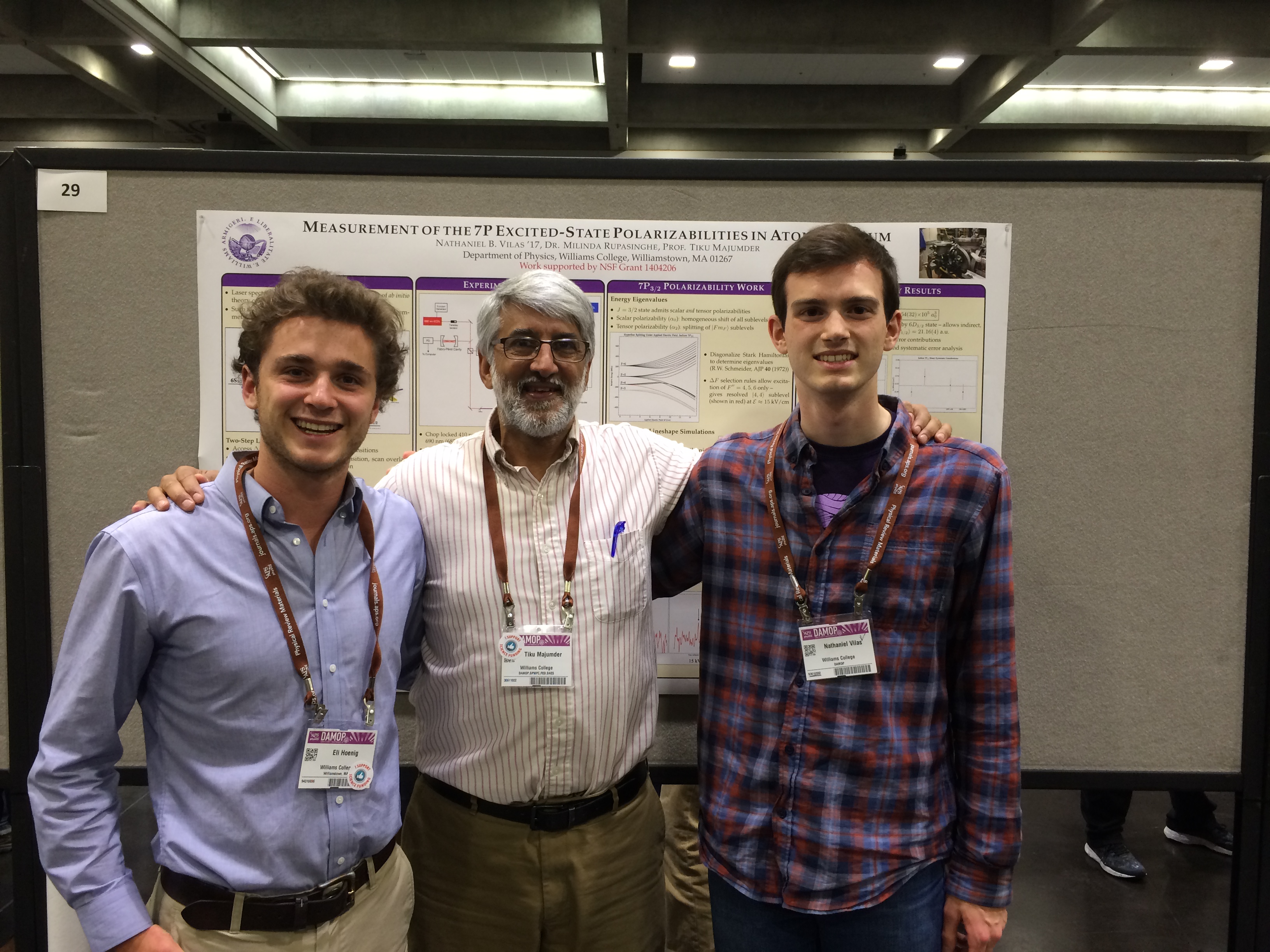 At poster session with Nathaniel and Eli
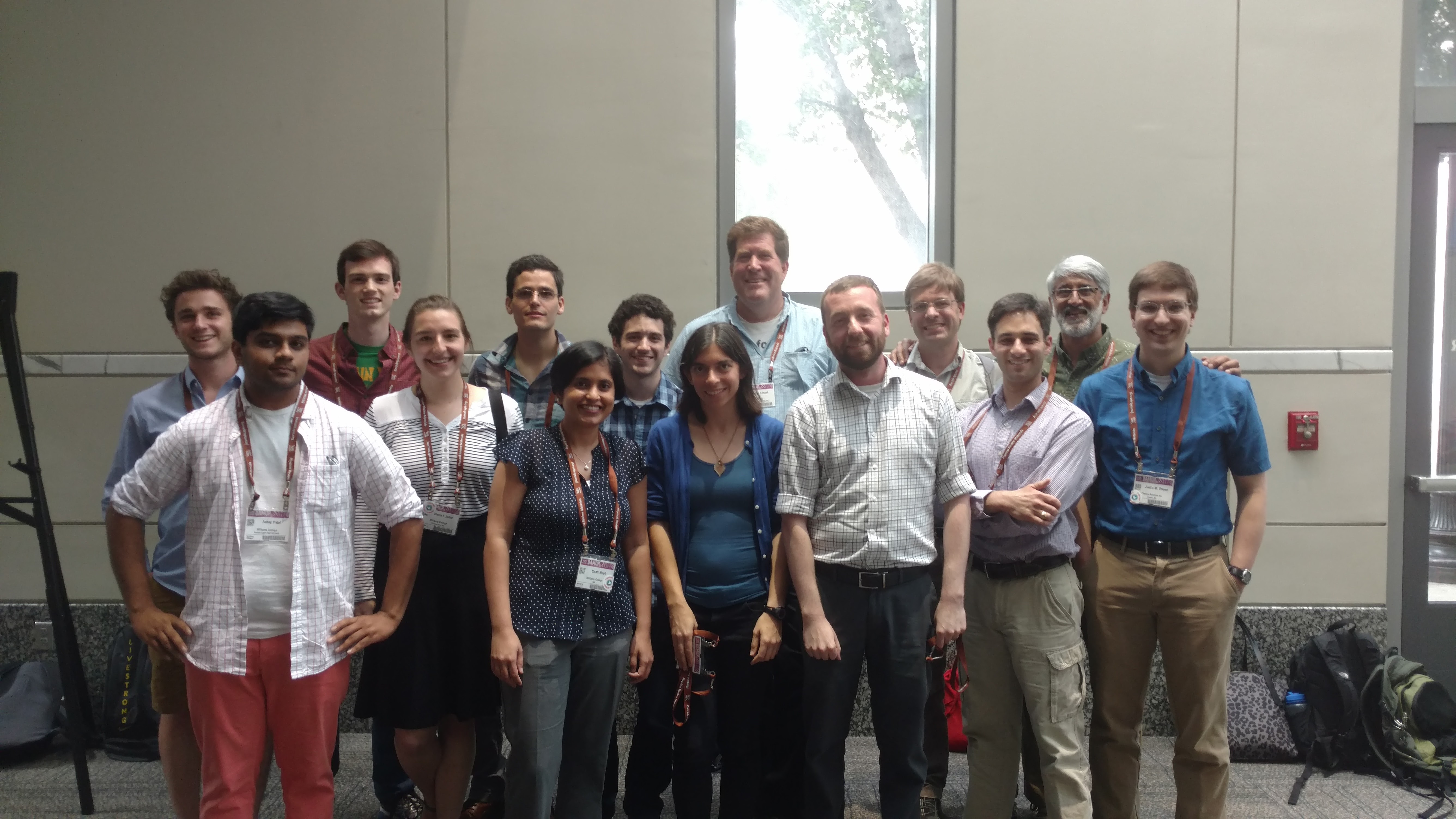 Ephs @ DAMOP 2017
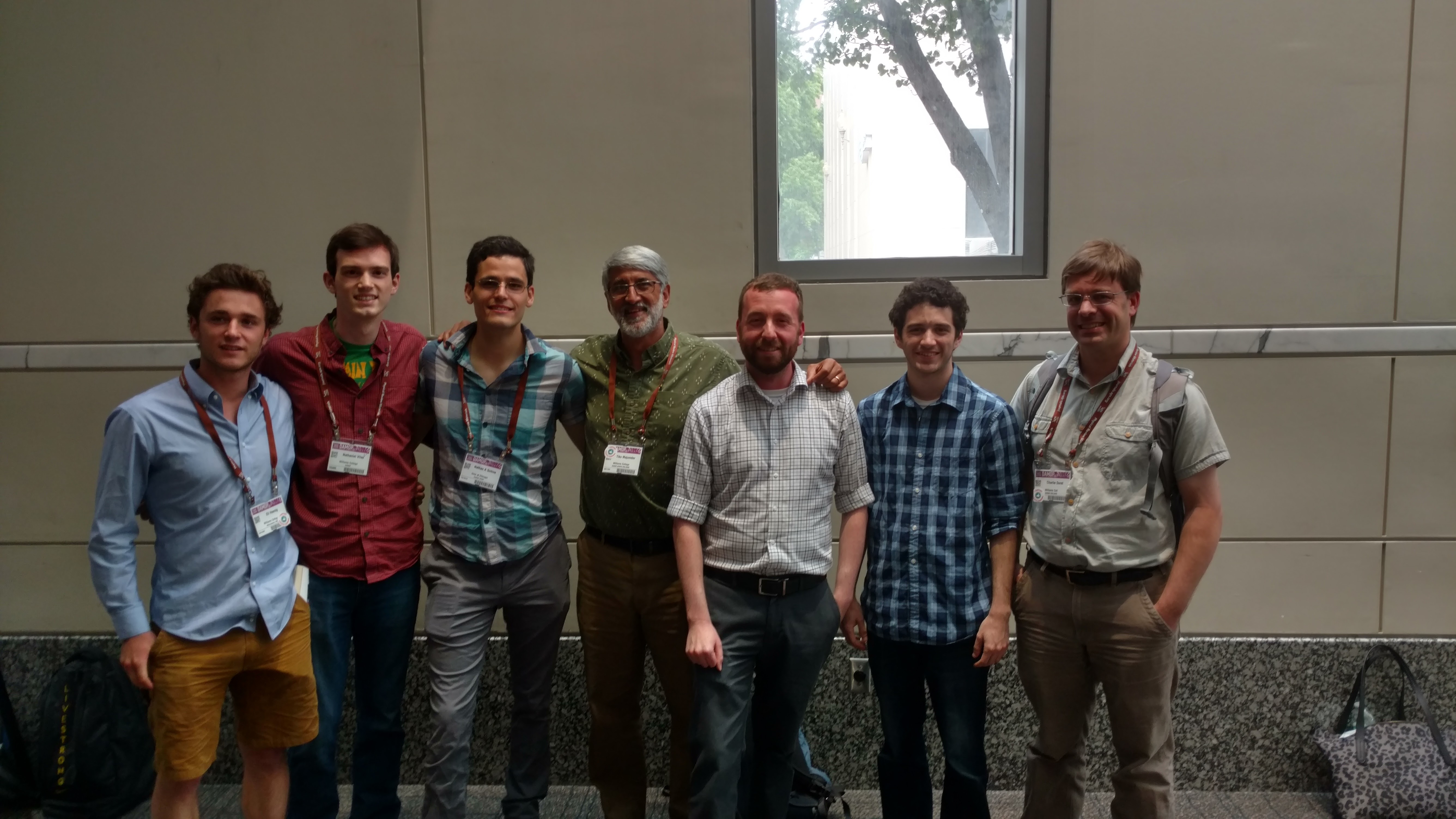
Current, former Majumder lab thesis students in attendance:
(L-R) Eli Hoenig ’17, Nathaniel Vilas ’17, Nathan Schine ’13, Colin Bruzewicz ’05, Ben Augenbraun ’15, Charlie Doret ’02
Here are the posters we presented on the Pb and In experiments:
Pb Faraday spectroscopy / E2 transition measurement
In atomic beam polarizability measurements
May 2017
Congratulations to Eli Hoenig ’17 and Nathaniel Vilas ’17 who completed their senior theses describing excellent work and exciting new results in two experiments:
Nathaniel Vilas – two-step atomic beam spectroscopy / polarizability measurements of the indium 7p states: Vilas Thesis (4 MB)
Eli Hoenig – Lead vapor cell polarimetry of both the 1279 nm M1 and 939 nm E2 transitions to measure absolute transition linestrengths: Hoenig Thesis (6 MB)
February 2017
We have resurrected our optical polarimeter, with plans to measure the M1 and E2 ground-state transition amplitudes in Lead (comparing Faraday Rotation signals for a common magnetic field and in the same vapor cell) to test new atomic theory calculations. Some pretty impressive measurements (thanks Eli!) of intrinsic angle noise at the 0.1 μradian / √Hz level:
Angle noise test with 940 nm laser
October 2016
Received this exciting news in a letter from the APS this week:
On behalf of the American Physical Society, it is my pleasure to inform you that you have been awarded the 2017 Prize for a Faculty Member for Research in an Undergraduate Institution:
“For contributions to the precision measurement of atomic properties, and sustained, inspirational mentorship of undergraduate researchers.”
This could not have happened without an institution committed to supporting research with undergraduates, as well as great colleagues, and, most of all, a wonderful and talented collection of Williams students with whom I’ve had the privilege of working for the past 20 years. I’m very grateful!
Summer 2016
Group picture from summer (L-R: Nathaniel Vilas ’17, PKM, Eli Hoenig ’17, Bingyi Wang ’18)

Rising thesis students Eli Hoenig ’17, Nathaniel Vilas ’17, as well as rising junior Bing Yi Wang ’18 and postdoc Milinda Rupasinghe completed a series of vapor cell spectroscopy experiments in thallium and indium using our two-step spectroscopy technique. All the second-step transitions were in the red 650-690 nm range and so by exchanging diodes we measured hyperfine structure and isotope shifts all with sub-MHz accuracy. This work is now being written up for publication.
Meanwhile, our paper describing the latest atomic beam polarizability measurement (in the indium 6p1/2 excited state) was published in Phys. Rev. A in August with Ben Augenbraun ’15 and Allison Carter ’16 as co-authors.
http://journals.aps.org/pra/pdf/10.1103/PhysRevA.94.022515
June 2016
Congratulations to Allison Carter ’16, and Sauman ’16 who graduated on June 5th, and completed very successful senior thesis projects in the lab this year! Good luck to Allison, who is starting in the Physics Ph.D. program at U. Maryland, and to Sauman, who is starting in the Mech. Eng. Ph.D. program at U. Colorado this fall. We will miss you!
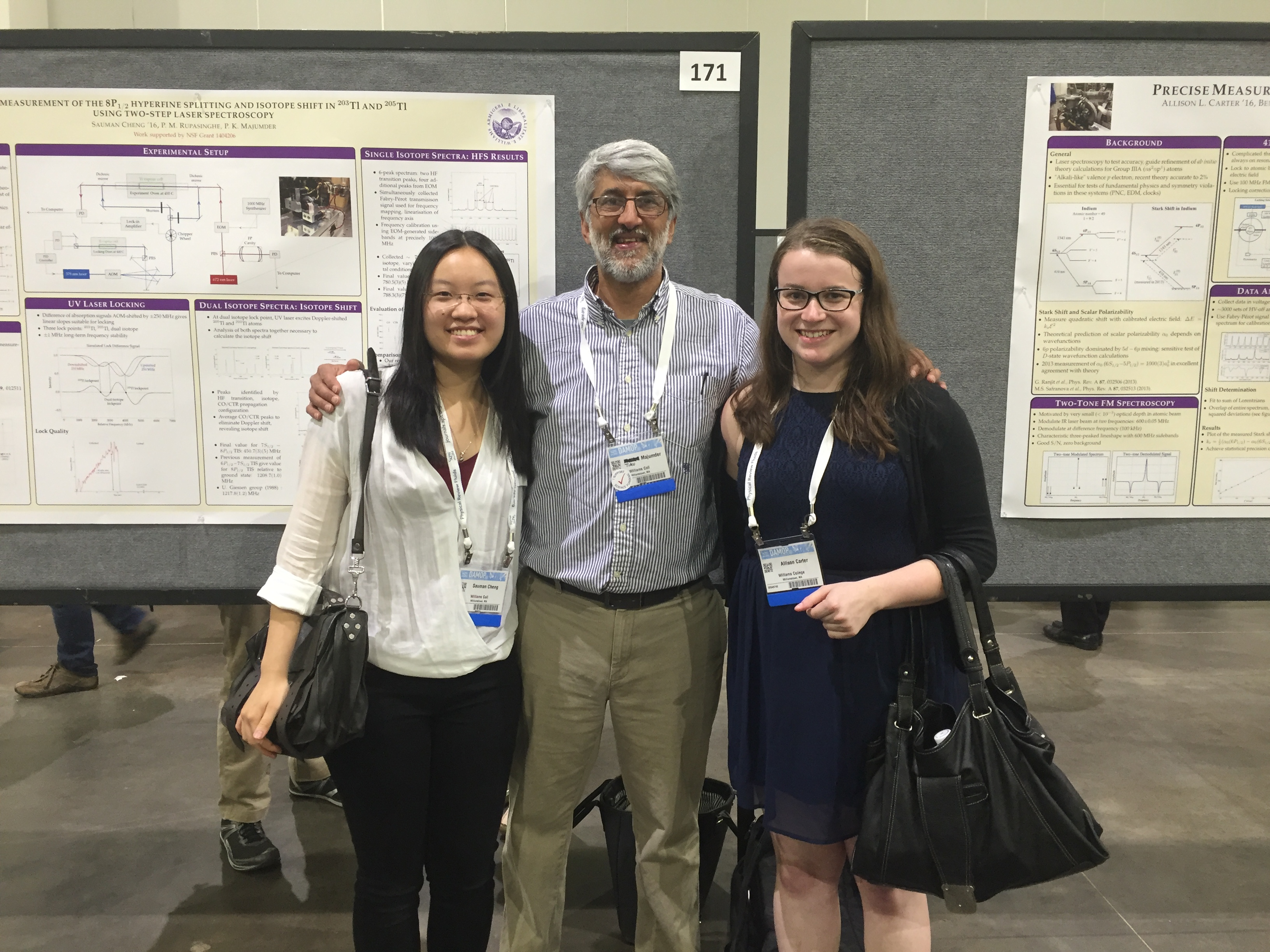
This year’s theses:
Allison: indium 6p1/2 state polarizability measurement using the atomic beam (2.7 MB)
Sauman: thallium 8p1/2-state HFS/ IS shift work using the heated vapor cell (8.4 MB)
———————–
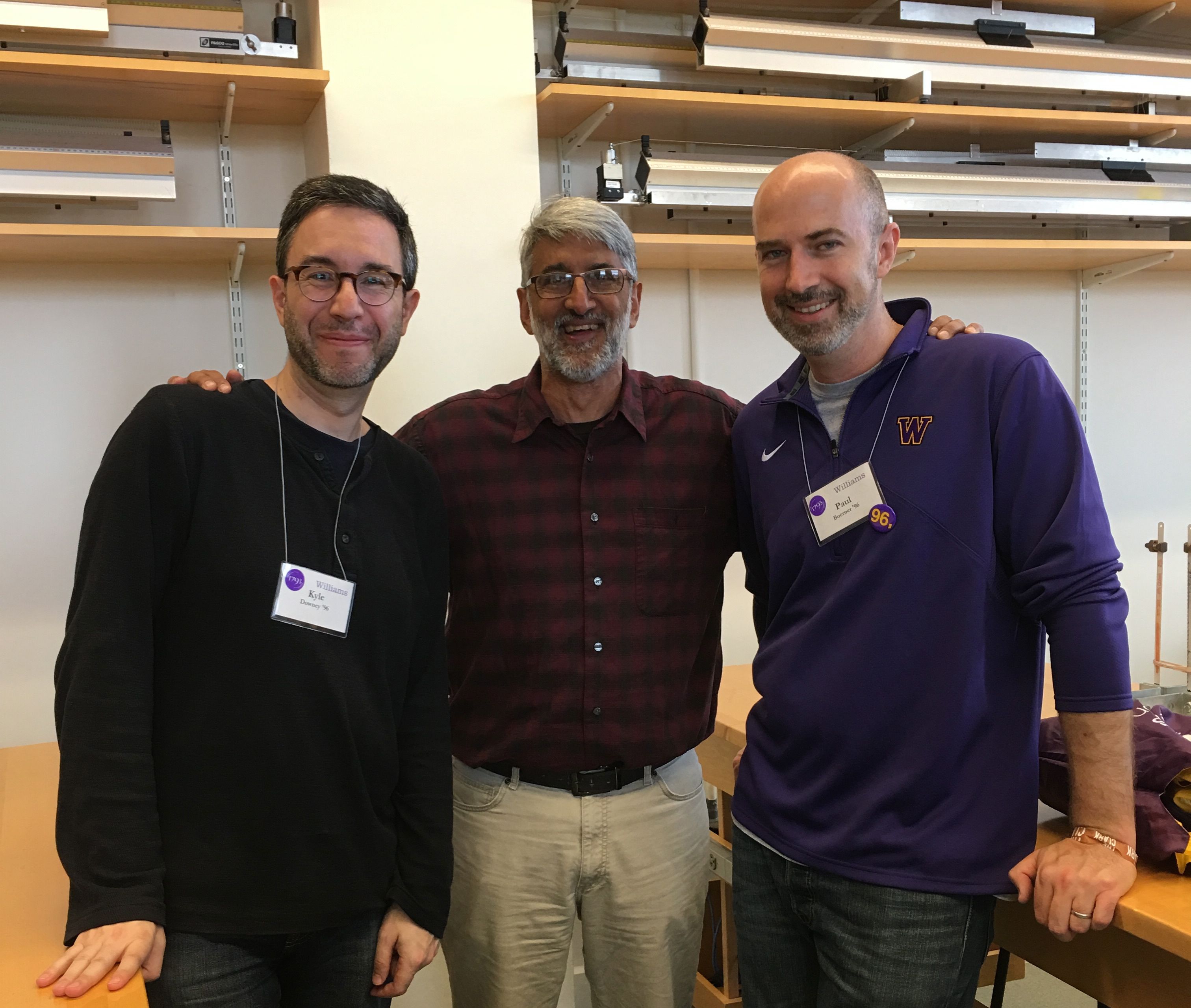
Oh — and something to make me feel old: Picture of my very first set of thesis students who returned this June for their 20th reunion!! (Kyle Downey ’96, Paul Boerner ’96):
DAMOP 2016, May 23-27 2016, Providence, RI
The proximity of this year’s DAMOP conference allowed Profs. Doret and Majumder to fill up a van with Ephs and drive. Accompanying them were graduating seniors Allison Carter ’16, Sauman Cheng ’16, and Ariel Silbert ’16. Also attending were Nathaniel Vilas ’17 and Sierra Jubin ’17, who will be starting thesis work this summer, and also postdoc Milinda Rupasinghe.
Ben Augenbraun ’15 attended the conference, and formally received his 2015 APS Apker Award certificate, and gave an excellent invited talk on his thesis work.
Many other Ephs (19 in all!) were in attendance (spanning more than a half century of graduating classes!):
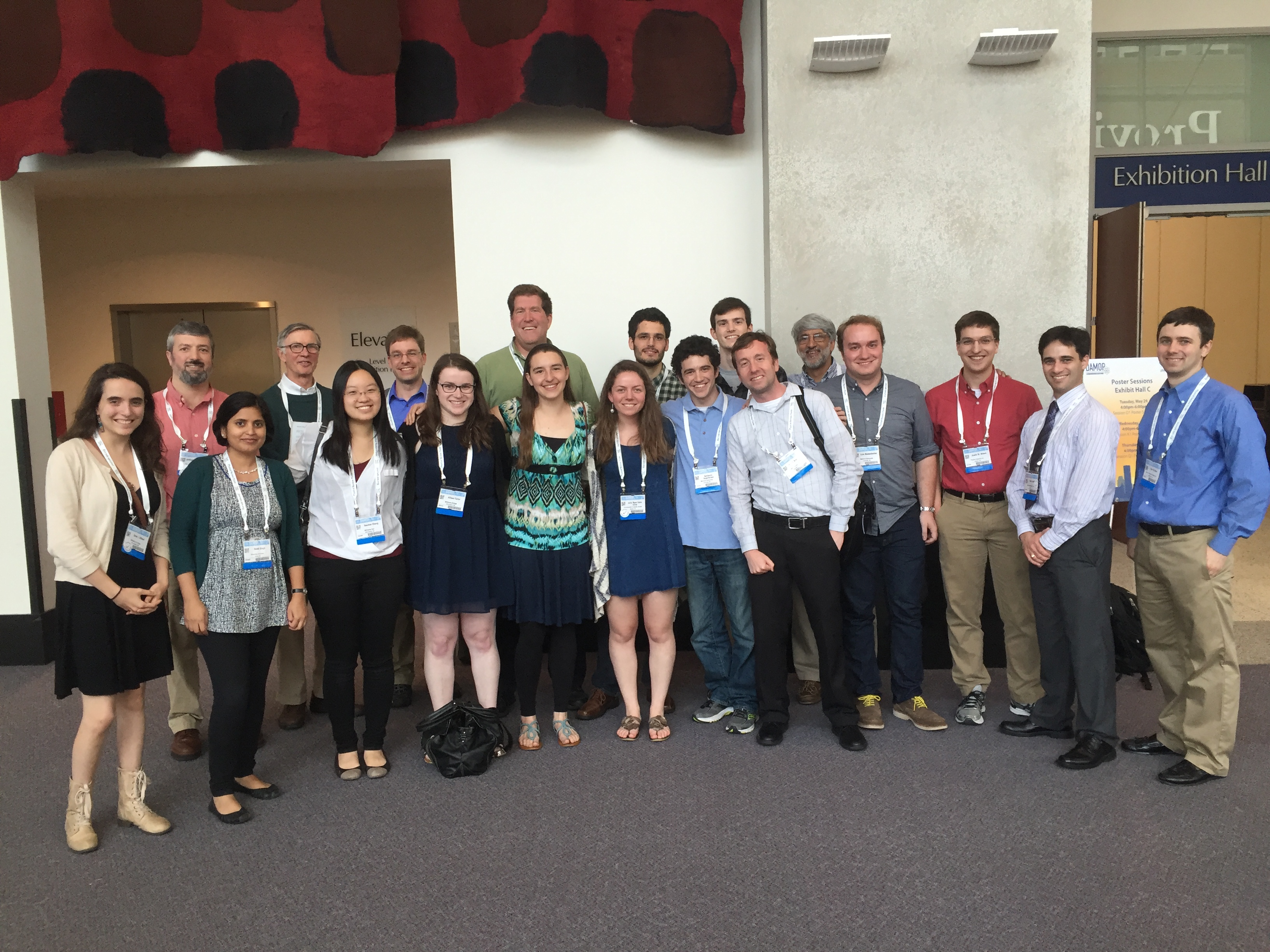
Here are all of the current and former Majumder group thesis students in attendance:
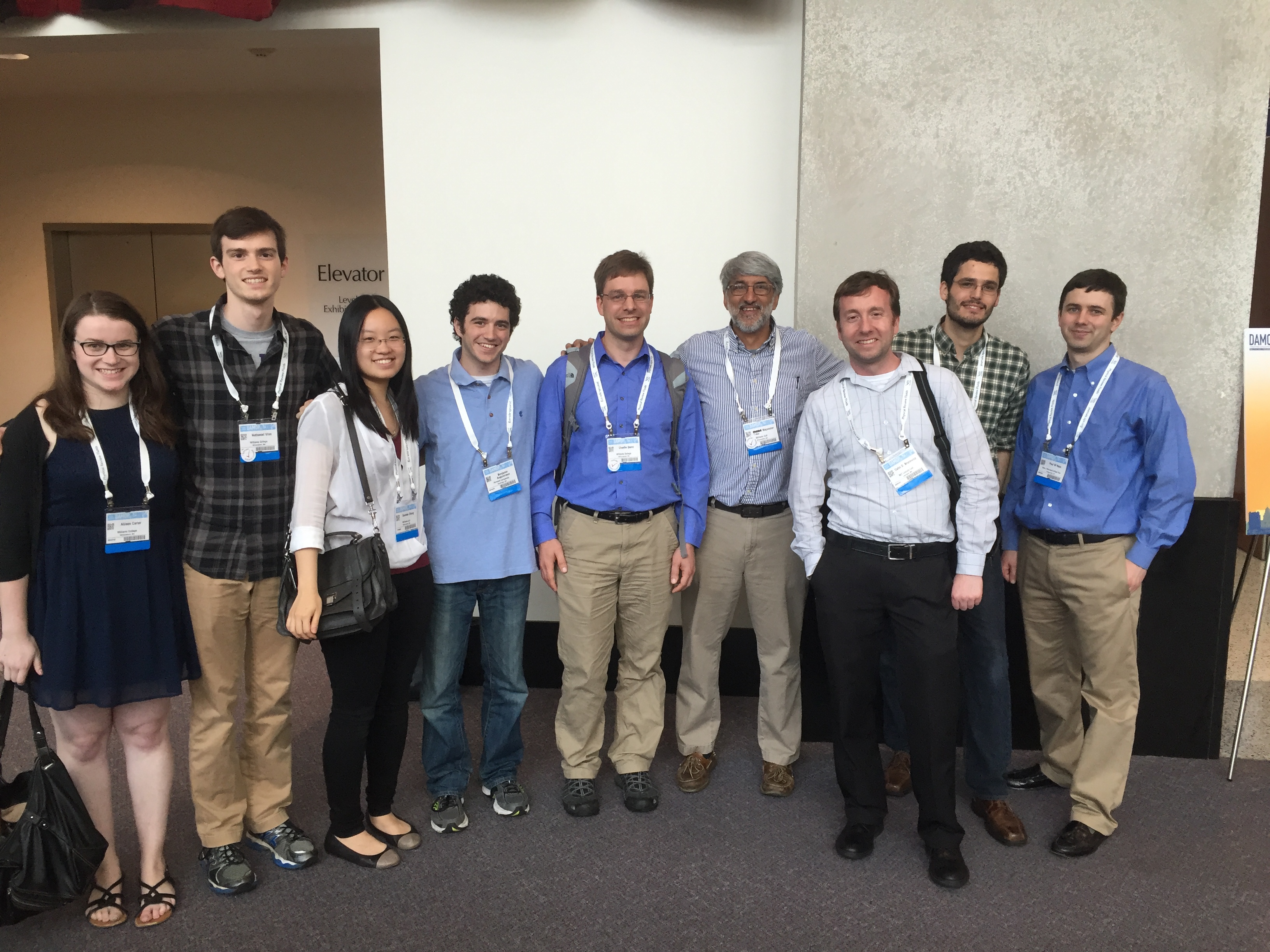
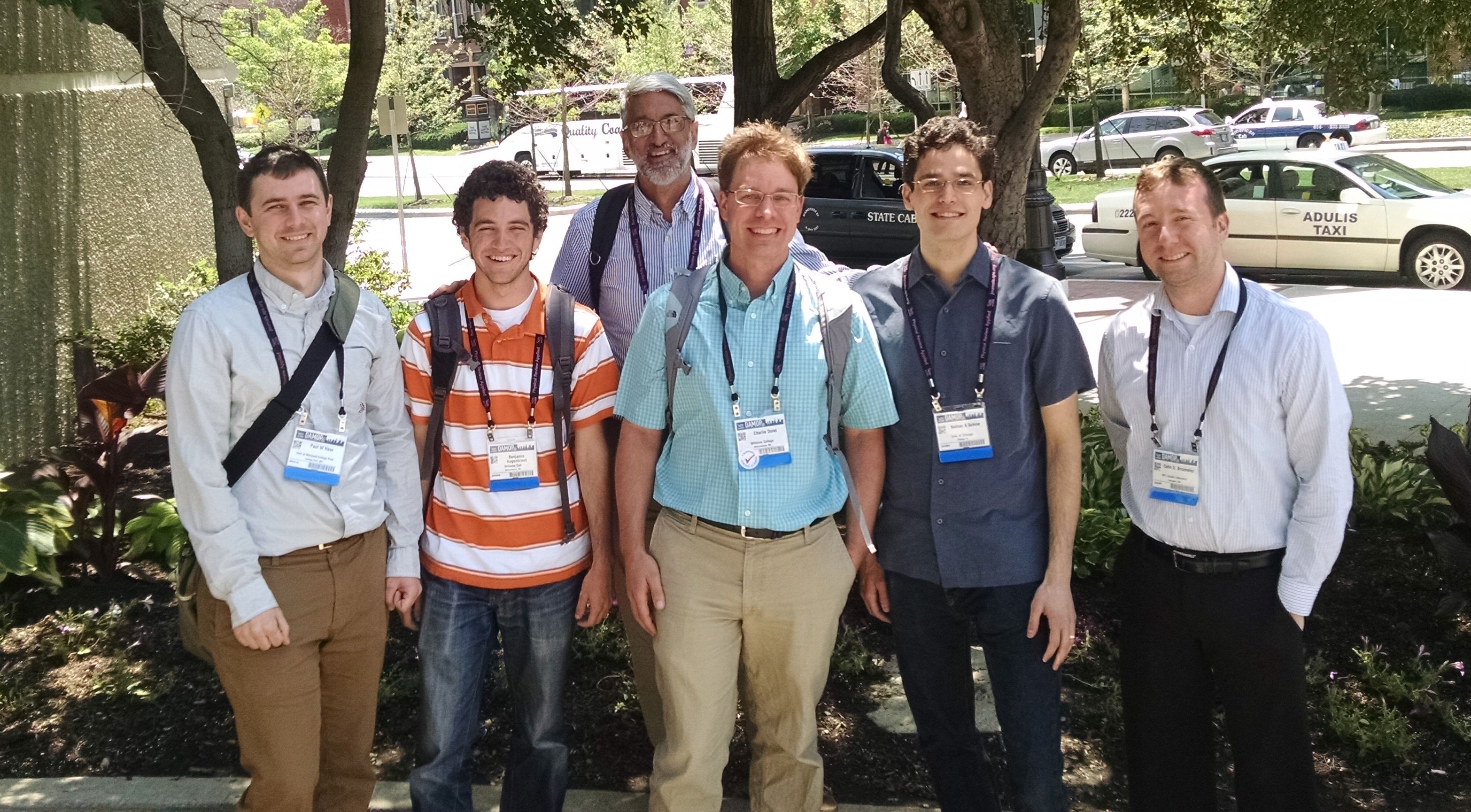
(L-R) Allison Carter ’16 (U. Maryland), Nathaniel Vilas ’17, Sauman Cheng ’16 (U. Colorado), Ben Augenbraun ’15 (Harvard), Charlie Doret ’02 (Harvard, GTRI, Williams!), PKM, Colin Bruzewicz ’05 (Yale, Lincoln Labs), Nathan Schine ’13 (U. Chicago), Paul Hess ’08 (Harvard, U. Maryland).
And here we are at the poster session with our two group posters behind:
PDFs of posters presented:
Indium 6p1/2-state Atomic Beam / Stark shift measurement
Thallium 8p/12-state HFS/IS spectroscopy
October 2015
Congratulations to thesis student Ben Augenbraun ’15 who is the 2015 A.P.S. LeRoy Apker Award WINNER !!! (the Apker Award is the nation’s top honor for undergraduate physics research). We wish Ben the very best as he begins in the Ph.D. program at Harvard this fall.
Former group member, and now Williams physics department colleague, Charlie Doret ’02 was the 2002 Apker Award winner. All together FIVE Williams physics majors have won this award.
Here is a link to Ben’s undergraduate thesis:
Augenbraun thesis (6.2 MB)
June, 2015
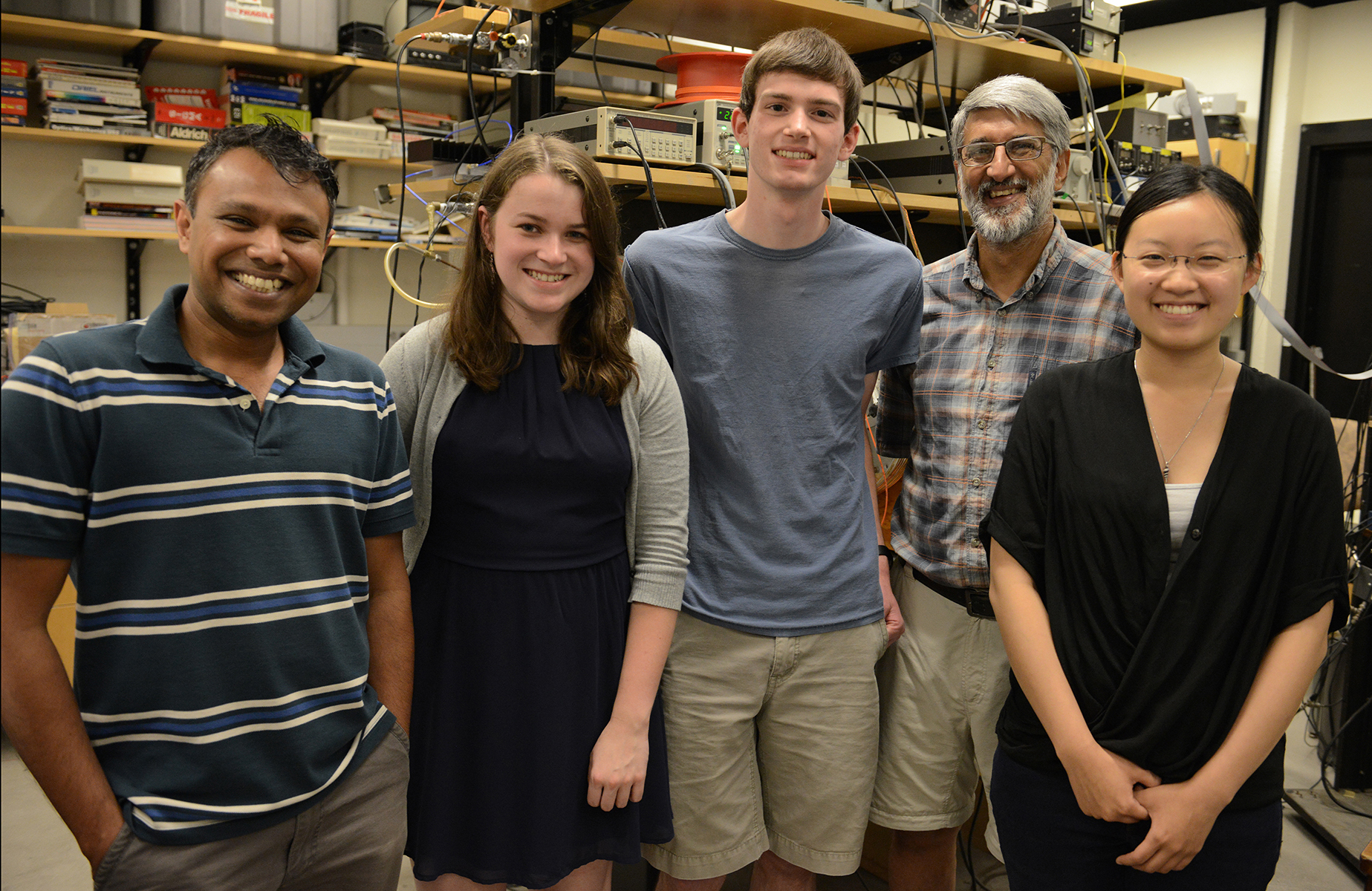
We welcome Sauman Cheng ’16 and Allison Carter ’16 to the lab this summer , who will begin their thesis work, and will be joined by Nathanial Vilas ’17, Milinda, and Prof. Majumder.
Here is a picture of the summer 2015 research group:
DAMOP 2015, Columbus, OH:
Ben Augenbraun ’15, Postdoc Milinda Rupasinghe, and Prof. Majumder attended the 2015 DAMOP conference in Columbus, OH. Here are some highlights:
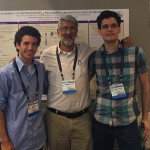
Ben Augenbraun ’15, Nathan Schine ’13 and PKM in front of latest group poster on two-step, atomic beam Stark shift experiment in Indium.

Ephs@DAMOP 2015: (L-R) Ben Augenbraun ’15,Dr. Justin Brown ’05 (Draper Labs), Paul Hess ’08 (Harvard, JQI), Colin Bruzewicz ’05 (Yale, Lincoln Labs),Prof. Charlie Doret ’02 (Harvard, Williams College), Dr. Milinda Rupasinghe (postdoc, Majumder group),Nathan Schine ’13 (U. Chicago),Ryan Carollo ’05 (U. Conn), Prof. Chad Orzel ’93 (Union College), PKM, Prof. Josh Grossman ’96 (St. Mary’s College)

Former Majumder group thesis students @ DAMOP: Paul Hess ’08 (Harvard), Ben Augenbraun (Harvard), Charlie Doret (Harvard), Nathan Schine (Chicago), Colin Bruzewicz (Yale)
Winter/Spring, 2015
Welcome to new postdoc, Dr. Milinda Rupasinghe, who joined us in January from Oklahoma, where he did his Ph.D. work in atomic physics.
We gratefully acknowledge the support of our new 3-year NSF grant #1404206 which supports our postdoc, summer studies, and equipment and supply needs.
DAMOP 2014, Madison, WI:
Here is the latest from our group, including recent photos, DAMOP 14 conference posters, senior honors theses, and publications
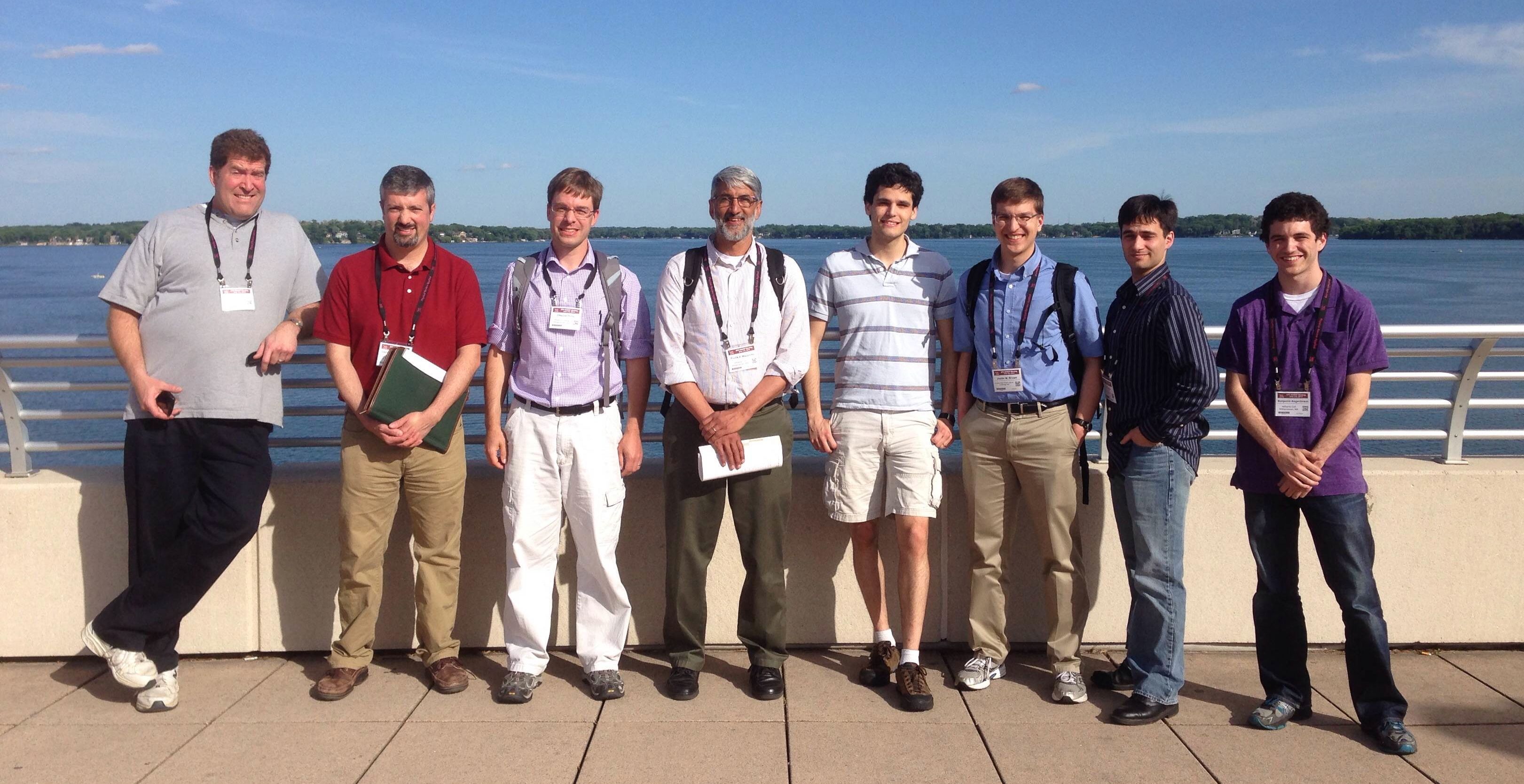
Ephs@DAMOP 2014: (L-R) Prof. Chad Orzel ’93 (Union College), Prof. Josh Grossman ’96 (St. Mary’s College), Prof. Charlie Doret ’02 (Williams College), PKM, Nathan Schine ’13 (U. Chicago), Dr. Justin Brown ’05 (Draper Labs), Ryan Carollo ’05 (U. Conn), Ben Augenbraun ’15
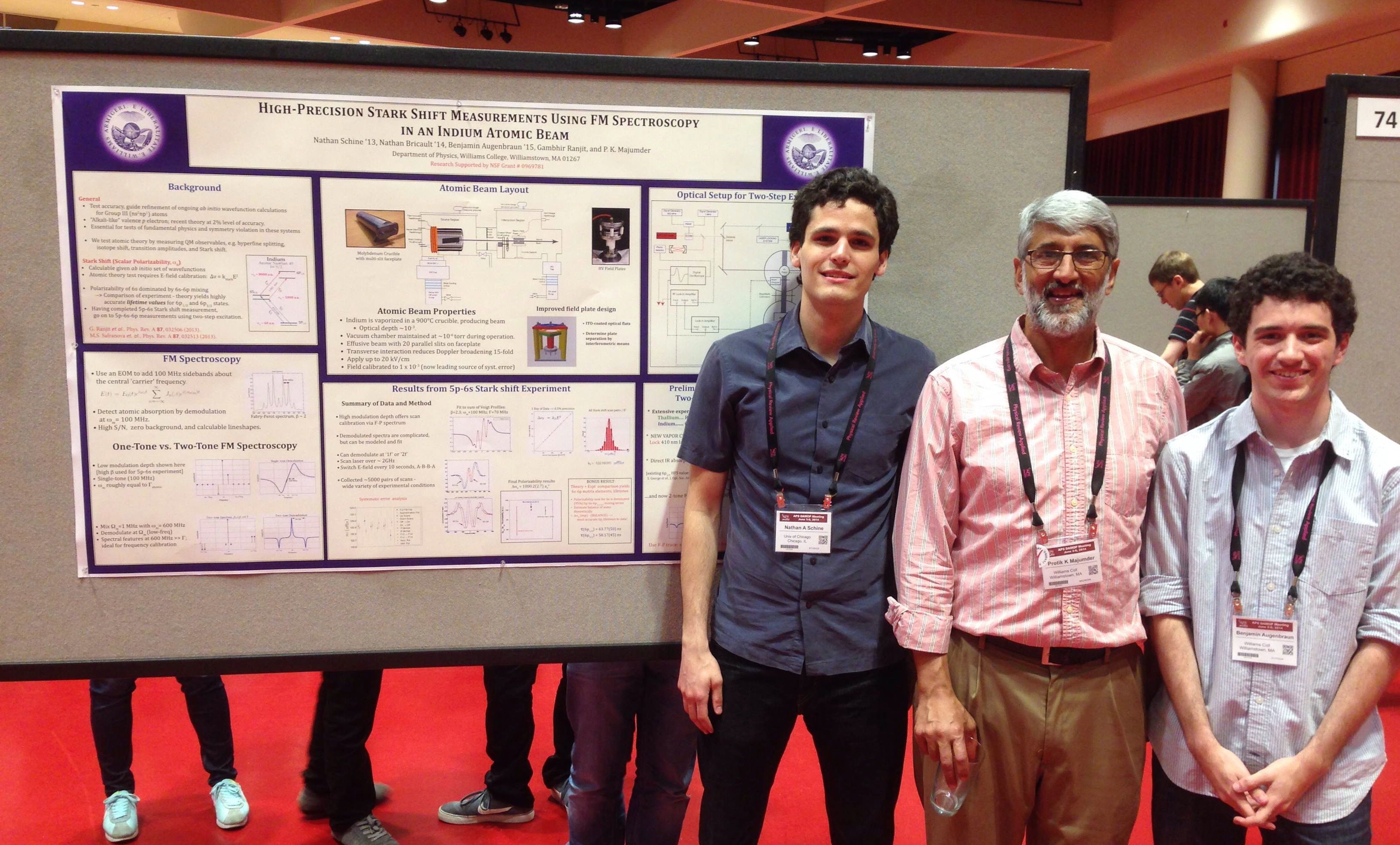
Nathan Schine ’13 (now at U. Chicago) and Ben Augenbraun ’15 at Poster Session w/indium atomic beam poster, DAMOP 14.
POSTERS FROM DAMOP 2014, Madison, WI, June 2-5
Atomic Beam / Stark shift poster (2.8 MB)
Vapor Cell / 2-step Spectroscopy poster (3.8 MB)
RECENT SENIOR HONORS THESES AND PUBLICATIONS
INDIUM ATOMIC BEAM WORK
- Senior Honors Thesis of Allison Carter ’16 (now at U. Maryland): Carter thesis (2.7 MB)
- Senior Honors Thesis of Ben Augenbraun ’15 (now at Harvard Univ.): Augenbraun thesis (6.2 MB)
- Senior Honors Thesis of Nathan Bricault ’14 (now at Cambridge Univ): Bricault_thesis
- Senior Honors Thesis of Nathan Schine ’13 (Simon group, U. Chicago): Schine_thesis
Phys. Rev. A paper describing this work:
http://pra.aps.org/abstract/PRA/v87/i3/e032506
THALLIUM VAPOR CELL WORK
- Senior Honors Thesis of Sauman Cheng ’16 (now at U. Colorado): Cheng thesis
- Senior Honors Thesis of Gabby Vukasin ’14 (now at Stanford Univ): Vukasin_thesis
- Senior Honors Thesis of David Kealhofer ’13 (now at UCSB): Kealhofer_thesis
Phys. Rev. A paper describing this work:
http://pra.aps.org/abstract/PRA/v89/i1/e012511