Books and Movies 2023
[Much lost in computer glitch]
February
Demon Copperhead by Barbara Kingsolver
Math, Teaching, and Other Items of Interest
[Much lost in computer glitch]
I had a bridge hand today at the Atlanta ACBL Nationals which I opened 6H:
AKxx AKQJTxx — AT
Dummy came down with JTxx — KQxxx Kxxx.
On the opening lead of the Diamond Ace, it was easy to make 7.
Same contract at other table after lots more bidding, but the bidding helped the opening lead and they made only 6. (After a Diamond control bid, it’s clearer not to lead the Diamond Ace!)
December 3, 2023
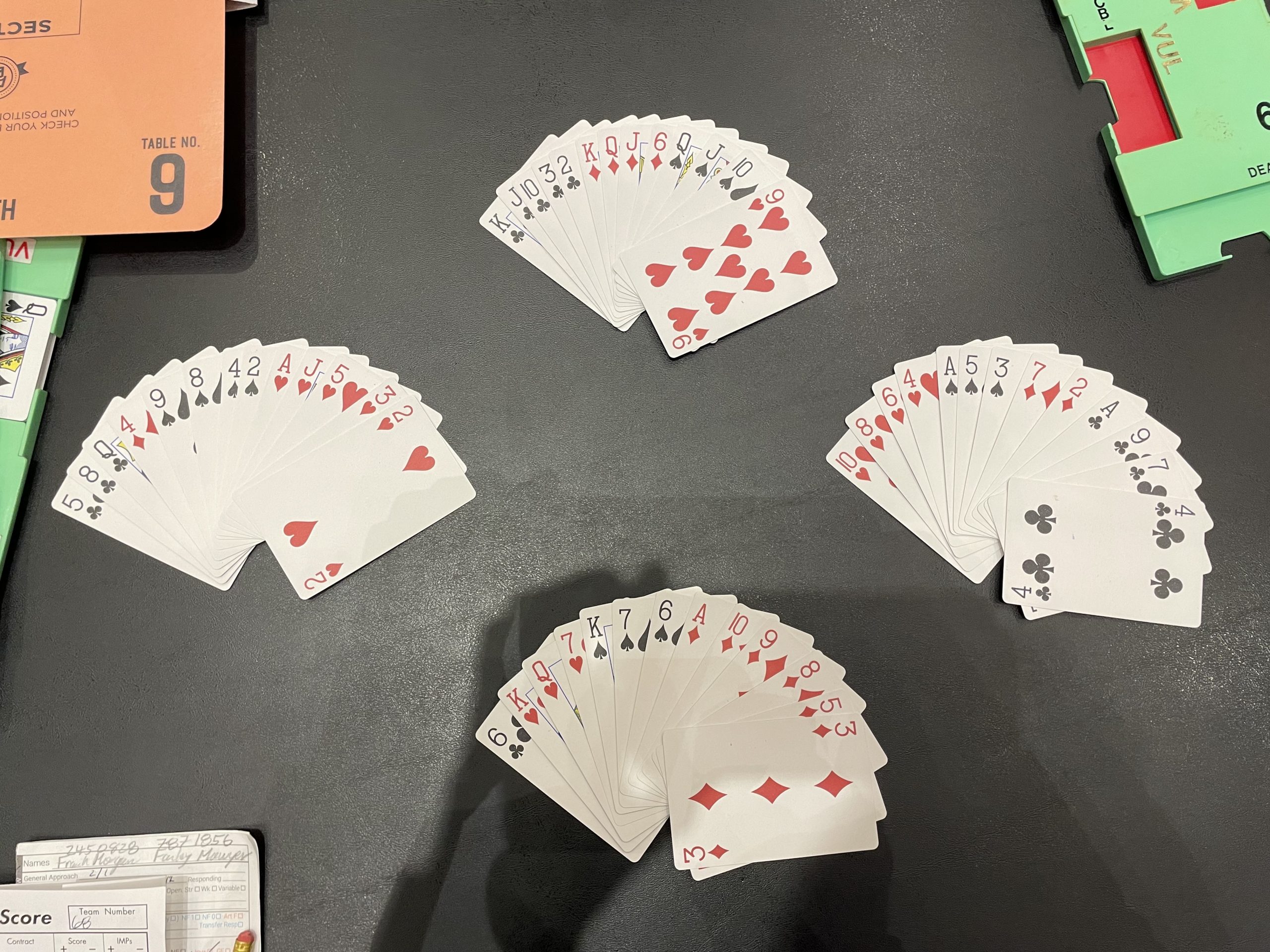 (Featured on Sorry Partner 14 December 2023.) At the Atlanta ACBL bridge Nationals, on December 1, 2023, Farley Mawyer and I played seven boards against David Berkowitz and Jeff Meckstroth in the Keohane swiss, with Michael Berkowitz kibitzing his dad. On the pictured Board 19, as South I opened 1D, Berkowitz 1H, Farley 2H, Meckstroth 3D, alerted as a limit raise, usually three pieces. After considering 3N, I passed, Berkowitz 3H, Farley 4C, I 5D, down 1. In between hands they vigorously discussed their system. I heard them say that in their system 3D is actually a mixed raise. I called the Director, thinking that with correct information we might for example have bid and made 3N. While the Director was off consulting, Meckstroth left and Berkowitz pointed out that 3N goes down 2 (as it did at the other table). So there was no change. Michael went to find Meckstroth. When they returned, Berkowitz told him that the Director had changed the result to 3N-2, which Meckstroth seemed to believe until Berkowitz told him he was joking.
Larry Cohen said, “That’s a very typical David story.”
P.S. When we sat down at the table with David Berkowitz, I asked him whom he was playing with. “Some guy. It said on ACBL this morning that he has zero Masterpoints.” “Some new client?” No, it was Meckstroth, whose posted total went back to zero when he hit 100,000.
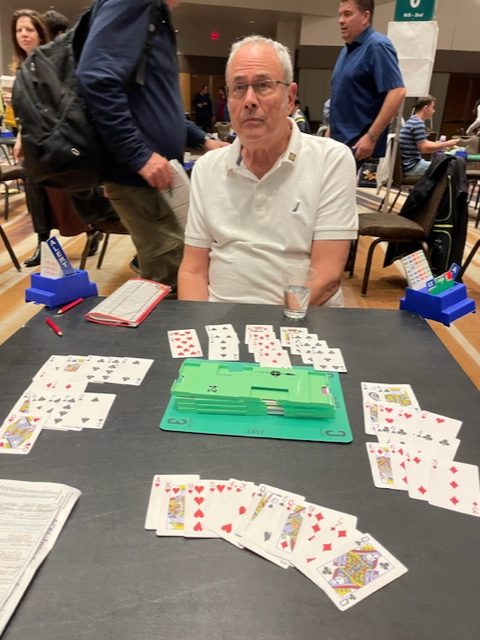 Lots of fun playing in Soloway with partner Farley Mawyer and teammates Abe Jakob and Priscilla Smith, even though we failed to qualify. We played against Lisa and Michael Berkowitz, Dana Berkowitz, Debbie Rosenberg and the young Cornelius, Giacomo and Giovanni on Mike Passell’s team, and many others.
On one hand my left-hand opponent South opened 3S, Farley bid 5C, South doubled, North bid 5S, I bid 6C, and South doubled for an unusual lead (Diamonds). To put South on lead and avoid the ruff that would set the slam, I converted to 6H, which made and earned us 11 IMPs.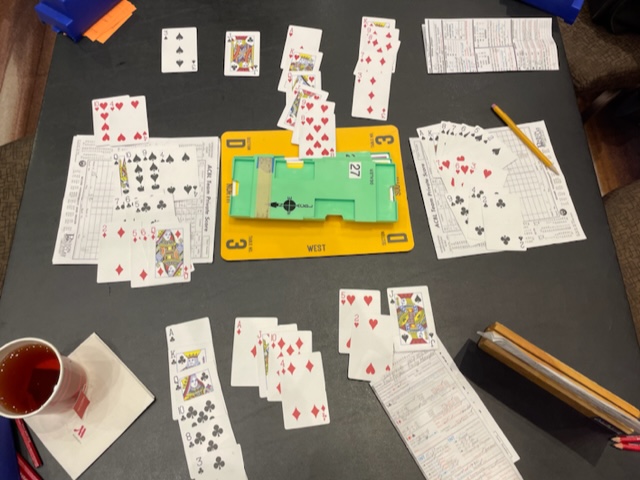
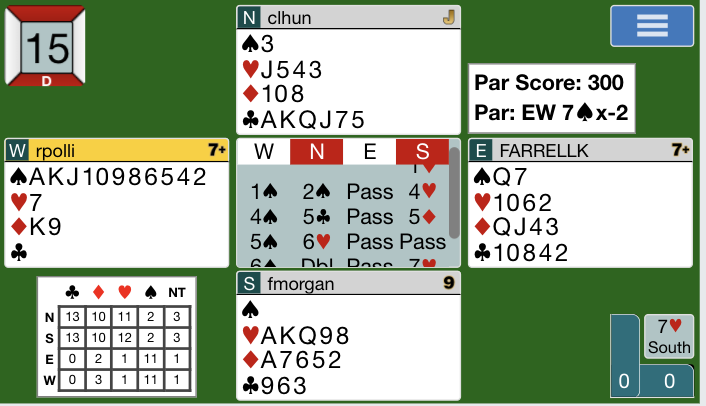 On BBO November 15, 2023, Matchpoints Speedball with Craig Huneke, an opponent had 10 Spades. We did well by not letting them play 5S, although we went down one at 7H for 58%. The odds of getting a 10-card suit are about 1 in 59,000, a once-in-a-lifetime occurrence. Continue reading ‘10 Spades’ »
Math Chat started as a live call-in cable TV show in Williamstown (1996-97, January 2000) and Princeton (1997-98), ran as a regular column in The Christian Science Monitor (1996-1998), continued on the Mathematical Association of America website, and finally became The Math Chat Book with a $1000 Math Chat Quest. Most of the columns are archived here.
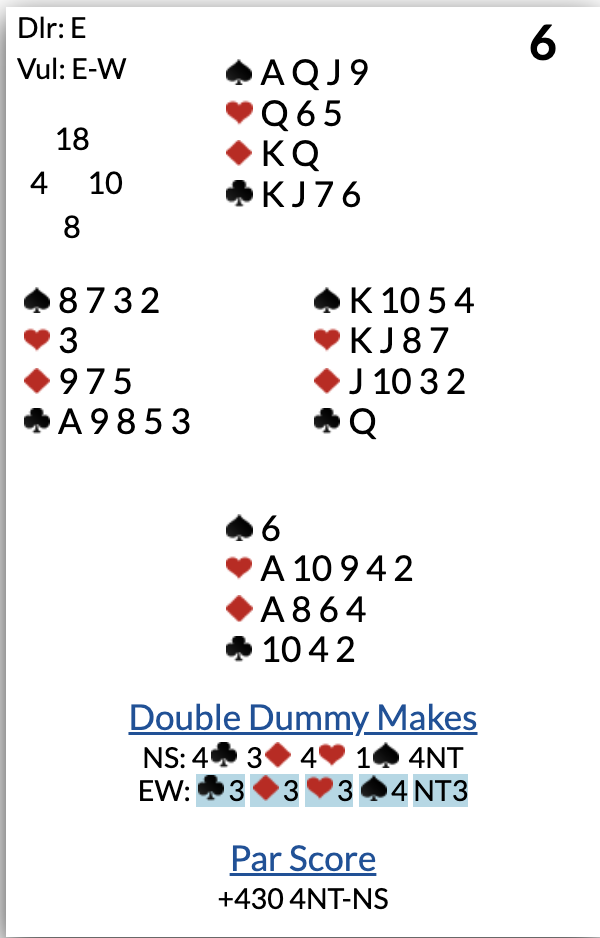 In the first-rate Allentown sectional October 20, 2023 (replete with delicious homemade baked goods), my partner Mike Kohler and I reached the optimal 4N on Board 6 after I as North opened 1C, East doubled, South bid 1H, West passed, and I bid 2N. In the five-card ending:
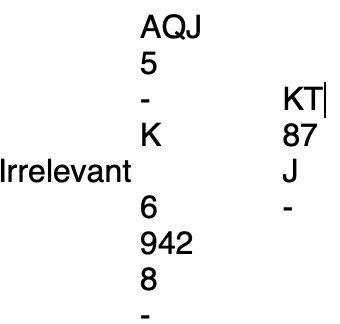
when West led a Spade, I rose with the Ace and played the Club King. East was squeezed in three suits. Hoping his partner had the Spade Queen he threw the King, and I had the rest of the tricks for a top.
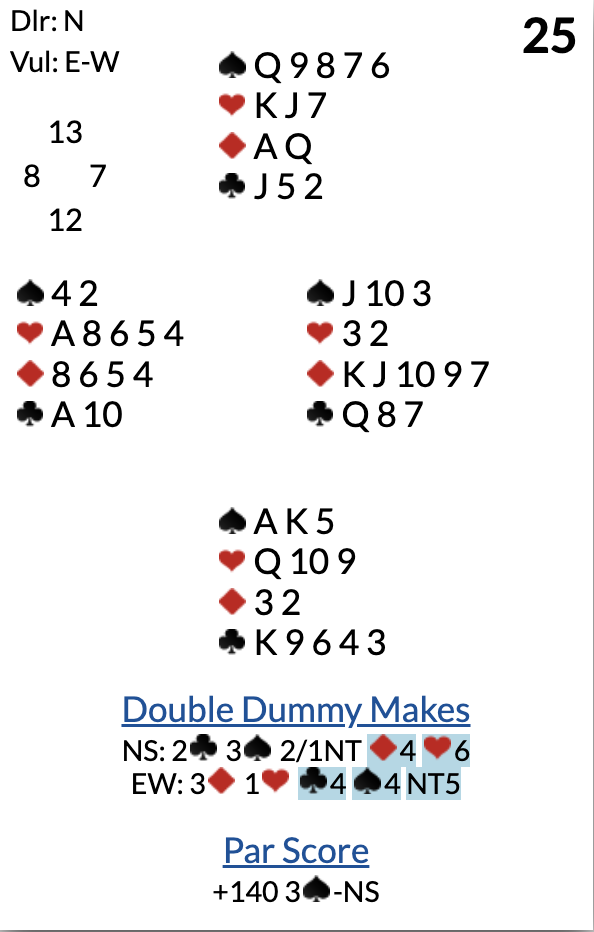 I went to Chicago Nationals to play in the Spingold with Farley Mawyer and teammates Larry Gordon and Steve Siegel, who had just placed second in Grand National Teams B. We lost in the first match to the Overdeck team against Norberto Bocchi and Leonardo Fruscoloni. Roberto can deal at ten times the normal speed. Leo bet me that you can get a review of the bidding any time during the play, and paid up $1. In the MiniSpingold we qualified the first day but then lost to the team that won the whole thing.* I also played with Victor Xiao (father of the precocious Eric and Jeff) and off-duty pro Alamiro Pinoargote from Equador. But no victories until Bob Cole and I won the final open pairs side game. Hand 25 at 4 Spades looked hopeless after the Diamond finesse failed, as I would have to keep Clubs to a single loser. I led low from South’s dummy and West erred by rising with the Ace. Now I could lead the J from hand, smothering the T.
*Martin Harris, Chicago IL; Miriam HarrisBotzum, Orefield PA; Mark Kinzer, New Berlin WI; Bob Marheine, Waukesha WI.
When a first-year student at MIT, I went to hear Jorge Luis Borges speak at Tuft University on April 9, 1971.
Two secretaries read Borges’s poetry in English and Spanish. Borges followed the readings with excellent explanation.
I found the poetry, much of which dealt with blindness and age, dramatically impressive, sensitive, and moving.
Some Comments by Borges
I awake to despair in the realization of my human identity, “Borges, the overrated writer.”
The dream poem I dreamt and wrote at my mother’s insistence. My enemy’s cane falls from view as objects fall from dreams. I never knew Treatise on Dreams; I selected the name from Encyclopedia Britannica.
Eternity is not the sum total of yesterdays, todays, and tomorrows stretching on forever; it is all time at once. In my poem on John xx:xx, I attempt (and of course fail) to write from eternity into time.
“Israel” a gift of inspiration, which no doubt came to many that week. Others, I hope, have written it better.
Forgiveness and revenge, I cannot understand. They are both the same.
“Cain and Abel:” the nameless star just sets the story in antiquity. Logical error: Abel’s ghost should meet Cain. But this would be a literary error.
Blind man in library autobiographical. Note early use of sense-impressions, casual mention of blindness. Happiness comes unreasonably; just enjoy it. Blindness can be an avenue of happiness.
Praise to darkness. Darkness has two meanings. Blindness simplifies, abstracts. I used to employ every moment (e.g. reading on bus), but now time flows differently. Simplification and abstraction. A sleepless night is not necessarily an unhappiness. Intimately personal poem.
Afterward, Borges autographed books, answered questions. I felt that he was not well enough befriended and taken care of and respected. His secretaries on stage whispered behind him even as he explained his poetry. People mobbed him before he could sit down, “I am tired.” He deserves respect.
A very humble man. He explains he is not completely blind, and demonstrates by distinguishing forms and colors accurately.
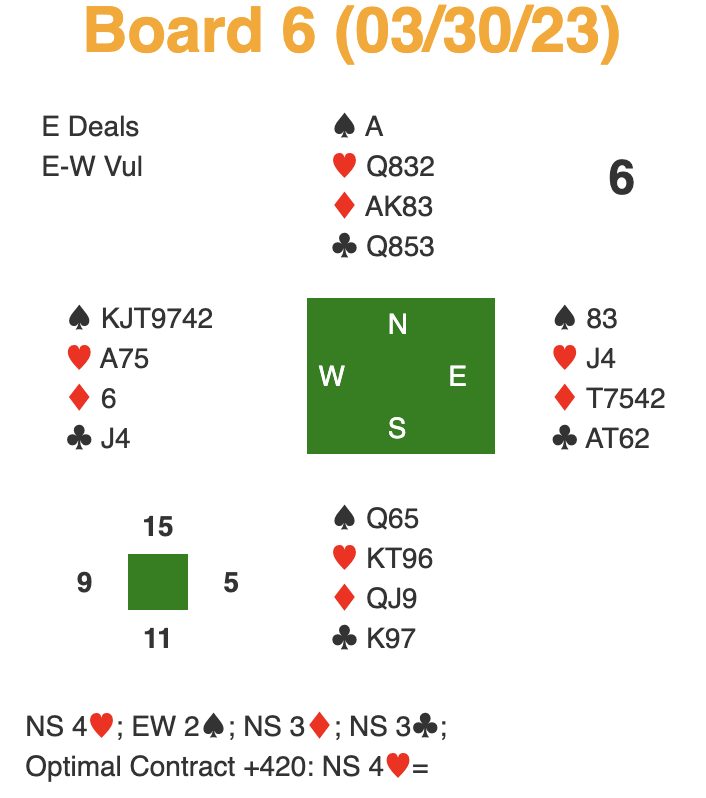 I fell to an amazing play by Harriet Walcott partnering Baby Vistenzo on Board 6 at the Karen Sylvester’s Cape May County Duplicate Bridge Club March 30, 2023. Declaring 4H in the North I won the Diamond lead with the J, led a Spade to the Ace, a Club to the King, and ruffed a Spade. As West popped the King, I could now turn my attention to trumps. A Heart to the King lost to the Ace. West returned a small Spade, I discarded a small Club, and Harriet smoothly discarded a Club, convincing me that West held the remaining Hearts (and even if not, Harriet held the guarded Jack). I confidently led the Heart 10 for a finesse, Harriet won the Jack, and led a Diamond for a ruff by her partner’s remaining Heart 7. They still had two Club tricks for down 2 and a top.
 Welcome to my blog. I also have a blog at the