Dating: URL vs. IRL

Like many other people in my generation, I participated in online dating apps. In the past five years, I made profiles on Tinder, Bumble, Hinge, and The League in order to expand my dating pool and see what type of people I attract. Nevertheless, I ultimately gave up on online dating once I realized that, for a black woman, dating URL is quite similar to dating IRL (in real life).
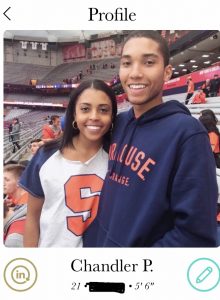
I tried to present myself authentically in my dating profiles by carefully selecting photographs and interests that highlight my strongest qualities. I consider myself to be a caring, liberal, social woman who is passionate about teaching, music, netflix, and basketball. So, I post pictures of my friends and I at a bar or me standing in the bleachers at a basketball game in order to demonstrate these qualities. My hope is that through my authentic self-presentation I will attract someone who has the personality traits that I desire in a partner which include outgoing, social, kind, respectful, athletic, passionate, and liberal. But despite my greatest efforts to present myself genuinely, my profile is always reduced to my physical appearance.
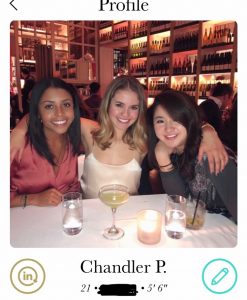
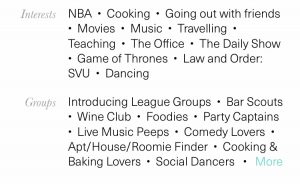
Dating apps are not designed to provide users with accurate depictions of various potential dating candidates. The quick swipe features as well as the abundance of photos coupled with a lack of description encourage users to judge a person largely by their appearance. As a black woman, I unfortunately belong to one of the least desirable dating categories. Thus, the design of dating apps encourages users to swipe past me due to my appearance as opposed to my personality characteristics.

Despite my general openness to people of all races and backgrounds, the pool of people I matched with was largely black and white males who were highly educated. Of this group, black males were most likely to message me and eventually ask to meet in person. The white males who messaged me mostly made commentary on my appearance and very rarely asked to meet up in person. Some examples of messages I received from white men were, “did you get that Spotify glitch yesterday too? It was so weird, I looked at the hottest singles and you weren’t #1” or “wow you’re stunning.” I had difficulty deciphering if men who sent comments like these had a genuine interest in me or fetishized black woman. So, I never replied.

The makeup of my online matches was very similar to the makeup of my dating pool IRL. I tend to be in spaces that are either predominantly black or predominantly white, so my dating candidates tend to be either black or white. Moreover, the men who express interest in dating me tend to be black while the men most interested in hooking up with me tend to be white. This trend follows a national phenomenon that men tend to want to pursue serious relationships with women of the same race, but are more willing to casually date women of other races (Wilson et al., 2007).

My experience with online dating led me to delete dating apps and revert to dating the old-fashioned way. Although dating IRL starts with a physical attraction, you get an opportunity to present yourself more authentically without a person swiping past you. So, I tend to form better, more lasting relationships with the people I meet IRL.

I can only hope that as society’s perceptions of race and gender change, I will be able to return to online dating. But until then, I will just have to put my phone down.


Word Count: 591

Works Cited

Wilson, S. B., McIntosh, W. D., & Insana II, S. P. (2007). Dating Across Race:
An 
Examination of African American Internet Personal Advertisements. Journal of
Black Studies,37
(6), 964-982. Retrieved March 16, 2019.

Structural Analysis #3: 28 Days Later

Structural Analysis #3: 28 Days Later

Plot Sequence

1– Primary Research Centre: Movie opens in a laboratory full of chimps. Men and women with masks come in and take pictures of the chimps. A scientist comes in and warns them that the chimps are infected with “Rage.” Despite the warning, one of the masked women releases a chimp and gets bit. She turns into a zombie.

2– Deserted Streets: A man awakens naked in a hospital bed. He walks around the hospital and around London’s streets, which are all deserted.

3– Church Attack: The man walks into a church and encounters a zombie. He is saved by two people.

4– The Store: The man and his two saviors hide away in an abandoned store. The man introduces himself as Jim and his two saviors introduce themselves as Selena and Mark. Selena explains to Jim that a virus spread across the world causing a zombie apocalypse.

5– Jim’s House: The next day, they get up and walk to a house that turns out to be Jim’s parent’s house. Jim finds his parents dead in the house. Zombies attack them. Mark gets infected and so Selena kills him.

6– The Apartment: Mark and Selena come across an apartment building with blinking Christmas lights in a window. They decided to go to the apartment. Zombies chase after them, but a man saves them. The man invites them into his apartment and introduces himself as Frank. They also meet his daughter, Hannah.

7– Time To Go: The group of four realize that they can’t stay in the apartment for much longer since they are running out of water. They listen to the radio and hear about a military base in Manchester that is safe. They get in Frank’s taxi car and drive to Manchester.

8– The Tunnel: On the way to Manchester, the group of four decide to go through a tunnel. In the tunnel, they get a flat tire. While changing the tire, zombies come. Luckily, they fix the tire just before the zombies attacked them and drive away.

9– The Field: After getting food in a grocery store and refilling the gas tank, they spend the night in a field. Hannah has trouble sleeping and Selena offers her drugs to help her sleep.

10– Welcome to Manchester!: They arrive at the 42nd blockade in Manchester. They see it is deserted. A drop of infected blood lands on Frank. Selena tells Jim to kill him, but a military man shoots Frank from a distance. He brings Selena, Jim, and Hannah to their military base.

11- Introduction to the Military Base: They are greeted by Major Henry West at the military base. He shows Jim around and explains how they are trying to rebuild civilization. Henry shows Jim the zombie prisoner Mailer that he is hold captive.

12– The Twist: After dinner, the men assault Selena. Jim attacks them, but Henry interrupts, informing them that in order to have a future they need the women to make children. Jim, Selena, and Hannah try to escape but fail. The men keep Jim and another man quarantined.

13– The Woods: The military men drag Jim and their other prisoner into the woods. The men shoot the other prisoner. Jim hides and escapes.

14– Preparing Hannah and Selena: Back at the base, the men dress Hannah and Selena. Selena offers drugs to Hannah to reduce the pain. An alarm goes off indicating an intruder.

15– The Final Attack: As the men combat with zombies, Jim comes back to the base and releases Mailer. Mailer and Jim kill all the men. Hannah, Selena, and Jim escape the base.

16– 28 Days Later…: Jim wakes up in a house. Downstairs, Selena is sewing together pieces of fabric . Hannah announces she heard something. The three rush outside with the fabric and lay out a huge banner that says “HELLO” as small jet flies by.


Structural Analysis of Frame 29:47:

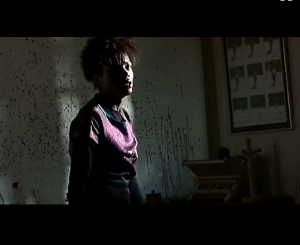
This frame (29:47) is taken from the scene where Selena kills Mark after he gets infected. The frame is a slightly tilted, medium-shot. The camera is shooting from a third party perspective. Selena’s body and the right side of her face are dimly lit and the left side of her face is overexposed to lighting. She is looking in the direction of the camera. Behind her is a white wall covered in splashes of blood (presumably from Mark’s body). On the right side of the screen, in the corner of the room, is a black and white drawing and some sort of wooden object.

In this frame, Selena’s face is so poorly lit that her face is almost unrecognizable. In fact, the only item that is lit properly is the blood on the white wall behind her. The lighting in the frame, dehumanizes Selena. Her face is unrecognizable, so her emotions are also unrecognizable. The audience’s ability to sympathize with Selena relies on its ability to understand her emotions. Consequently, this frame inhibits the audience from sympathizing with her. Instead, the frame encourages audience members to focus on the blood, a symbol of Selena’s cold, heartless killing of Mark, thus dehumanizing her further.

The camera angle also dehumanizes Selena. The tilted angle is disorienting and nauseating. The angle was intentionally done to make the viewers feel confused and uncomfortable. The audience’s feelings of discomfort become attributed to Selena and her actions.

This single frame follows a common theme throughout the movie, which is that black people are less than human. Each black character is portrayed as savage and uncivilized. Selena is portrayed as a stone-cold killer and drug dealer. Mailer is rabid zombie who is chained up until he gets released and kills some of the military men. Finally, the only black military man is a member of a group of men who desire to savagely rape women and kill intruders.

Word Count: 959