
Structural Analysis #2: I, Robot
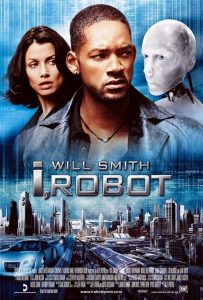
Movie Sequence:
Sequence 1– Prologue: The audience is presented with the 3 Laws of Robotics.
Sequence 2– Introduction to Detective Spooner: Detective Spooner wakes up and completes his morning routine. He then heads to his grandmother’s house for breakfast, but along the way Spooner chases a robot he wrongfully assumes is stealing a woman’s purse.
Sequence 3– The Office: Detective Spooner arrives at the office, where his boss and colleagues mock him for assuming a robot could do something wrong. He asked to go to the USR.
Sequence 4– USR: Detective Spooner investigates an apparent suicide of Dr. Lanning at the USR. Along the way, he is introducted to CEO Dr. Robertson, psychologist Dr. Calvin, and head robot VIKI. While investigating the crime scene, Detective Spooner discovers a rogue robot.
Sequence 5– The Chase: Detective Spooner chases the robot and ultimately captures it and brings it into an interrogation room. The robot identifies himself as Sonny and insists he did not kill Dr. Lanning. Dr. Robertson arrives and takes Sonny
Sequence 6– The Bar: While talking with his boss at a bar, Spooner realizes that Lanning wanted him to find Sonny.
Sequence 7– Robot Attack #1: Spooner goes to Lanning’s house to find more clues. A robot attacks the house with Spooner in it but Spooner escapes and goes to Dr. Calvin’s house to inform her of what happened. Dr. Calvin is skeptical that a robot would break the 3 Laws of Robotics
Sequence 8– Robot Attack #2: On the day of the massive distribution of NS-5 robots, Spooner figures out the Lanning is leaving him breadcrumbs and he continues his investigation efforts. While investigating a group of rogue robots attack Spooner. Spooner defeats the robots, but when his boss arrives to the scene, he still does not believe robots attacked him and he takes Spooner’s badge
Sequence 9– Calvin’s Come-around: Dr. Calvin confirms that Sonny is not bound to the 3 Laws of Robotics. Dr. Calvin learns of Spooner’s robotic prosthesis and Spooner reveals that his distrust of robots stems from a robot saving him in a car accident instead of saving a young girl named Sarah. Dr. Calvin and Detective Spooner decide to go to the USR to talk to Sonny.
Sequence 10– Sonny’s Dream: Sonny informs Calvin and Spooner that he has this dream of Spooner standing above an army of robots. Robertson interrupts and kicks Spooner out of the USR and orders Dr. Calvin to decommission Sonny
Sequence 11.1–Sonny’s Execution: Dr. Calvin decommissions Sonny
Sequence 11.2– Commencement of Robot Revolution: Spooner visits the robot storage units that are in Sonny’s dream. Thousands of NS-5 robots come and kill the older robots that were locked in the storage units. The robot revolution commences.
Sequence 12.1– Robots vs. Humans: Robots and humans battle
Sequence 12.2– Spooner, Calvin, and Sonny Save the World: Spooner visits Calvin and then together they head to the USR. They sneak into the USR, with the help of Sonny who is surprisingly still alive. They find Robertson’s dead body, which leads Spooner to realize that VIKI is behind the rogue robots and the robot revolution. Spooner, Calvin, and Sonny battle the robots and ultimately decommission VIKI. The robots are sent to storage.
Sequence 13– A New Leader?: Sonny visits the storage unit and the robots line up in front of him, mimicking the imagery in his dream.
Structural Analysis of 1:25:04 in I, Robot
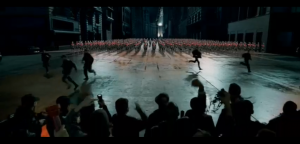
For my analysis, I chose the above frame because it encapsulates the film’s implicit advocacy of the current racial status quo.
The frame is a wide shot with two areas of focus. In the upper half of the shot, is an army of rogue NS-5 robots, identifiable by the red lights illuminating their chest cavities. The robots are environed by dark, concrete skyscrapers as they march towards an angry mob located on the bottom half of the screen. The camera is shooting at a high-angle behind the mob. Although the mob is not illuminated, another frame shown earlier in this scene indicates that the mob consists of largely white men. The mob of white men are holding an assortment of bats, chains, and other metal weapons.
This frame captures the central underpinning of the film largely due to the film’s associations between the robots and Black people coupled with the frame’s depictions of robots as evil beings that must be eliminated.
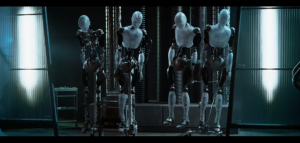
(The decommissioned robots hanging in the room during Sonny’s “execution”)
The robots depict Black people in six ways. First, their role in society is a modern day slave. They are built to answer their human masters’ commands and fulfill their every need. Secondly, the movie uses various imagery to paint the robots as criminals, a common stereotype of Black people. One scene shows old robots housed away in small storage units, where they are locked up away from society with no intention of ever being reintegrated into society. Sonny also endures the criminal justice process when he is interrogated after being suspected of murdering Dr. Lanning and then supposedly executed. In this execution scene, four decommissioned robots hang by their necks in the corner, evoking lynching imagery. Thirdly, the unwanted robots are colored. The older robots are colored and the rogue robots have a red light that shines from their chest. Fourthly, in order to get to Dr. Calvin and Detective Spooner, the robots climb the USR building like apes or monkeys. Racist caricatures depict Black people as apes. Fifthly, one of the only Black characters in the movie, Detective Spooner, is in fact a robot. Lastly, in the frame mentioned at the beginning of this essay, the positioning of the marching robots and the angry white mob evoke imagery of the Civil Rights Movement. The robots resemble Black marchers while the white mob resembles an angry crowd of racists. Overall, the amalgamation of these images subliminally force the audience to view the robots as symbolic representations of Black people.
Moreover, while simultaneously evoking blackness in the robots, the movie also vilified the robots and their revolution. It does so by portraying Detective Spooner, Sonny, and Dr. Calvin as heroes for terminating VIKI, the head of the revolution. It also does so in the aforementioned frame. In this frame, the camera is purposefully positioned behind the white mob. As if the camera positioning were not enough, the robots appear to be marching out of darkness, a classic film technique used to indicate that a person or group is evil (while also vilifying Blackness, but I’ll save that for another essay). Together these film elements encourage audience members to stand in solidarity with the white mob as they make efforts to end the robot revolution and maintain the status quo. Furthermore, since the robots are symbolic representations of Black, this frame subconsciously positions that audience to root for the maintenance of the racial status quo.
Word Count 1,119