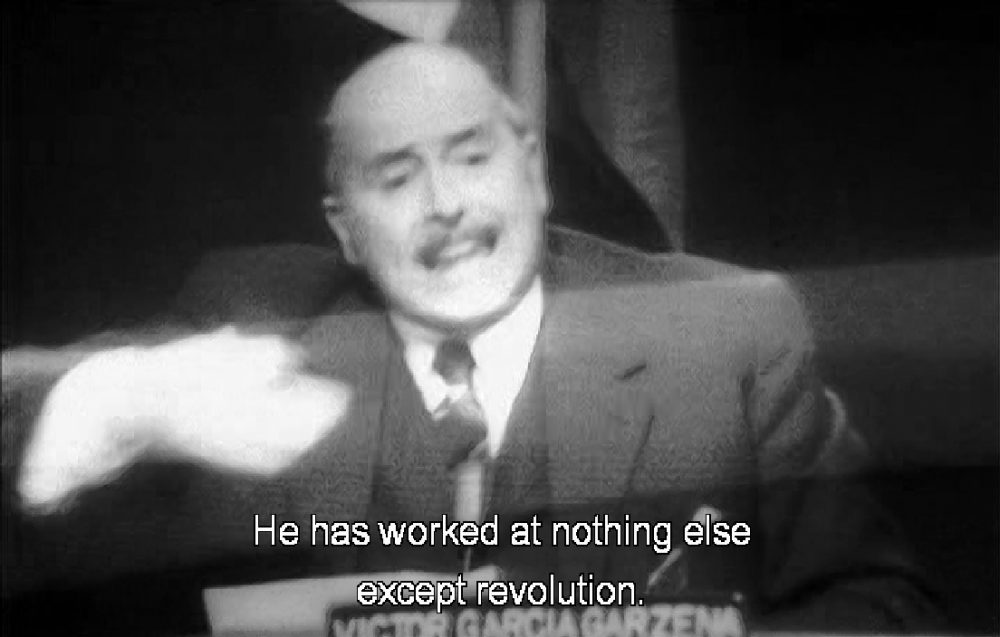
1. The motif of the “grammatical fiction” appears several times in Darkness at Noon. What is meant by this?
2. What is the role of the individual in Koestler’s story? Who or what is the agent of historical change? Who is the revolution’s beneficiary, who receives its fruits, as it were?
3. Please pay attention to body and mind, to the physical and the rational. What, if any, relationship is there between the two, and how is it made manifest (if at all!) in the narrative?
4. Why does Rubashov give in to the show trial? What prevents him from using his superior intellect to denounce the party? Is it simply that the interrogations wear him down, or is it something more regarding the ideology of the revolution?
5. Finally, who was right? Ivanov? Gletkin? Rubashov? Poor 402, in his lonely confinement?
More broadly:
A. Did the Russian revolution have to devour its own? Is this a process that has to happen in every revolution? Could the revolution survived without the purging of the “old-school?”
B. If we (perhaps arbitrarily) divide the revolutionaries into moderates and hard-liners, who won out (thinking across multiple phases of the revolution)? Does the in-fighting of these groups follow similar patterns of other revolutions we’ve studied?
C. How was the Russian Revolution affected by the shadow of France in 1789 (specifically, the effects of the Bolsheviks looking to avoid Thermidor)? How might the revolution have progressed differently if the Bolsheviks had not known about or cared about the French Revolution?
Why does Rubashov give in to the show trial? What prevents him from using his superior intellect to denounce the party? Is it simply that the interrogations wear him down, or is it something more regarding the ideology of the revolution ragdoll hit free?
Every level, or “week,” has its own original songs with a range of styles, from funky beats to powerful electronic tracks. The music is not only catchy, but it also goes nicely with the ragdoll hit free.
How might the revolution have progressed differently if the Bolsheviks had not known about or cared about the French Revolution ragdoll hit free.
Transform a limp character into an unstoppable killing machine! Experience ragdoll hit now and taste the thrill of obliterating hordes of enemies with every bizarre weapon you can find.
For anyone who enjoys physics-based challenges, NoomiClone offers a fun way to practice timing and improve with every attempt.
The ‘grammatical fiction’ question seems to point at how language can turn an abstraction like the collective into a felt reality, while individual experience gets treated as a mere error in the sentence.
The ‘grammatical fiction’ seems to name the gap between the party’s official language and the lived reality it keeps rewriting. Once Rubashov sees that split, the show trial becomes less about facts and more about forcing him to speak the fiction.
GoW Laufey Wiki
How was the Russian Revolution affected by the shadow of France in 1789 (specifically, the effects of the girl games How might the revolution have progressed differently if the Bolsheviks had not known about or cared about the French Revolution?
That’s a good idea. I think Rubashov’s surrender during the show trial reflects the tension between ideology and individuality—a theme that resonates across revolutions.girl games online
Each room in Scary Teacher 3D has its own mix of sounds, from footsteps around the house to doors slamming and Miss T reacting to what you do. The sound effects fit the action well, making sneaking around the house feel more tense, especially when you hear her coming before you can see her.
hay so nice i see Scary Teacher 3D
The Scary Teacher 3D game works well for players who prefer short objectives because missions are built around specific tasks rather than one long uninterrupted adventure
The weekly Crossy Road character releases connected with Airport World also make it useful to keep a separate page for new additions instead of letting the information get buried in a general guide.
I enjoyed reading this post because it included small but meaningful details that added depth without making the subject fnf difficult to follow.
Step into the relaxing world of 2048, where logic and patience lead to success. Every swipe offers new possibilities as you merge tiles, organize the board, and search for the perfect strategy to achieve higher numbers in 2048.
Step into the relaxing world of 2048, where logic and patience lead to success. Every swipe offers new possibilities as you merge tiles, organize the board, and search for the perfect strategy to achieve higher numbers in 2048.
This is a brilliant set of questions that really gets to the heart of the novel. From my own experience, the “wear down” factor (question 4) is so true to life; mental fatigue can really break down resolve. For anyone curious about testing their own limits under pressure, I’d suggest checking out a site like Cps Test – it’s fascinating to see how long you can maintain focus.
geometry dash lite is a fast-paced rhythm-based platformer where every jump, move, and obstacle is synced to energetic music. Players control a customizable cube and navigate through challenging levels filled with spikes, traps, and unexpected surprises.
These are fascinating questions that delve deep into the philosophical and historical layers of Darkness at Noon. Personally, I think Rubashov’s surrender during the show trial reflects the tension between ideology and individuality—a theme that resonates across revolutions. On a lighter note, if you’re into thought-provoking challenges like these, you might enjoy testing your music knowledge with heardle. It’s a fun game that lets you guess songs based on short audio clips—perfect for relaxing after intense discussions like this!
Your perspective on this topic is both unique and enlightening. sprunki shifted It took me a little while to read all of the comments, but I found the article to be quite intriguing.
Every level, or “week,” has its own original songs with a range of styles, from funky beats to powerful electronic tracks. The music is not only catchy, but it also goes nicely with the fnf game. It’s very immersive because every note, sound effect, and character movement fits the beat.