Introduction:
Sachiko Takamuro is interested in the concept of “shokunin”, a word that is somewhat difficult to translate into other languages. To give a simplistic definition, a shokunin can be viewed as an artisan, but even among shokunin communities, what exactly makes someone a shokunin is not truly known. Takamuro works with shokunin in various fields whose work is grounded in nature and living tradition, and supports their productive collaborations with international creators while developing educational programs and tours to help people experience the world of craft as a mirror of culture. Through her work, she hopes to connect the forest, which is the fountainhead of all craftsmanship, with crafts, which are a manifestation of people’s enduring connection with nature.
She is a co-founder and member of the organization PERSPECTIVE, which focuses on and uses Urushi (a natural lacquer that has been used in Japan for more than ten thousand years) as a central axis to learn about the relationship between people and nature that has been passed down through crafts as well as sow the seeds for social harmony, heightened attunement to nature, and sustainable lifestyles. This organization created an initiative called “Forest of Craft” that makes “[an] effort to raise awareness that nature is the source of everything we make, and that incorporating a cradle to cradle approach in practices of making in turn creates a healthy and robust relationship between people and nature.” To read more about PERSPECTIVE and “Forest of Craft”, please visit their website.
Takamuro currently resides in Keihoku, Kyoto, working with PERSPECTIVE, ROOTS, and other organizations that aim to spread the traditions and lifestyle of rural shokunin towns as a method of sustainability and improving one’s craft, as well as with various shokunin in and around Kyoto to learn about them and their work, and circulate and share that craft with the world.
Questions:
- Do you believe that nature plays a role in every form of art?
- Do you view yourself as shokunin?
- Do you believe shokunin is specific to Japanese artisans?
- Would you want to expand PERSPECTIVE to work with international artists, or keep its focus on uplifting the voices of Japanese craftspeople?
______________________________________________________________
Reflection:
With Dramamine packed, snacks secured, and coffee slowly digesting, we were off to Keihoku, Kyoto. The winding, narrow streets up the mountains uncovered a whole new side to Kyoto we had not seen before. The stat that Japan is around 70% of forest became a reality as the windows of the bus revealed soaring coniferous trees, slowly dusted with snow towards the horizon.
We began the day walking through the forest. Forestry began in Keihoku in 1780, and later the government incentivized the town to plant coniferous trees after WWII. As a result, 60% of the forest is man-made.
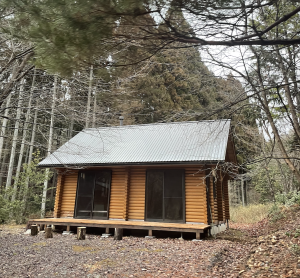
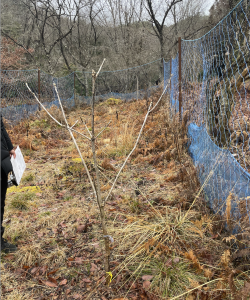
The goal of Sachi-san’s company is to restore the ecosystem of craft or the nexus of people and a cycle of living. As we’ve learned throughout our time in Kyoto, the decline of urushi production can have a compounding impact on the shokunin. The economics of lumber is one that is important to consider. We learned that it’s hard to use natural materials for two reasons. Firstly, imported lumber is cheaper, and secondly, there are several building regulations in Kyoto that challenge the use of natural wood. Through our walk, we saw urushi trees and polynya trees – both of which were fenced in. In Keihoku there are now more deer than people – an issue that impacts the planted rare trees. This reality made us wonder how we have to control parts of nature in order to let other parts thrive.
Towards the end of our walk, we learned that the forest used to be a rice paddy field, and stones in the distance were tombstones for the ruling class back in the 6th century. This truly resonated with the theme of Inochi through time, given that this land has seen different identities and provided Keihouku in such different ways.