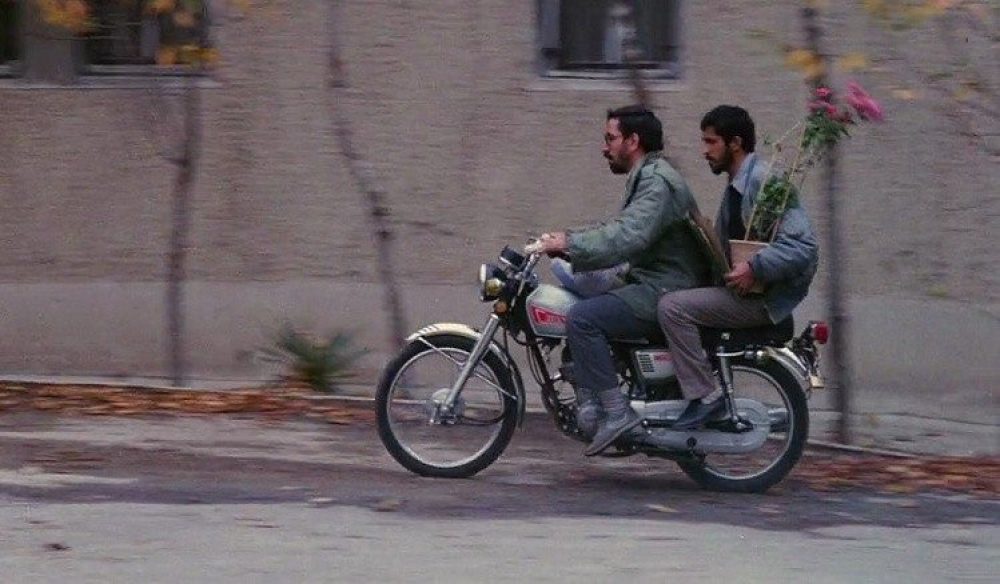
In my first impression of it and upon further analysis of it, I very much appreciated this film. I love the ambiguously wise nature of it, the loud noises and incoherent shouts followed immediately by literally minutes of complete silence, the blank look on Hassan’s big bovine face as he stares at his neighbors and slowly chews hay.
Without analysis, it would be hard to examine this film as making a statement at all about the Iranian experience of modernity. I do believe that it says quite a bit about modernity though. The experience of the “hospital” as some far-away object capable of healing of the mind and the body very well experiences some of the first interactions between the premodern and the modern: a feeling of distant longing for modern amenities in times of trouble such as this one. I also loved observing the (largely sexist) relationship between men and women in this movie. One quote in particular stood out to me as meaningful, and I paraphrase: “Yes, good. It is not good to leave a young woman home alone.” This quote illustrates one relationship between men and women in rural Iran, after it had been exposed to “modern” ideas of the gender binary (as Afsaneh Najmabadi pointed out in her book) but before it had “modernized” enough to re-normalized the idea of woman as potentially just as dominant as men. The subtle subjugation of women in this film goes hand-in-hand with the illustration in this film of a culture of authority (as opposed to “reason”) and the portrayal of women as the spiritual/religious figures in Iran.
Despite the Chief being the chief of the village, it is clear throughout the film that Eslam is the true brains of the village. When the men talk about what to do with Hassan before they do decide to take him to the hospital, Eslam makes a suggestion, another man objects to the suggestion, and the Chief says “If Eslam suggested it, it must be a good idea.” In this sense, a strong authority culture is portrayed throughout the film, as the idea itself does not matter as much as the authority/ethos of the person suggesting the idea. There is a clear hierarchy of ethos that runs through all the men of the village, starting with the man with a mental disability on bottom, running up from the young troublemaker and irritating, avoidable man in the window all the way up to the Abbas, the Chief, and Eslam.
In the film, there are several occurrences of the whole village going out and engaging in some form of mass panic. In all these scenarios, however, the men do either the action or the reasoning. For example, when Hassan’s (unnamed) wife cries out, the whole village rushes to her rescue, but only the men are able to calm her down, and only the men figure out what to do after an answer is coaxed out of her. But, in the final gathering, which is Hassan’s “funeral” scene, the women run things. They conduct the ceremony, lead the men and children in mourning, etc. In all spiritual/religious events in the story (except when Eslam says that it is a sin to use animal skins), it is the women who are the main focus.
It is hard to tell the extent to which this film is strictly Iranian, since indeed it portrays a rural life that many already view as being typical, rural “pre-modern” life in any country. There is nothing in this film that could distinguish this film as being strictly Iranian, since the men in the village are largely “nationalistic” only for their own village (as distinct from the evil Bolouris), which many would characterize as “tribalism.” Perhaps this film is attempting to say something about the connection between “premodern values” (such as authority culture, the subjugation of women, the femininity of spirituality, the animal nature of mankind, etc.) and the lack of true nationalist fervor in a populace.
Sorry, this ended up being super long. I guess I got a little too excited.
Great piece—your reading of the film’s silence, authority, and gender dynamics really brings out how “modernity” in the village feels uneven and embodied rather than simply historical. I especially liked the point about the hospital as a distant symbol of modern life and the way ethos seems to matter more than logic. It made me think of how playful, culture-specific experiences can still feel universal. In that spirit, if you want a fun break after all the analysis, check out Random Pokémon Generator for a quick, surprising diversion.
Thoughtful analysis of “Moo”dernity — I especially appreciated how the film uses silence, ritual, and the hospital motif to frame modernity as something distant yet deeply desired. Your points about authority culture, gender roles, and the contrast between men’s practical control and women’s spiritual leadership are really compelling. It also made me think about how rural life can feel both specifically Iranian and universally premodern at the same time. For anyone interested in turning ideas like this into visuals or creative projects, the AI Art Colorizer at AI Art Colorizer is worth a look.
Thoughtful post—I liked how you connected the film’s quiet absurdity to larger questions of modernity, authority, and gender roles in rural Iran. The contrast between the men’s decision-making and the women’s religious/spiritual presence was especially compelling, and your point about authority outweighing “reason” felt very sharp. It made me want to revisit the film with those themes in mind. If anyone’s interested in similar reflections and creative ideas, you might also enjoy checking out Witch Hat Atelier Spell Maker.
Interesting take on how the film uses rural life, authority, and gender roles to reflect a broader tension between premodern values and modernity in Iran. I especially liked your point about the village’s “authority culture,” where the source of an idea matters as much as the idea itself. The contrast between male-driven decision-making and the women’s role in the funeral/spiritual scenes is also a strong observation. I’d be curious how you would connect this to other Iranian films or to the concept of national identity more directly. For a different kind of perspective, I also found 格ゲー認知診断 worth checking out.
Great read — I liked how this post connects the film’s absurd, almost quiet surrealism to bigger questions about modernity, authority, and gender roles in rural Iran. The contrast between men handling “reason” and women carrying the spiritual and communal weight was especially interesting. The discussion also made me think about how easily a local village story can reflect broader tensions between premodern values and modern ideas. If you enjoy these kinds of film-and-culture reflections, you might also find Deltarune Prophecy Maker interesting to explore.
Thoughtful post — I especially liked your reading of how the film contrasts authority, silence, and collective panic to show modernity arriving in fragments rather than all at once. Your point about women carrying the spiritual moments while men handle the reasoning was also compelling. It made me think about how cultural change is often reflected through subtle roles, not just big political events. If you enjoy this kind of media analysis and reflective interpretation, you might also like the AI Singing Voice Generator for exploring how voice, tone, and expression shape meaning in another creative medium.
Thoughtful analysis of modernity, authority, and gender in the film. I especially appreciated the way the post connects rural ritual, hierarchy, and the tension between premodern and modern values. The observations about women carrying the spiritual weight of the village were particularly strong. If you’re interested in a creative way to process or present your own ideas, Lofi Converter is a surprisingly useful tool to check out.
Make a formal announcement or offer more promotion for a post, thread, or event in the calendar by using this area.
? Agar.boston – The Best Agar.io Private Server in the World!
? Why Agar.boston Reigns Supreme Among Agar.io Private Servers
? Agar.boston: The Ultimate Agar.io Experience You Can’t Miss!
? The #1 Agar.io Private Server – Agar.boston Review
? Custom Skins, XP Boosts & More – Why Agar.boston Stands Out
Looking for the Perfect Agar.io Server? Agar.boston Has It All!
Looking for the Perfect Agar.io Server? Agar.boston Has It All!
agario
It’s really a nice and helpful piece of information. I’m glad that you simply shared this helpful info with us. Please stay us up to date like this. Thanks for sharing.
Very nice post. I just stumbled upon your blog and wanted to say that I’ve really enjoyed browsing your blog posts. In any case I’ll be subscribing to your feed and I hope you write again soon!
“Moo”dernity | Iran, Islam, and the Last Great Revolution Fall 2018
Use this space to announce important information or provide extra promotion for a post, discussion, or calendar event.